










AI can write an email in seconds. It can summarize a 50-page document before your coffee gets cold. It can even make decisions, trigger workflows, talk to customers, and move information between business systems.
But here is the uncomfortable part: an impressive AI demo does not automatically create a better business.
The real test starts when AI has to work with your CRM, understand messy business data, handle exceptions, follow rules, and keep running after the excitement of launch is gone.
That is why choosing among the top AI automation companies in 2026 is no longer simply about finding the company with the newest model or the flashiest AI agent. Businesses need partners that understand processes, integrations, security, scalability, and—most importantly—what success should look like in numbers.
This guide takes a practical approach. Instead of treating every provider as equally capable, we look at what each company is best suited for, the kind of automation it can support, and where it may make the most sense for a business.
So, if you are comparing providers and wondering which AI automation partner actually fits your business, this list is a good place to start.
Turn Your Automation Idea Into Reality
See how AI can automate repetitive work and improve your business workflows.
Quick Answer: Which Are the Top AI Automation Companies in 2026?
There is no single “best” company for every business. A global enterprise may need governance and large-scale process automation, while a growing company may need a custom AI agent connected to its existing tools.
Here is a quick comparison to help narrow the field:
| Company | Best For | Key Strength | Ideal Business |
| TechBuilder | Custom AI automation | AI agents, custom solutions & integrations | Startups, SMBs & enterprises |
| Genpact | Process automation | AI-powered operations | Mid-market & enterprises |
| WNS | Intelligent automation | AI, RPA & business processes | Enterprises |
| Sutherland | Business-process automation | AI & hyperautomation | Enterprises |
| EXL | AI-powered operations | AI, analytics & automation | Enterprises |
| TTEC | Customer experience automation | AI & customer operations | Customer-focused businesses |
| Concentrix | Customer-service automation | AI & CX | Enterprises |
| TELUS Digital | Digital operations | AI & customer experience | Enterprises |
| Firstsource | Business-process automation | AI & industry operations | Healthcare & financial businesses |
| HGS | Customer & business operations | AI & CX automation | Enterprises |
How We Selected These AI Automation Companies
A long list of company names does not necessarily help a buyer.
In fact, one of the biggest problems with “best company” lists is that they often mix completely different types of providers. A platform company, an enterprise consultancy, and a custom development agency can all claim to provide AI automation—but they solve very different problems.
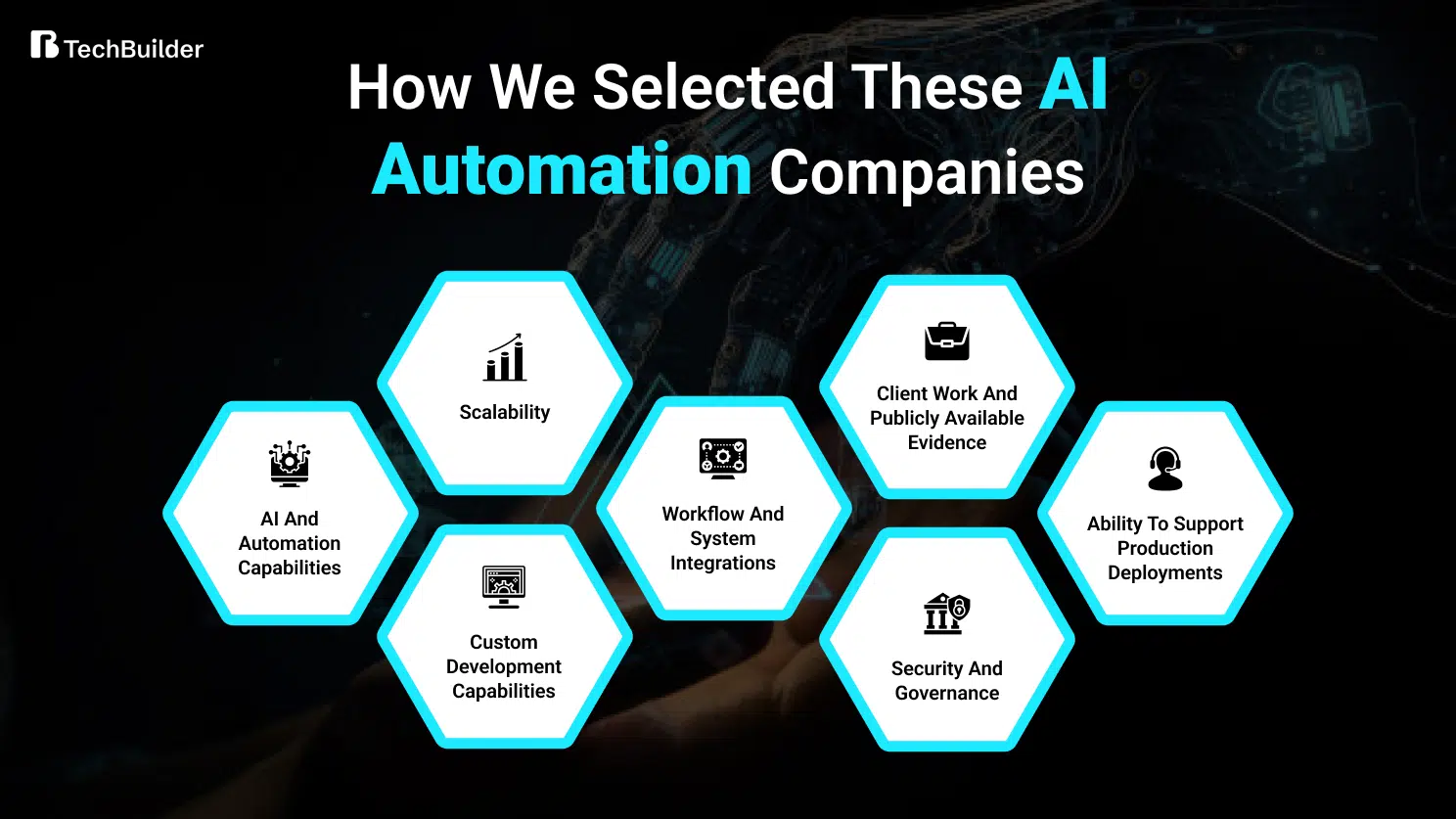
For this list, the focus is on practical buyer considerations:
- AI and automation capabilities
- AI agent and agentic workflow expertise
- Custom development capabilities
- Workflow and system integrations
- Industry experience
- Scalability
- Security and governance
- Client work and publicly available evidence
- Ability to support production deployments
- Fit for different business sizes and use cases
Most importantly, “proven results” should mean more than a polished website.
Useful evidence includes measurable time savings, lower operating costs, faster processing, improved customer response, fewer errors, higher conversion, or other clearly defined business KPIs.
That distinction matters even more in 2026 as companies move AI from experiments into real operational systems. Recent industry commentary also highlights the gap between AI prototypes that look good in demonstrations and systems that remain reliable in production.
Have a Workflow Worth Automating?
Find a smarter way to simplify the processes slowing your team down.
Leading AI Automation Companies in 2026
AI automation is no longer limited to chatbots or simple workflow triggers. Businesses are using AI to automate customer operations, document-heavy processes, finance workflows, service delivery, decision support, and complex business operations.
However, different companies approach automation differently. Some specialize in custom AI solutions, while others focus on intelligent business processes, customer experience, or large-scale operational automation.
Here are 10 companies worth considering in 2026:
-
TechBuilder
Best for: Custom AI automation, AI agents and intelligent business solutions
TechBuilder takes a custom-development approach to AI automation, helping businesses build intelligent solutions around their specific workflows, applications and operational requirements.
Its AI capabilities include AI agent development, AI application development, smart chatbots, generative AI, predictive modeling and AI integrations.
Rather than forcing businesses into a predefined automation platform, TechBuilder can build AI-powered solutions that connect with existing CRMs, ERPs, APIs and other business systems.
Key capabilities include:
- AI agent development
- Custom AI applications
- Intelligent workflow automation
- Generative AI solutions
- AI chatbots
- Predictive analytics
- AI integrations
- Custom web and mobile applications
Best suited for: Startups, SMBs and enterprises that need custom AI automation rather than a one-size-fits-all automation platform.
Our take: A strong option when AI automation needs to become part of a custom business application, workflow or digital product.
-
Genpact
Best for: Intelligent process and business automation
Genpact focuses heavily on using AI, automation and advanced analytics to transform business processes.
Its approach combines technologies such as AI, machine learning, robotic process automation and process orchestration with industry-specific operational expertise.
This makes Genpact particularly relevant for organizations looking to automate large-scale business processes rather than simply introduce an AI chatbot.
Key areas include:
- Intelligent process automation
- AI and machine learning
- Finance automation
- Supply-chain automation
- Customer operations
- Data and analytics
- Process transformation
Best suited for: Large and mid-sized enterprises with complex operational processes.
Our take: A strong choice when AI automation is part of a broader business-process transformation initiative.
-
WNS
Best for: Intelligent automation and AI-powered business operations
WNS combines business-process expertise with automation, analytics and AI to help organizations improve operational efficiency.
Its intelligent automation capabilities span areas such as RPA, AI/ML, process optimization and workflow automation.
The company is particularly relevant for businesses that want to automate repetitive operational processes while maintaining human oversight where necessary.
Key areas include:
- Intelligent automation
- RPA
- AI and machine learning
- Business-process optimization
- Finance and accounting
- Customer operations
- Industry-specific automation
Best suited for: Enterprises looking to automate established business processes at scale.
Our take: A good fit for organizations where automation needs to work across multiple business functions.
-
Sutherland
Best for: AI-led business-process automation
Sutherland focuses on applying AI and automation to real-world business operations, including customer service, finance, healthcare, retail and other industry processes.
Its approach goes beyond simply implementing AI technology. The company works with businesses to redesign and automate processes while improving operational performance.
Key areas include:
- Intelligent automation
- AI agents
- Business-process automation
- Customer operations
- Hyperautomation
- Digital transformation
- Industry-specific AI solutions
Best suited for: Enterprises looking to combine AI with large-scale business-process management.
Our take: Particularly relevant when automation involves entire operational processes rather than isolated tasks.
-
EXL
Best for: AI-powered operations and hyperautomation
EXL combines data, AI, analytics and automation to improve business operations across industries.
Its AI capabilities are applied to areas including insurance, healthcare, finance, logistics and other data-intensive business functions.
The company’s focus on industry-specific processes makes it particularly relevant for organizations dealing with complex operational workflows.
Key areas include:
- AI-powered automation
- Hyperautomation
- AI agents
- Predictive analytics
- Process optimization
- Healthcare automation
- Financial services automation
Best suited for: Enterprises with data-heavy and industry-specific automation requirements.
Our take: A strong option for businesses where AI automation needs to work alongside analytics and domain-specific processes.
-
TTEC
Best for: AI-powered customer experience automation
TTEC focuses on customer experience and customer operations, making it different from providers focused primarily on custom AI software development.
Its AI capabilities can be used to automate customer interactions, improve service workflows and support customer-service teams.
Key areas include:
- AI customer service
- Conversational AI
- Customer-service automation
- Contact-center automation
- Customer experience analytics
- Digital customer experiences
Best suited for: Companies with large customer-service operations and high volumes of repetitive customer interactions.
Our take: Worth considering when improving customer experience is the primary objective of AI automation.
-
Concentrix
Best for: AI-powered customer-service automation
Concentrix combines AI with customer experience and business-process services.
Its automation capabilities can help organizations improve customer interactions, support agents and automate repetitive service processes.
The company’s strength is its ability to apply AI within large-scale customer operations rather than simply providing an isolated AI tool.
Key areas include:
- AI customer service
- Conversational AI
- Contact-center automation
- Customer experience
- Agent assistance
- Business-process automation
Best suited for: Enterprises with large customer-support and contact-center operations.
Our take: A strong option when customer-service automation is a major part of the AI strategy.
-
TELUS Digital
Best for: AI-enabled customer experience and digital operations
TELUS Digital combines AI, digital experience and customer operations to help organizations automate and improve customer-facing processes.
Its capabilities cover customer experience, digital transformation, AI data services and operational support.
Key areas include:
- AI-enabled customer experiences
- Customer-service automation
- Digital transformation
- AI data services
- Conversational AI
- Digital operations
Best suited for: Businesses looking to improve both customer interactions and digital operational processes.
Our take: Particularly relevant for companies where AI automation needs to connect customer experience with broader digital operations.
-
Firstsource
Best for: AI-powered business-process automation
Firstsource focuses on business-process services across areas such as healthcare, financial services, communications and customer operations.
Its AI and automation capabilities are designed to streamline repetitive processes, improve decision-making and increase operational efficiency.
Key areas include:
- Intelligent automation
- AI-powered operations
- Healthcare automation
- Financial-services automation
- Customer operations
- Document and process automation
Best suited for: Organizations with document-heavy and process-intensive operations.
Our take: A useful option for businesses looking to automate specific industry processes rather than build a standalone AI product.
-
HGS (Hinduja Global Solutions)
Best for: AI-enabled customer and business operations
HGS combines customer experience services with digital technologies, AI and automation.
Its AI capabilities are particularly relevant to customer-service and business-process environments where repetitive interactions and operational tasks can be automated.
Key areas include:
- AI customer service
- Intelligent automation
- Contact-center automation
- Customer experience
- Digital operations
- Business-process services
Best suited for: Organizations seeking AI automation across customer interactions and operational processes.
Our take: A relevant option for businesses where customer experience and operational efficiency are closely connected.
Find the Right AI Automation Approach
Explore an automation strategy built around your goals and existing systems.
AI Automation Companies by Business Need
Not every business needs the same type of automation. The right provider depends largely on the process you want to improve.
Best for Custom AI Automation
TechBuilder is a strong option when you need a custom AI solution, AI agent, application or intelligent workflow built around your existing business systems.
Best for Large-Scale Process Automation
Genpact, WNS, Sutherland and EXL are better suited to organizations looking to transform established business processes across departments or regions.
Best for Customer Experience Automation
TTEC, Concentrix, TELUS Digital and HGS are particularly relevant when customer service, contact centers and customer interactions are the primary automation opportunities.
Best for Industry-Specific Operations
EXL, Firstsource and Genpact can be considered when automation needs to work within specialized industries such as healthcare, insurance, finance or supply chain.
The important point is that there is no universal winner. The right AI automation company depends on whether you need a custom AI product, business-process automation, customer-service automation or industry-specific operational transformation.
What Can AI Automation Actually Automate?
The phrase “AI automation” sounds broad because it is.
A business might use it for something as simple as automatically categorizing incoming requests or as complex as an AI agent that gathers information, makes a decision, updates several systems and asks a human for approval when something falls outside predefined boundaries.
Here are some common applications.
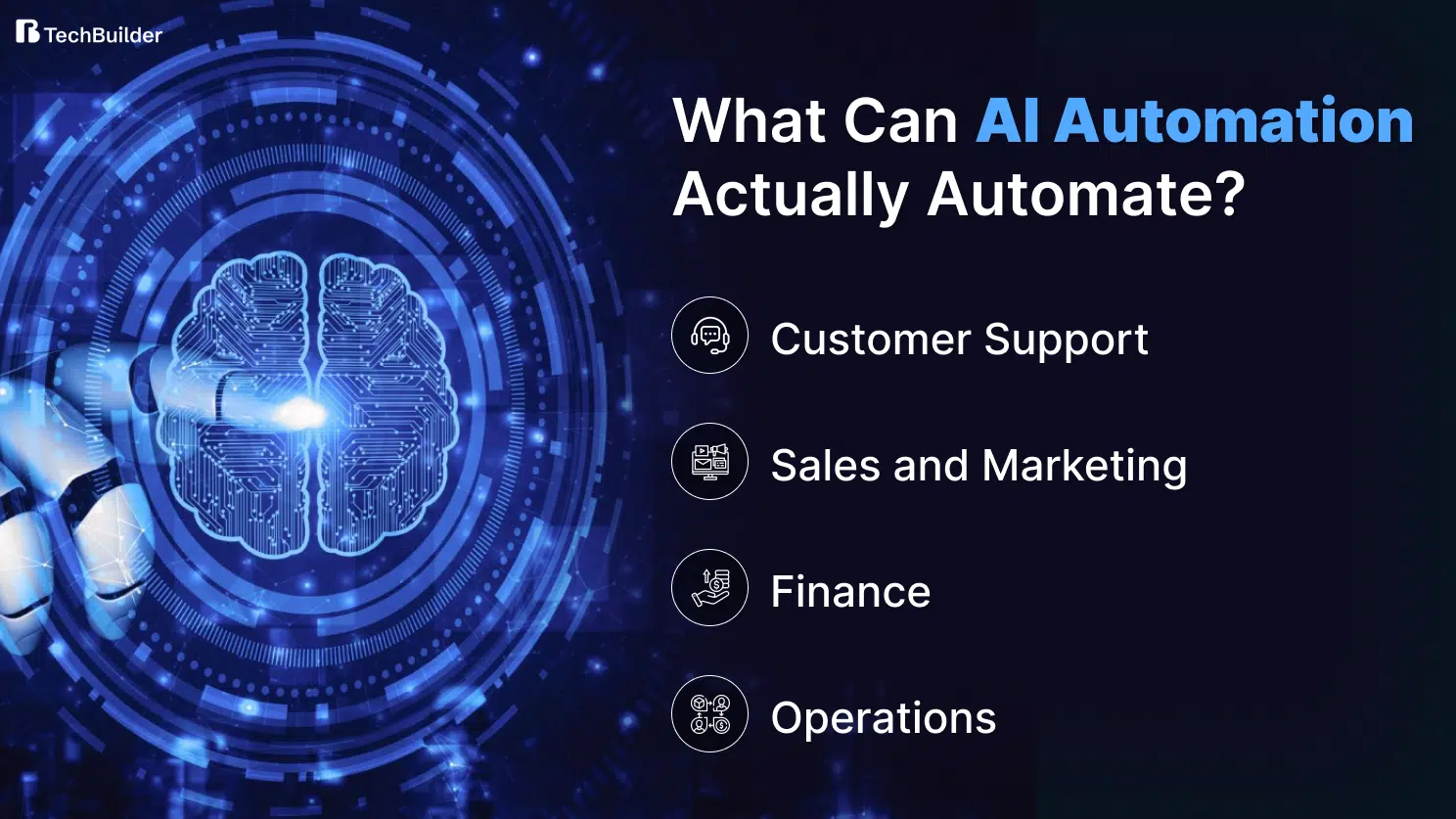
Customer Support
AI can classify tickets, answer routine questions, summarize conversations, route complex issues and assist support agents.
Sales and Marketing
Automation can help qualify leads, update CRM records, personalize communication and trigger follow-up sequences.
Finance
Businesses can automate document extraction, invoice processing, reconciliation support and financial reporting workflows.
Operations
AI can identify bottlenecks, route tasks, summarize information and coordinate repetitive processes.
HR
Recruitment screening, employee questions, document processing and onboarding workflows can all benefit from intelligent automation.
Logistics
AI can support route planning, demand forecasting, shipment monitoring, exception handling and operational reporting.
The key is not to ask, “Where can we put AI?”
Ask instead:
“Which repetitive, expensive or slow process would be worth improving if we could make it faster and more reliable?”
That small change in thinking can prevent a lot of wasted AI investment.
AI Workflow Automation vs Traditional Automation vs RPA
AI workflow automation is not simply a more fashionable version of RPA. The technologies overlap, but they are designed for different kinds of work.
| Capability | Traditional Automation | RPA | AI Workflow Automation |
| Rule-based tasks | Excellent | Excellent | Excellent |
| Repetitive data entry | Good | Excellent | Excellent |
| Unstructured text | Limited | Limited | Excellent |
| Natural-language understanding | No | Limited | Excellent |
| Prediction | No | No | Excellent |
| Decision support | Limited | Limited | Excellent |
| AI agents | No | Limited | Excellent |
| Multi-step reasoning | Limited | Limited | Strong |
| Human approval workflows | Good | Good | Strong |
| Best use case | Fixed processes | Repetitive UI tasks | Dynamic knowledge-based processes |
The smartest implementation may actually combine all three.
For example, RPA can move data between legacy systems, while an AI model interprets an incoming document and a rules engine handles final approval.
That hybrid approach is often more practical than trying to force every business process into an AI agent.
How Much Does AI Automation Cost in 2026?
There is no meaningful single price for AI automation.
A simple workflow connecting a few applications is completely different from a custom AI agent connected to an ERP, CRM, internal knowledge base and multiple APIs.
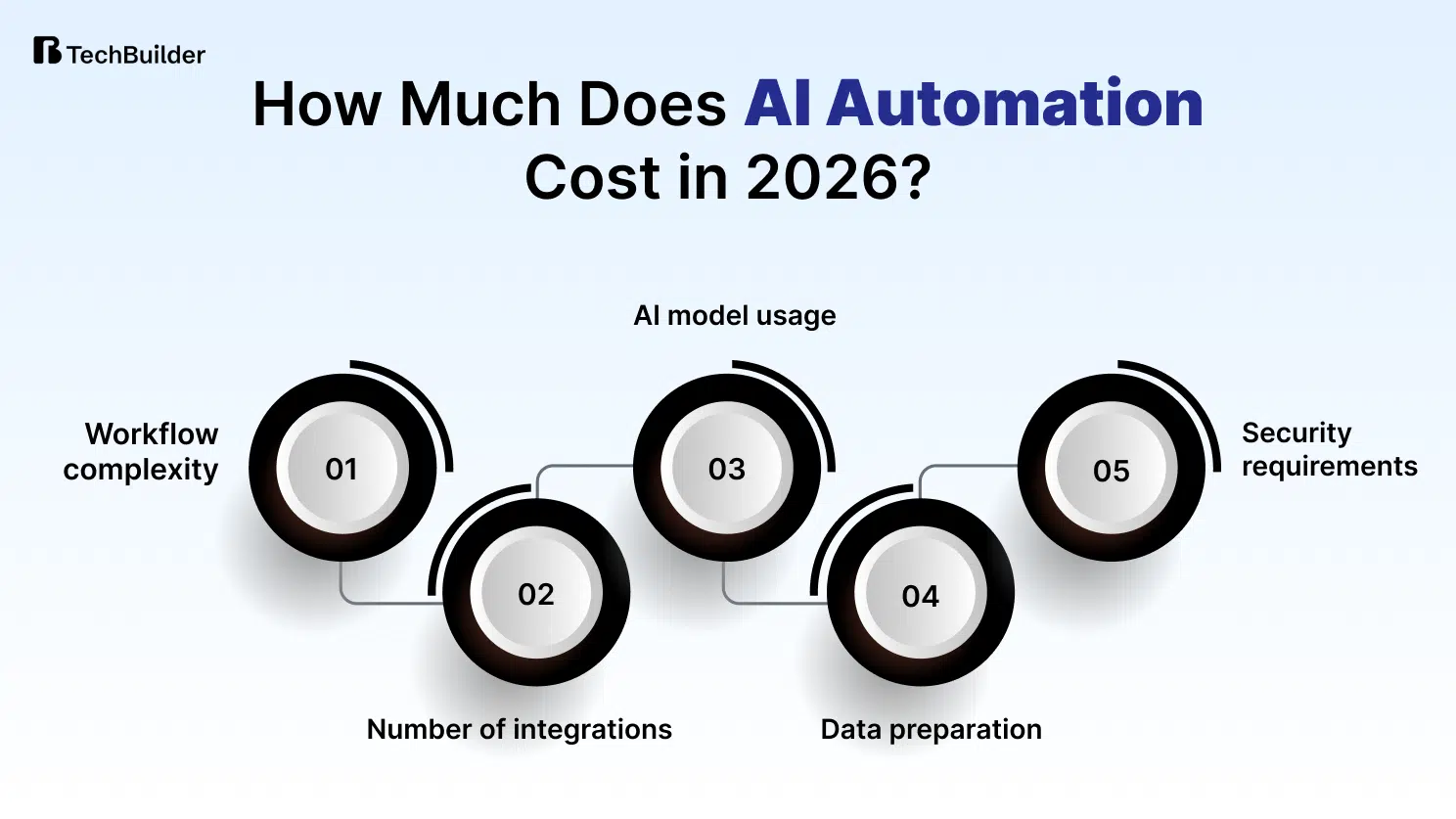
Cost can depend on:
- Workflow complexity
- Number of integrations
- AI model usage
- Data preparation
- Custom development
- Security requirements
- User volume
- Deployment environment
- Monitoring
- Ongoing maintenance
A useful way to think about the budget is in three layers:
Simple automation: predefined workflows, integrations and basic AI capabilities.
Advanced automation: multiple systems, custom logic, AI models and human approval steps.
Enterprise automation: complex architecture, security, governance, large-scale deployment, monitoring and continuous optimization.
Do not compare two proposals only by their development price. Compare what each one includes, what happens when the automation fails, who maintains it, and how success will be measured.
How to Choose the Right AI Automation Company
Choosing between the top AI automation companies should start with your process—not the vendor’s technology stack.
- Define the Business Problem
Do not begin with “We want an AI agent.”
Begin with:
- What takes too much time?
- Where are errors happening?
- Which tasks are repetitive?
- Where are customers waiting?
- Which process costs too much to operate?
- Ask for Relevant Case Studies
A company may have impressive AI capabilities but no experience in your type of workflow.
Ask for examples that resemble your situation.
- Check Integration Experience
Your AI solution needs to work with your existing systems.
Ask what happens when an API fails, data is missing or a workflow reaches an unexpected condition.
- Define Your KPIs Before Development
Decide what success means.
It could be:
- 30% less processing time
- 50% fewer manual tasks
- Faster response times
- Lower cost per transaction
- Higher lead conversion
- Fewer operational errors
Without a baseline, it is difficult to prove ROI.
- Understand Human Oversight
Not every decision should be fully autonomous.
High-value, financial, legal or sensitive processes may need a human approval step.
- Ask About Post-Launch Support
AI systems need monitoring.
Models change. Business processes change. APIs change. Data changes.
A solution that works perfectly on launch day still needs attention months later.
- Look Beyond the Demo
A polished demonstration proves that something can work.
It does not prove that it can work reliably with your data, systems and users.
That distinction is becoming increasingly important as organizations move from AI experiments into production. Current AI engineering discussions emphasize testing, observability, rollback planning and clearly defined boundaries between autonomous actions and human oversight.
What Results Should You Expect From AI Automation?
The strongest AI automation solutions are measurable.
Instead of saying “AI will improve efficiency,” identify the number that should move.
Operational Results
Measure:
- Processing time
- Hours saved
- Error rates
- Tasks completed automatically
Financial Results
Measure:
- Cost per transaction
- Labor hours
- Operational costs
- Revenue generated
- ROI
Customer Results
Measure:
- Response time
- Resolution time
- Customer satisfaction
- Conversion rate
Growth Results
Measure:
- Qualified leads
- Sales productivity
- Customer retention
- Revenue per employee
This is also why the phrase “proven business results” matters in the title of this article. A successful automation project is not the one with the most impressive AI model. It is the one that improves a business metric that actually matters.
Common Mistakes Businesses Make When Choosing an AI Automation Company
Even the best AI automation agencies cannot fix a poorly defined project.
Here are some mistakes worth avoiding.
Choosing based only on price: The cheapest proposal can become expensive if it requires constant manual correction.
Automating a broken process: If the existing workflow is inefficient, automating it may simply make the inefficiency happen faster.
Chasing the newest AI model: The latest model is not automatically the best solution for your business.
Ignoring integrations: An AI tool that cannot communicate with your existing systems may create another silo.
Skipping measurement: Without KPIs, you cannot tell whether automation delivered value.
Expecting complete autonomy: Some workflows are better with human review.
Forgetting maintenance: AI automation is not always “build once and forget.”
Trusting marketing claims without evidence: Ask what was actually deployed, for whom, and what changed afterward.
Ready to Automate What’s Holding You Back?
Turn repetitive business processes into smarter, scalable workflows.
Conclusion
The top AI automation companies in 2026 aren’t interchangeable. Some focus on custom AI solutions, while others specialize in business-process automation, customer experience, or industry-specific operations.
Instead of asking, “Which company is number one?”, ask: “Which company can best solve my automation needs?”
For custom AI agents, intelligent workflows, AI-powered applications, and business integrations, TechBuilder is worth considering. Its AI capabilities include custom AI development, AI agents, chatbots, generative AI, predictive modeling, and system integration.
For large-scale business-process automation, consider Genpact, WNS, Sutherland, or EXL. For customer experience automation, TTEC, Concentrix, TELUS Digital, and HGS may be better suited. Firstsource is another option for specialized industry operations.
Ultimately, the right AI automation solution is the one that delivers measurable results—reducing costs, saving time, minimizing errors, improving customer response, or helping your business scale efficiently.
That’s the standard worth using when comparing AI automation companies in 2026.
FAQs About AI Automation Companies
What is an AI automation company?
An AI automation company helps businesses use artificial intelligence, software integrations and automated workflows to reduce manual work or improve business processes. Depending on the provider, this can include AI agents, chatbots, RPA, predictive systems, document processing and custom software.
What do AI automation companies do?
They identify processes that can be automated, design the workflow, integrate the required systems, build or configure AI capabilities, deploy the solution and often provide ongoing monitoring and support.
How much does AI automation cost in 2026?
It depends heavily on complexity. A simple workflow automation project can be far less expensive than a custom AI agent connected to multiple enterprise systems. The number of integrations, AI usage, data requirements, security and ongoing support all affect the final cost.
What is the difference between AI automation and RPA?
RPA is particularly effective at repetitive, rule-based tasks. AI automation can handle more dynamic work involving language, prediction, classification, decision support and unstructured data. In many businesses, the two technologies work best together.
What businesses benefit most from AI automation?
Businesses with repetitive processes, large data volumes, high customer-support workloads, document-heavy operations or complex workflows can often find strong automation opportunities.
How long does AI automation take to implement?
Simple workflows can be implemented relatively quickly, while enterprise-grade systems may take considerably longer because of integrations, testing, security, data preparation and deployment requirements.
How do I choose the best AI automation company?
Start by defining the workflow you want to improve. Then compare providers based on relevant experience, integrations, AI capabilities, case studies, security, support, scalability and measurable outcomes—not just price.