











What’s holding your limo business back—too few bookings, idle vehicles, slow reservations, or customers who never return?
You may have premium vehicles and excellent chauffeurs, yet still struggle to turn your limo business into a consistently growing operation. Why? Because today’s customers expect more than luxury. They want instant booking, quick responses, transparent pricing, reliable pickups, and a seamless experience from start to finish.
Meanwhile, manual reservations, inefficient dispatching, weak online visibility, inconsistent demand, and outdated processes can quietly drain your time, revenue, and opportunities.
But here’s the good news: these roadblocks aren’t permanent.
With the right strategies, you can simplify daily operations, attract more qualified customers, improve customer retention, keep your fleet productive, and create a stronger foundation for growth.
So, which roadblocks are standing between your limo business and its next stage of growth—and how can you overcome them?
Let’s explore 10 proven strategies that can help you turn those challenges into growth opportunities.
Ready to Simplify Your Limo Bookings?
Make every reservation faster and easier with a seamless booking experience designed to help your business capture more opportunities.
What Are the Biggest Roadblocks in a Limo Business?

Every operator has a different story. A small company may struggle with getting enough bookings, while an established fleet may have plenty of demand but lose money through inefficient dispatching or unused vehicles.
However, several roadblocks appear again and again across the industry.
- Struggling With Manual Reservations
Phone calls are still useful in the limousine industry. Some customers prefer speaking directly with an operator before booking a premium limousine service.
The problem starts when every booking depends on a phone call.
A potential customer searching for an airport transfer shouldn’t have to wait until the next morning to find out whether a vehicle is available. If they can’t get a quick answer, they can easily move to another provider.
Manual booking also creates unnecessary work for your team. Staff members may need to:
- Check vehicle availability manually
- Calculate quotes
- Confirm customer details
- Contact chauffeurs
- Send confirmations
- Update calendars
- Process payments
- Follow up on changes
As the number of bookings increases, small administrative tasks quickly become a major workload.
Modern limo operators are increasingly moving toward centralized reservation systems that bring bookings, dispatch, driver information, billing, and customer data into one workflow.
The real roadblock: Your team spends more time managing bookings than growing the business.
- Inconsistent Demand and Seasonal Bookings
A limo operation naturally has a more specific customer base than a standard taxi or rideshare service.
People don’t necessarily book a limousine every day.
Demand may increase around weddings, corporate events, airport travel, concerts, proms, holidays, or other special occasions. That can create periods of intense demand followed by slower weeks.
The danger is relying on occasional bookings instead of building multiple reliable sources of revenue.
For example, a company that focuses only on weddings may experience excellent revenue during the wedding season but struggle during slower months.
The goal should be to create a broader customer mix.
Consider targeting:
- Corporate travelers
- Airport passengers
- Hotels and hospitality businesses
- Wedding and event planners
- Executives and business travelers
- Private clients
- Recurring corporate accounts
- Special-event customers
A diversified customer base gives your limo company more opportunities to keep vehicles moving throughout the year.
- Low Online Visibility
A customer doesn’t always know which limo company they want.
They search.
They may type something like “airport limo service near me,” “corporate chauffeur service,” or “limo service for weddings.”
If your company isn’t visible when those searches happen, another operator gets the booking.
This is where online visibility becomes more than a marketing issue. It becomes a revenue issue.
A professional website, optimized service pages, accurate business listings, customer reviews, useful content, and a strong local search presence can help your company appear in front of people who are already looking for your services.
The roadblock isn’t always a lack of customers. Sometimes customers simply can’t find you.
- Inefficient Driver and Fleet Coordination
A limo operation can become complicated very quickly.
Imagine having 15 vehicles, 20 chauffeurs, multiple airport pickups, corporate rides, wedding bookings, and last-minute changes happening on the same day.
Now imagine managing all of that through spreadsheets, calls, text messages, and separate calendars.
That’s where mistakes happen.
A driver may receive an outdated pickup time. A vehicle may be assigned to two trips too close together. A dispatcher may not know that a vehicle is unavailable for maintenance. A chauffeur may arrive at the wrong location because the latest trip information wasn’t communicated.
Centralized dispatch boards, driver applications, live trip information, and fleet management can reduce these communication gaps.
When information is scattered, your operation becomes slower than it needs to be.
- Losing Customers After the First Ride
Getting a new customer is only half the job.
The bigger opportunity is turning that customer into a repeat client.
Consider a corporate traveler who books an airport transfer. If the experience is excellent, that person may need another ride next week, next month, or every time they visit your city.
But if you don’t follow up, collect feedback, encourage reviews, or make future bookings easy, the relationship can end after one trip.
Customer retention doesn’t require complicated tactics.
It can start with simple things:
- Send a professional trip confirmation
- Communicate clearly before pickup
- Provide accurate arrival updates
- Make payment easy
- Ask for feedback
- Thank customers after their trip
- Make repeat booking simple
- Offer corporate account options where appropriate
The objective is to make the second booking easier than the first.
10 Proven Strategies to Overcome your limo operation Roadblocks
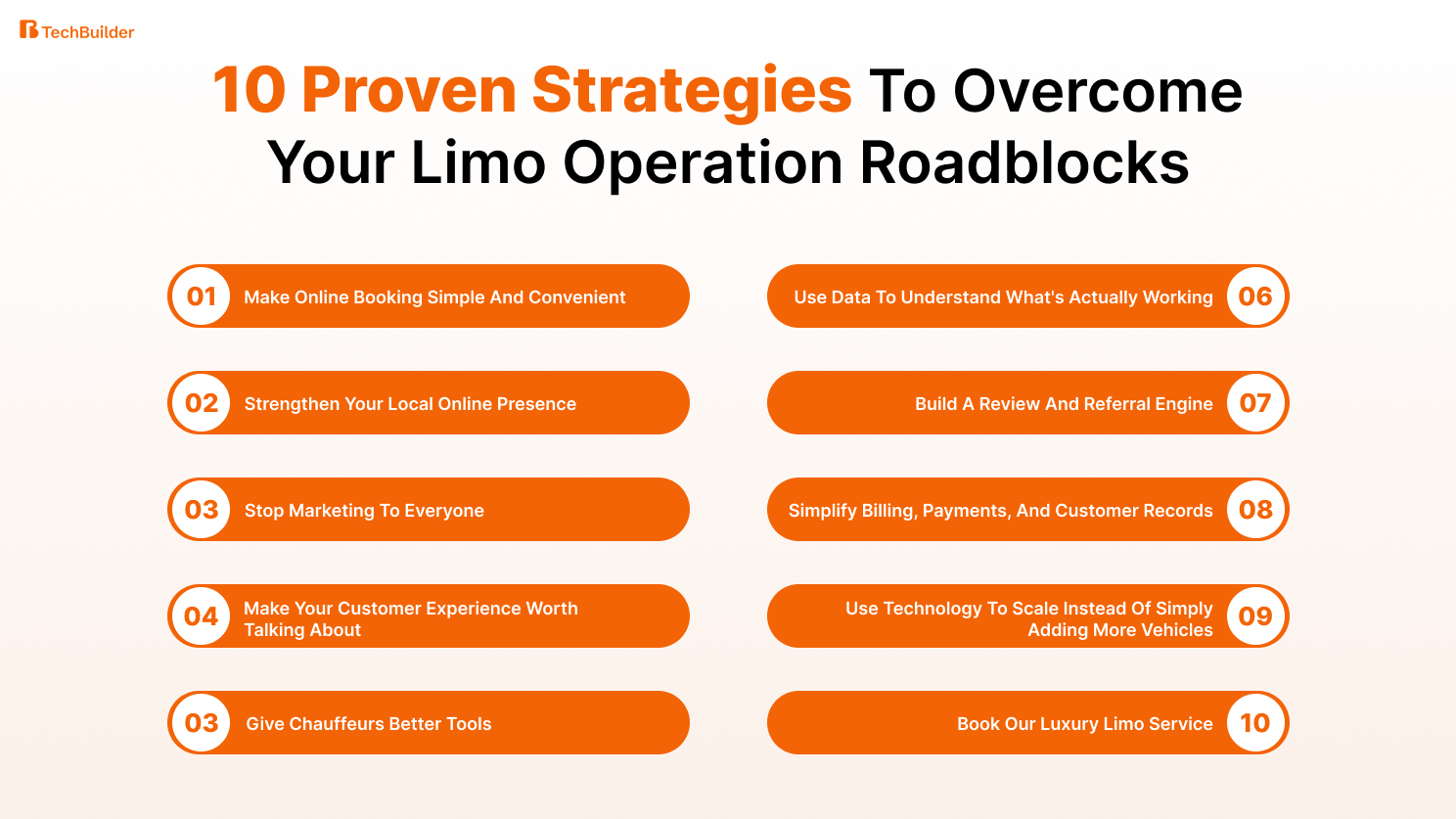
Understanding the problems is important, but identifying them isn’t enough.
The next step is turning those problems into practical improvements.
- Make Online Booking Simple and Convenient
The first major improvement is making it easier for customers to book your service.
Your website should allow customers to request or book a ride without unnecessary back-and-forth communication.
Depending on your business model, customers should be able to enter details such as:
- Pickup and drop-off locations
- Date and time
- Number of passengers
- Vehicle preference
- Special requirements
- Contact information
An online reservation process doesn’t eliminate limousine service; it simply removes unnecessary friction. It simply removes unnecessary friction.
You can still offer phone support for customers who want personal assistance while allowing others to book whenever it is convenient for them.
This is where limo booking software can become particularly useful. A modern platform can connect reservations with dispatch, driver assignments, billing, and customer records instead of treating each process separately.
The goal isn’t to replace your team. It’s to give your team fewer repetitive tasks to handle.
Turn More Searches Into Bookings
Give potential customers a simple way to discover your services, request a ride, and book without unnecessary delays.
- Strengthen Your Local Online Presence
If you want more bookings, you need to be visible where customers are searching.
Start with the basics.
Create and maintain a complete Google Business Profile. Make sure your business name, service area, phone number, website, operating information, and service categories are accurate.
Then build dedicated pages for your most valuable services.
For example:
- Airport transportation
- Corporate transportation
- Wedding transportation
- Event transportation
- Hourly chauffeur service
Don’t create pages simply to insert keywords. Create pages that answer real customer questions.
Explain what you offer, where you operate, what types of vehicles are available, how booking works, and what customers can expect.
Then strengthen those pages with genuine customer reviews, high-quality vehicle photos, clear calls to action, and simple booking options.
That combination helps both search visibility and customer confidence, while giving your limo marketing a stronger foundation.
- Stop Marketing to Everyone
One of the easiest ways to waste a marketing budget is trying to reach everyone.
Your ideal customer isn’t “anyone who needs a ride.”
Different customer groups have different needs.
A corporate client may care about punctuality, invoicing, recurring bookings, and reliability.
A wedding customer may care about appearance, presentation, vehicle selection, and coordination.
An airport traveler may care about flight monitoring, pickup instructions, luggage space, and dependable arrival.
Create your limo marketing around these differences.
Instead of one generic message saying:
“Book Our Luxury Limo Service.”
Create specific messages such as:
“Reliable Airport Transfers for Business Travelers.”
or
“Make Your Wedding Transportation Seamless From Pickup to Reception.”
Specific messaging makes your offer easier to understand and gives customers a stronger reason to choose you.
- Build Multiple Revenue Channels
A healthy limo company shouldn’t depend on one type of booking.
Look for opportunities to build recurring and complementary revenue.
Corporate Accounts
Corporate clients can become valuable long-term customers because transportation needs are often recurring.
Create a simple corporate program with convenient invoicing, account management, priority support, and easy repeat bookings.
Hotel Partnerships
Hotels regularly need dependable transportation options for guests.
Build relationships with hotel managers, concierge teams, and hospitality businesses.
Event Planners
Wedding planners, conference organizers, venues, and event agencies can become consistent sources of referrals.
Airport Transportation
Airport transfers can provide recurring demand and create opportunities for repeat travelers.
Affiliate Relationships
Networking with other transportation providers can also help you handle overflow bookings or trips outside your normal operating area.
A broader network reduces your dependence on a single customer segment.
- Make Your Customer Experience Worth Talking About
Luxury transportation isn’t only about the vehicle.
Customers remember how easy the entire experience felt.
Was the booking process simple?
Did the chauffeur arrive on time?
Was communication clear?
Was the vehicle clean?
Did the customer know who was picking them up?
Could they pay without hassle?
These small details collectively define your brand.
Think of the customer journey as a chain:
Search → Booking → Confirmation → Pickup → Ride → Payment → Follow-up
A weak link anywhere in that chain can damage the overall experience.
For example, a beautiful limousine doesn’t compensate for a confusing booking process.
On the other hand, a smooth digital booking experience combined with professional service can make a standard trip feel significantly more premium.
- Give Chauffeurs Better Tools
Your chauffeurs are one of the most visible parts of your brand.
They interact directly with customers, handle pickups, navigate locations, and represent your company on the road.
Give them the information they need before they start a trip.
A driver app or centralized dispatch system can support a more consistent chauffeur service by providing access to:
- Trip details
- Pickup location
- Customer information
- Navigation
- Schedule updates
- Status changes
- Special instructions
This reduces dependence on calls and messages.
It also creates a better experience for chauffeurs because they don’t have to constantly contact dispatch to find out what changed.
Better communication inside the business usually becomes better communication with the customer.
- Use Data to Understand What’s Actually Working
Your booking data contains answers that intuition can’t always provide.
Look beyond total bookings.
Track questions such as:
- Which services generate the most revenue?
- Which vehicles are booked most frequently?
- Which days have the highest demand?
- Which marketing channels generate actual bookings?
- How many customers return?
- Which routes are most profitable?
- Where are cancellations happening?
- Which vehicles sit idle too often?
Once you have this information, you can make better decisions.
For example, if airport transfers consistently generate strong demand while one vehicle category remains underused, you may reconsider how you allocate that vehicle.
If one advertising campaign generates hundreds of clicks but very few bookings, while another produces fewer clicks but more customers, the second campaign may deserve more investment.
Data becomes valuable when it changes a decision.
- Build a Review and Referral Engine
For a premium transportation business, trust matters.
People are handing your company their schedule, safety, money, and often important occasions.
That’s why reviews can influence whether a new customer chooses your company.
Don’t simply hope customers leave reviews.
Build the request into your process.
After a successful trip, send a short follow-up asking customers to share their experience.
You can also create a referral program that encourages existing customers to recommend your service to friends, colleagues, or businesses.
But the foundation should always be genuine service.
You can’t build a strong review profile consistently if the customer experience isn’t strong enough to earn positive feedback.
- Simplify Billing, Payments, and Customer Records
Billing problems can quietly damage an otherwise successful operation.
If invoices are created manually, receipts are scattered across email threads, and customer information lives in different systems, your team spends valuable time fixing administrative problems.
A centralized system can bring trip information, customer records, payments, and invoices together.
This becomes particularly useful when working with corporate customers who may require recurring billing or account-based transportation.
A client portal can also allow customers to view trip history, manage bookings, and handle invoices without repeatedly contacting your office.
The benefit isn’t only convenience.
Cleaner financial and customer records give business owners better visibility into where money is coming from and where operational costs are going.
- Use Technology to Scale Instead of Simply Adding More Vehicles
A common assumption is that growing a limo industry means buying more cars.
Sometimes it does.
But adding vehicles before fixing operational problems can actually make the business harder to manage.
More vehicles mean:
- More maintenance
- More drivers
- More scheduling
- More dispatching
- More insurance
- More customer coordination
- More opportunities for operational mistakes
Before expanding your fleet, ask whether your existing operation is being used efficiently.
Could you increase bookings with the current fleet?
Could better scheduling reduce idle time?
Could you handle more reservations without adding administrative staff?
Could better customer retention increase revenue without increasing advertising spend?
Technology can help answer those questions.
A centralized operating system can connect reservations, dispatch, fleet information, drivers, customers, billing, and reporting. That gives you a foundation for growth rather than simply adding more moving parts.
Ready to Run Your Limo Business Smarter?
Connect bookings, dispatch, chauffeurs, fleet, payments, and customer management in one streamlined platform.
Why Digital Transformation Matters for a Modern Limo Operation
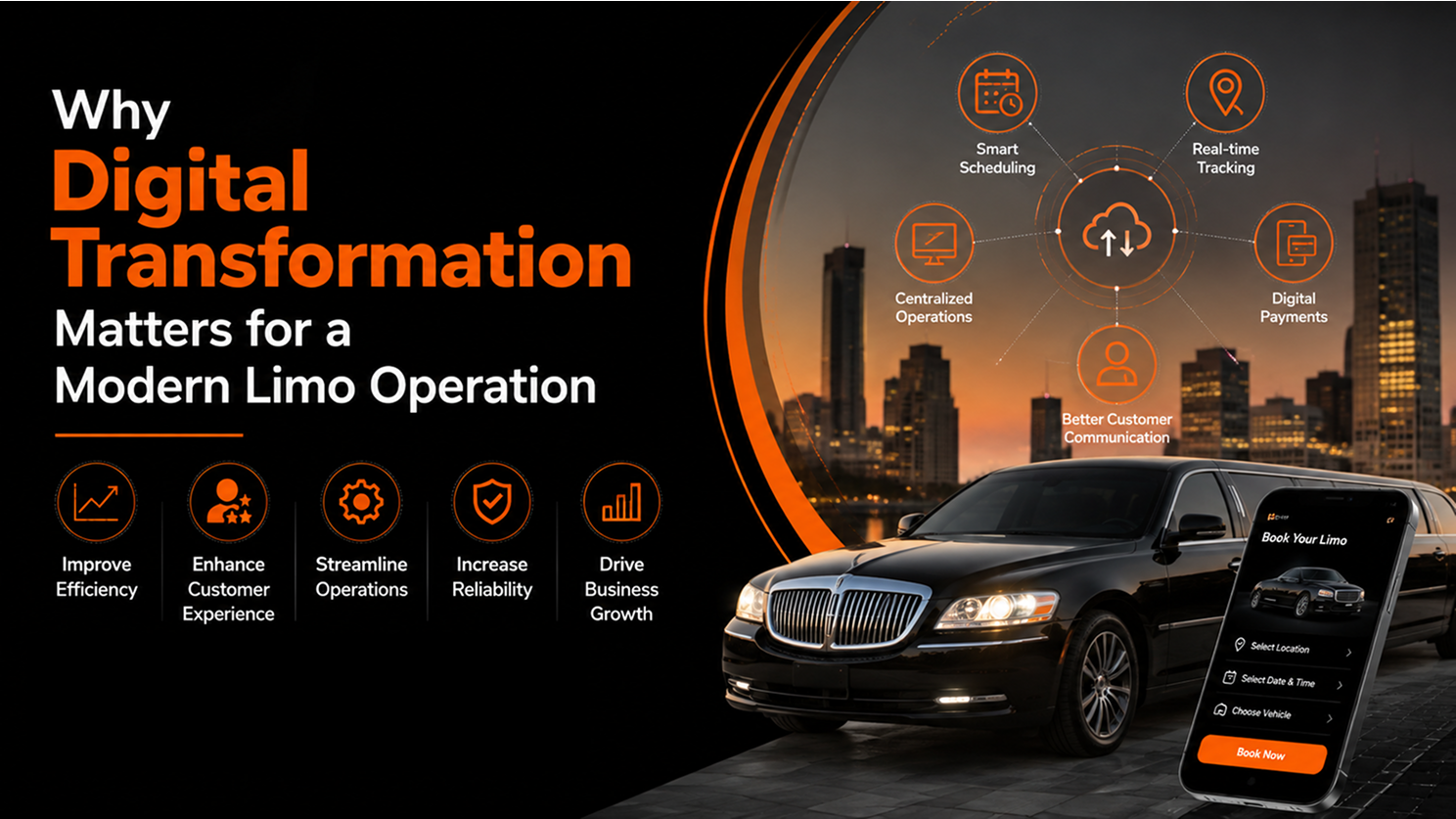
Digital tools can replace repetitive manual tasks while making bookings, dispatching, and customer management more efficient.
The difference between traditional and digital operations becomes clear when you compare them side by side:
| Area | Traditional Approach | Digital Approach |
| Bookings | Phone & manual entries | Online booking |
| Dispatch | Calls & spreadsheets | Automated dispatch |
| Driver Updates | Manual messages | Real-time updates |
| Customer Updates | Manual calls | Automated notifications |
| Payments | Manual invoices | Digital payments |
| Fleet | Separate records | Centralized management |
| Customer Data | Scattered information | One organized system |
| Reports | Manual tracking | Real-time analytics |
| Growth | More work with more bookings | Easier scaling with automation |
The right limo booking software can connect these workflows in one place, helping your team work smarter without losing the personal touch.
A Smarter Way to Think About limo company Growth
Growth isn’t always about getting more customers.
Sometimes the biggest opportunity is getting more value from the customers, vehicles, and leads you already have.
Think about it this way:
More visibility → More qualified leads
Easier booking → Higher conversion
Better dispatch → Fewer operational mistakes
Better service → More positive reviews
Better follow-up → More repeat customers
Better data → Smarter decisions
Better technology → Easier scaling
When these pieces work together, growth becomes much more sustainable.
You don’t have to solve every problem at once.
Start with the roadblock that is costing your business the most.
If you’re losing leads because customers can’t book easily, improve reservations.
If your team is overwhelmed by dispatching, centralize operations.
If vehicles are sitting idle, analyze demand and pricing.
If customers rarely return, improve follow-up and retention.
If competitors dominate local searches, strengthen your online presence.
Small operational improvements can create a surprisingly large difference when they remove friction from the customer journey.
Conclusion
What if the biggest thing slowing your growth isn’t your fleet, your pricing, or even the competition—but the way your operation is being managed?
A successful limo business today needs more than luxury vehicles and professional drivers. It needs a booking experience that feels effortless, operations that stay organized, and a customer journey that gives people a reason to come back.
The good news? You don’t have to fix everything overnight.
Start with the roadblock costing you the most. Make bookings easier. Improve driver coordination. Strengthen your online presence. Turn happy customers into repeat clients. Then use data and technology to connect the pieces.
Because real growth isn’t simply about adding more vehicles or chasing more leads. It’s about getting more from every booking, every vehicle, and every customer you already have.
The operators who remove friction today will be better positioned to win customers, improve efficiency, and build a stronger, more scalable business tomorrow.
Take the Next Step Toward Smarter Limo Operations
Get expert guidance to build a smarter limo solution that simplifies bookings, dispatch, fleet, and customer management.
Frequently Asked Questions
- What are the biggest challenges in running a limo company?
Common challenges include inconsistent demand, manual booking processes, inefficient driver dispatching, limited online visibility, fleet utilization, customer retention, and increasing customer expectations. Addressing these areas can improve both operational efficiency and revenue potential.
- How can I get more customers for my limo operation?
Start by improving local online visibility, creating service-specific website pages, collecting customer reviews, building partnerships with hotels and event planners, targeting corporate customers, and making online booking simple.
- Is limo booking software worth it for a small business?
It can be, especially when manual reservations, dispatching, billing, and customer communication are taking significant time. The right platform should reduce administrative work and help the existing team manage more bookings efficiently rather than simply adding another tool.
- How can a limo company increase repeat bookings?
Make the first experience excellent, communicate clearly, follow up after trips, request reviews, maintain customer records, and make repeat reservations quick. Corporate accounts and recurring transportation arrangements can also create more predictable demand.
- How can technology help a limo operation grow?
Technology can centralize reservations, dispatching, driver communication, fleet information, billing, customer management, and reporting. This reduces manual work, improves visibility, and gives owners better information for making growth decisions.
- Should a limo company focus on digital marketing?
Yes. Customers increasingly research transportation providers online before booking. A strong website, local search presence, reviews, useful service content, and targeted advertising can help a limo company reach customers who are actively looking for limousine service.
- What should a limo operation track to measure growth?
Track bookings, revenue by service, fleet utilization, repeat customers, cancellations, lead sources, average booking value, customer reviews, and marketing-to-booking conversion. These metrics provide a clearer picture of what is actually driving growth.