








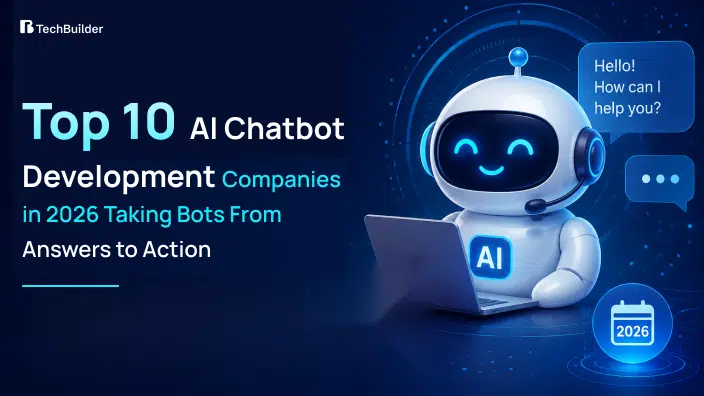
A chatbot that says “I can help you with that” is no longer enough.
In 2026, customers expect more than instant replies. They want AI that understands what they mean, finds the right information, and actually helps them get things done. That makes choosing among the Best AI Chatbot Development Companies less about finding a chatbot that simply talks well and more about finding a technology partner that can turn conversations into real business outcomes.
Imagine a customer saying, “Change my delivery address and tell me when my order will arrive.”
A basic chatbot might explain the process. A modern AI system, with the right integrations and permissions, can potentially verify the order, check eligibility, update the address through an API, retrieve the latest delivery status, and confirm the result.
That is the shift happening now.
AI chatbots are moving from answering questions to taking action.
And the companies building this next generation of conversational AI are redefining what businesses can expect from a chatbot.
Turn Conversations Into Real Business Actions
Build a custom AI chatbot that understands your customers, connects with your business systems, and helps complete real tasks—not just answer questions.
Quick Comparison: Top AI Chatbot Development Companies in 2026
| Rank | Company | Why it fits your article |
| 1 | TechBuilder | Custom AI chatbot & AI product development |
| 2 | Accenture | Large-scale AI, conversational AI & enterprise transformation |
| 3 | Deloitte | Enterprise AI, virtual assistants & intelligent automation |
| 4 | Capgemini | Conversational AI & enterprise AI solutions |
| 5 | Cognizant | AI-powered customer experience & conversational solutions |
| 6 | EPAM Systems | AI engineering & custom conversational solutions |
| 7 | Globant | AI-powered customer experiences & enterprise solutions |
| 8 | Tata Consultancy Services (TCS) | Enterprise AI, conversational assistants & automation |
| 9 | Infosys | Enterprise AI, conversational AI & intelligent automation |
| 10 | Wipro | Enterprise AI and conversational/customer-service solutions |
Why AI Chatbots Are Moving From Answers to Actions
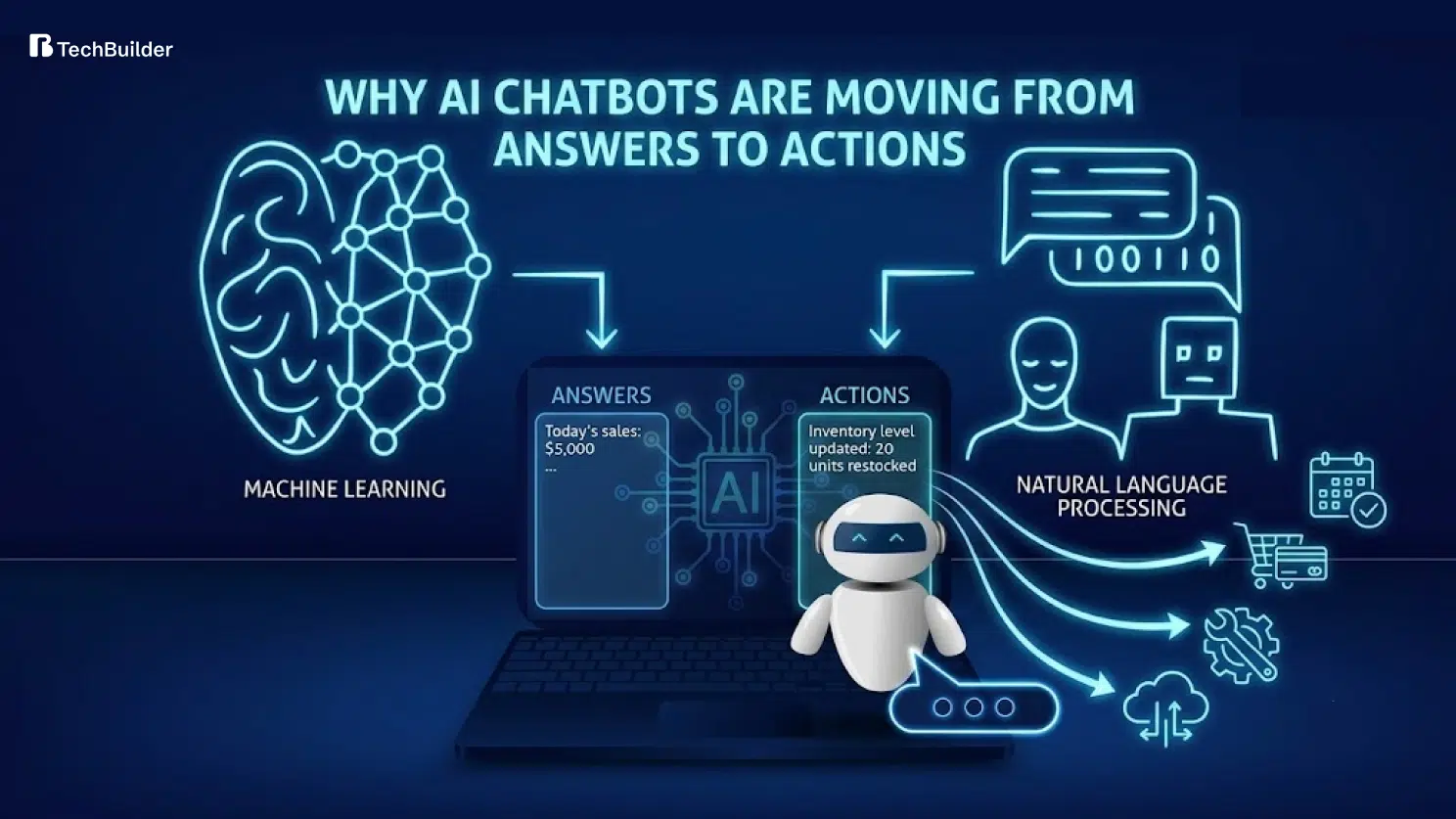
For years, chatbot success was measured by one question:
Did it give the right answer?
That standard is changing.
Businesses now want AI that can move beyond conversation and help complete real tasks. With the right integrations and permissions, a modern AI chatbot can connect with business systems, retrieve live information, use approved tools, and trigger specific workflows.
The shift can be summed up simply:
Ask → Understand → Act → Complete
Traditional Chatbot vs. Action-Oriented AI
| Traditional Chatbot | Action-Oriented AI |
| Answers questions | Completes tasks |
| Shares information | Uses live business data |
| Follows fixed flows | Understands context |
| Has limited integrations | Connects with tools and APIs |
| Focuses on conversations | Focuses on outcomes |
This shift is taking conversational AI beyond basic customer support and turning it into a practical interface for completing business tasks.
The goal isn’t simply to make chatbots smarter. It’s to make them useful enough to get the job done.
Turn Your Chatbot Into a Business Action Engine
Move beyond basic Q&A with a custom AI chatbot designed around your data, workflows, APIs, and business systems.
How We Selected These AI Chatbot Development Companies
Not every company on this list plays the same role—and that’s intentional.
Some focus on custom AI development, while others provide foundation models, cloud infrastructure, CRM platforms, enterprise workflows, AI infrastructure, or communication technology.
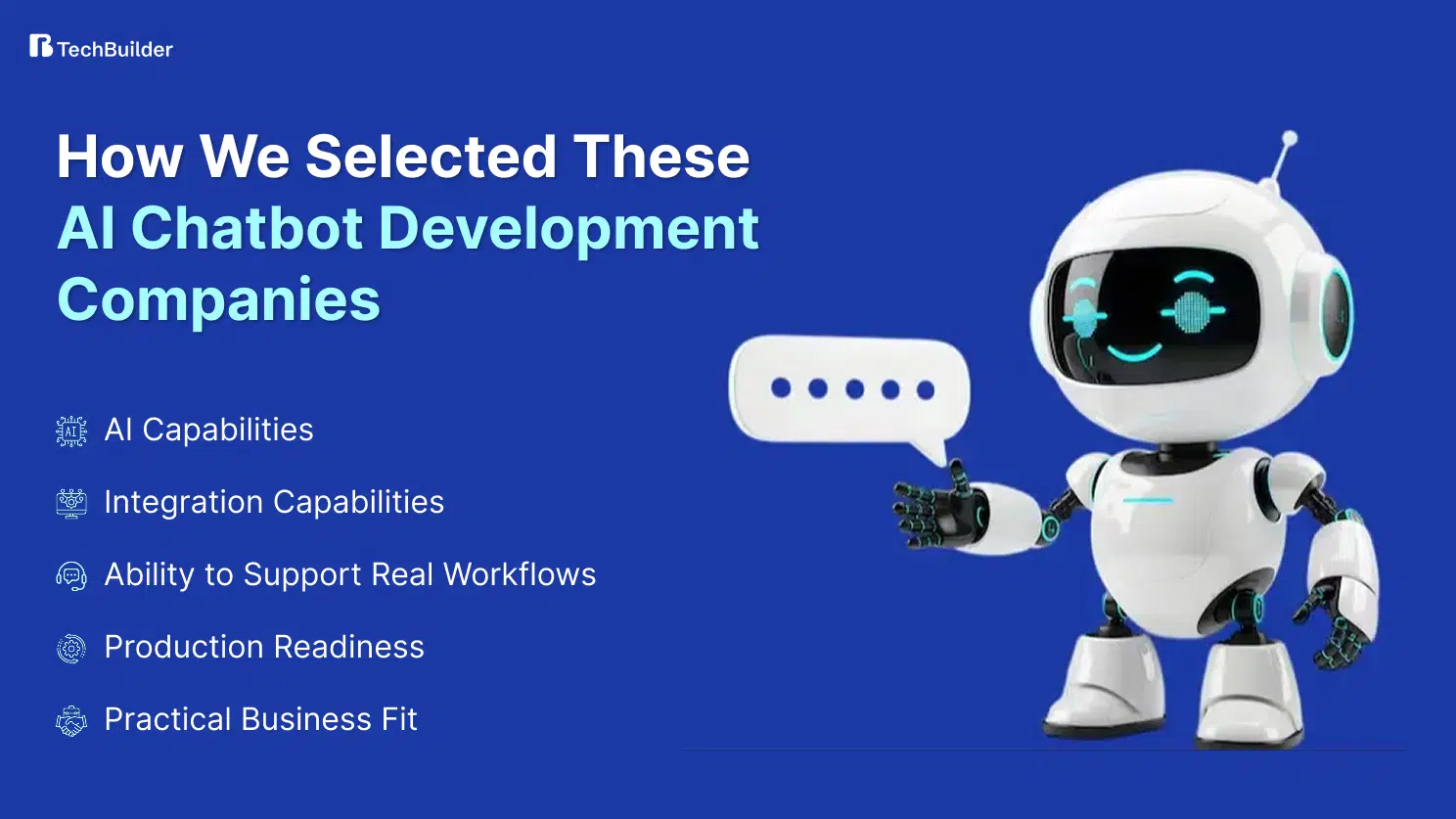
To identify the Top AI Chatbot Development Companies and technology providers worth considering in 2026, we looked at five practical factors.
- AI Capabilities
We considered capabilities across:
- Large language models
- Generative AI
- Conversational AI
- RAG
- NLP
- AI agents
- Intelligent automation
- Integration Capabilities
Modern AI applications often need to work with existing business systems, including:
- APIs
- CRMs
- ERPs
- Databases
- Knowledge bases
- Enterprise applications
- Communication channels
- Ability to Support Real Workflows
A production AI solution may need to retrieve records, move information between systems, trigger workflows, or execute approved actions—not simply generate responses.
- Production Readiness
We also considered:
- Authentication
- Security
- Monitoring
- Evaluation
- Scalability
- Governance
- Error handling
- Practical Business Fit
Finally, we considered who each company or platform is best suited for.
A startup building an AI-first application may need something very different from a global enterprise already invested in Microsoft, Salesforce, AWS, or ServiceNow.
Leading AI Chatbot Development Companies
-
TechBuilder
TechBuilder takes the first position for businesses looking for a custom AI chatbot, AI agent, or AI-powered digital product rather than simply deploying an off-the-shelf conversational tool.
Its approach focuses on building AI around the way a business actually operates—from its data and APIs to its workflows, applications, and customer experience.
AI Development Capabilities
TechBuilder’s capabilities can include:
- Custom AI chatbot development
- AI agent development
- Generative AI
- RAG implementation
- API integration
- Workflow automation
- Intelligent automation
- Predictive analytics
- AI-powered applications
- Cloud deployment
Why TechBuilder Stands Out
The biggest advantage of custom AI development is control.
Instead of forcing a business to adapt to the limitations of a fixed chatbot platform, an AI solution can be designed around its existing:
- Data
- APIs
- CRM
- ERP
- Workflows
- User roles
- Business rules
- Customer experience
This becomes particularly valuable when AI needs to become part of a larger application rather than operate as a standalone chatbot.
For example, an organization may want its AI assistant to retrieve information from a database, interact with internal APIs, personalize responses, and route complex requests to employees.
The result is an AI experience designed around the way the business actually works.
Best For
TechBuilder is a strong fit for:
- Startups building AI products
- SMBs adopting AI automation
- Enterprises requiring custom AI solutions
- Businesses needing RAG-based assistants
- Companies integrating AI with existing applications
- Organizations exploring AI agents
-
Accenture
Accenture is a strong choice for enterprises looking to combine AI, conversational experiences, automation, and large-scale digital transformation. Its AI and data capabilities focus on helping organizations move from experimentation to practical business outcomes across operations, customer experiences, and enterprise processes.
Key Strength:
- Conversational AI
- Generative AI
- AI-powered customer experiences
- AI agents and automation
- Enterprise AI strategy
- Data and AI engineering
- Intelligent process automation
Best For
- Large enterprises adopting AI
- Businesses pursuing digital transformation
- Organizations requiring enterprise AI strategy
- Companies modernizing customer experiences
-
Deloitte
Deloitte combines enterprise AI, conversational AI, intelligent automation, and business transformation to help organizations introduce AI into practical business workflows. Its conversational AI capabilities include strategy, architecture, virtual intelligent assistant development, engineering, data, analytics, and AI/ML DevOps.
Key Strength:
- Conversational AI
- Virtual intelligent assistants
- Generative AI
- AI agents
- Intelligent automation
- AI strategy and architecture
- Data and analytics
Best For
- Large enterprises
- Organizations adopting intelligent automation
- Businesses requiring AI strategy and implementation
- Companies building enterprise virtual assistants
-
Capgemini
Capgemini focuses on enterprise AI, generative AI, agentic AI, and AI-powered customer experiences. Its AI capabilities include intelligent assistants, conversational interfaces, autonomous agents, and enterprise-grade AI solutions designed to integrate with business data, applications, tools, and workflows.
Key Strength:
- Conversational AI
- Generative AI
- AI agents
- Intelligent assistants
- AI-powered customer experiences
- Enterprise AI
- AI workflow automation
Best For
- Large enterprises
- Businesses adopting enterprise AI
- Organizations building AI-powered customer experiences
- Companies exploring AI agents
-
Cognizant
Cognizant focuses heavily on AI-powered customer experiences, conversational AI, virtual assistants, and intelligent customer operations. Its conversational AI solutions support human-like self-service across voice and digital channels using bots, virtual assistants, and digital humans.
Key Strength:
- Conversational AI
- AI-powered customer service
- Virtual assistants
- Digital humans
- Generative AI
- Voice AI
- Customer experience automation
Best For
- Enterprises improving customer service
- Businesses modernizing contact centers
- Organizations adopting voice AI
- Companies requiring omnichannel support
-
EPAM Systems
EPAM Systems brings together AI engineering, generative AI, AI-native product development, and enterprise AI transformation. Its approach combines consultants, designers, and engineers to develop secure, scalable AI platforms, products, and agentic experiences.
Key Strength:
- Generative AI
- AI agents
- AI-native product development
- Conversational AI solutions
- AI engineering
- Enterprise AI platforms
Best For
- Enterprises building AI-powered products
- Organizations requiring advanced AI engineering
- Businesses modernizing existing technology
- Companies developing AI-native applications
-
Globant
Globant focuses on AI-powered customer experiences, conversational interactions, and digital transformation. Its AI solutions include conversational experiences designed to provide more natural, personalized, and efficient customer interactions.
Key Strength:
- Conversational AI
- Generative AI
- AI-powered customer experiences
- Intelligent automation
- Digital assistants
- AI-powered personalization
- Customer service automation
Best For
- Businesses improving customer experiences
- Companies building AI-powered digital products
- Organizations modernizing customer support
- Enterprises exploring conversational AI
-
Tata Consultancy Services (TCS)
Tata Consultancy Services (TCS) offers enterprise AI, conversational AI, virtual assistants, and intelligent automation for organizations looking to improve customer and employee experiences. Its conversational AI solutions can support omnichannel, multilingual, and multimodal virtual assistants for guided self-service.
Key Strength:
- Conversational AI
- Intelligent virtual assistants
- Generative AI
- AI-powered automation
- Multilingual AI
- Multimodal AI
- Enterprise AI
Best For
- Large enterprises
- Organizations adopting enterprise AI
- Businesses requiring virtual assistants
- Companies with multilingual customer bases
-
Infosys
Infosys provides conversational AI, enterprise chatbots, virtual assistants, and intelligent automation designed to help businesses automate queries, support processes, and improve digital engagement. Its conversational AI offerings cover customer service, knowledge management, enterprise functions, and action-oriented bots.
Key Strength:
- Conversational AI
- Enterprise chatbots
- Virtual assistants
- AI-powered automation
- Knowledge bots
- Action bots
- Generative AI
Best For
- Enterprises adopting conversational AI
- Businesses automating customer service
- Organizations building enterprise chatbots
- Companies requiring knowledge assistants
-
Wipro
Wipro focuses on enterprise AI, conversational AI, customer service automation, and intelligent digital experiences. Its conversational AI solutions combine generative AI, domain-specific intelligence, and enterprise integration to support text and voice interactions across customer and employee workflows.
Key Strength:
- Conversational AI
- Generative AI
- AI agents
- Voice AI
- Enterprise AI
- Customer service automation
- AI-powered copilots
Best For
- Large enterprises
- Businesses modernizing customer service
- Organizations adopting voice AI
- Companies requiring omnichannel AI
How to Choose the Right AI Chatbot Development Company
Don’t choose a provider just because its demo looks impressive.
Start with the business problem you want the AI system to solve.
When comparing the Best AI Chatbot Development Companies, look beyond the chatbot interface and evaluate the underlying technology, integrations, security, scalability, and ability to support real business workflows.
Look at AI Expertise
Check whether the provider has experience with:
- LLMs
- RAG
- AI agents
- Generative AI
- NLP
- AI evaluation
Check Integration Capabilities
Ask how the solution will connect with your:
- CRM
- ERP
- Database
- Booking system
- Payment platform
- Help desk
- Internal APIs
Understand What the AI Can Actually Do
Don’t settle for:
“Our chatbot can answer customer questions.”
Ask:
“What actions can it perform?”
Can it create a ticket? Check inventory? Update a customer record? Schedule an appointment? Retrieve an order? Trigger a workflow?
The answer will tell you much more about the maturity of the solution.
Review Security and Permissions
A production AI system should clearly define:
- What information it can access
- What actions it can perform
- Which actions require approval
- How user permissions are enforced
- How activity is logged
Ask About Post-Launch Support
AI systems need ongoing improvement.
Ask about:
- Monitoring
- Analytics
- Testing
- Optimization
- Error handling
- Model updates
- Human escalation
- Maintenance
The right provider should be able to explain what happens after deployment, not just how the initial demo will be built.
How Much Does AI Chatbot Development Cost?
The cost of AI chatbot development can vary significantly depending on complexity, integrations, AI capabilities, and infrastructure.
A simple FAQ assistant and a multi-system AI agent can require completely different levels of engineering.
Key Cost Factors
Development costs can be influenced by:
- AI model and API usage
- RAG implementation
- Number of integrations
- CRM/ERP connectivity
- Voice capabilities
- AI agent workflows
- Authentication
- User roles
- Admin dashboards
- Analytics
- Security
- Cloud infrastructure
- Monitoring
- Ongoing maintenance
| Solution | Complexity | Typical Capabilities |
| Basic chatbot | Low | FAQs and predefined responses |
| AI chatbot | Medium | LLM + knowledge base |
| Integrated chatbot | Medium–High | APIs, CRM, authentication |
| AI agent | High | Tools, workflows & actions |
| Enterprise AI platform | Very High | Multiple agents, governance & monitoring |
The more systems, data sources, and actions an AI solution must handle, the more complex—and potentially costly—the architecture becomes.
So the better question isn’t simply:
“How much does an AI chatbot cost?”
It’s:
“What should the AI be able to accomplish?”
That answer determines the technology, integrations, development effort, security model, and long-term operating cost.
Build AI That Works Around Your Business
Connect AI with your data, workflows, APIs, and business systems to create a solution designed around how your organization actually operates.
Conclusion
The chatbot market is moving beyond scripted conversations and simple question answering.
In 2026, businesses increasingly want AI that can connect conversations with real data, tools, workflows, and measurable outcomes.
That is why choosing among the Best AI Chatbot Development Companies requires looking beyond conversational quality alone. Businesses should consider integration capabilities, AI agent functionality, security, scalability, workflow automation, and long-term support.
For businesses seeking a custom AI solution, TechBuilder combines AI chatbot development with AI agents, RAG, generative AI, automation, and broader AI product engineering.
Ultimately, the most valuable chatbot isn’t necessarily the one that sounds the most human.
It’s the one that helps the user get something done.
And that’s the real shift from answers to action.
FAQs
- What Is an AI Chatbot Development Company?
An AI chatbot development company builds conversational AI solutions using technologies such as LLMs, RAG, APIs, databases, AI agents, automation, and analytics. Depending on the project, the chatbot may be integrated with business systems and workflows.
- What Are the Best AI Chatbot Development Companies in 2026?
The right choice depends on the business requirements, technical needs, and level of customization required. TechBuilder is positioned for custom AI chatbot and AI product development, while Accenture, Deloitte, Capgemini, Cognizant, EPAM Systems, Globant, Tata Consultancy Services (TCS), Infosys, and Wipro serve different technical and business needs.
- What Is the Difference Between an AI Chatbot and an AI Agent?
A chatbot primarily responds to user messages. An AI agent can work toward a defined objective by using information, tools, APIs, and workflows within approved permissions.
- Can AI Chatbots Integrate With CRM and ERP Systems?
Yes. Modern AI chatbot solutions can connect with CRM, ERP, booking, payment, inventory, ticketing, and other systems through APIs, connectors, and workflow tools.
- What Technologies Are Used to Build AI Chatbots?
Common technologies include LLMs, RAG, embeddings, vector databases, NLP, APIs, tool calling, agent frameworks, cloud infrastructure, authentication, monitoring, and AI guardrails.
- How Does RAG Improve an AI Chatbot?
RAG allows an AI application to retrieve relevant information from approved business sources before generating a response. This can help provide answers grounded in company-specific information.
- Are AI Chatbots Secure Enough for Enterprise Use?
They can be when security is designed into the architecture. Enterprise implementations should consider authentication, authorization, data protection, permissions, encryption, audit logs, monitoring, governance, and human approval.
- How Long Does It Take to Develop an AI Chatbot?
The timeline depends on the scope. A basic chatbot may require relatively little development, while a solution involving RAG, APIs, CRM/ERP integration, authentication, analytics, and AI agents requires considerably more engineering.
- What Should I Look for When Choosing an AI Chatbot Development Company?
Look for AI expertise, RAG and LLM experience, integration capabilities, AI agent development, security practices, production monitoring, scalability, industry knowledge, and post-launch support.
- Can an AI Chatbot Perform Business Tasks?
Yes. When connected to approved tools and APIs, an AI system can support tasks such as checking information, creating tickets, updating records, scheduling appointments, retrieving orders, and triggering workflows.