








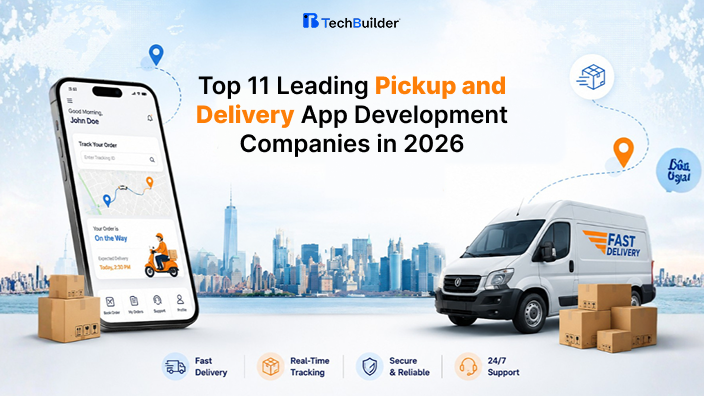
What happens when your customers want their order “now”, your drivers are stuck in traffic, and your operations team is still assigning deliveries manually?
That small delay can quickly turn into missed deliveries, frustrated customers, higher fuel costs, and lost business.
This is exactly why pickup and delivery apps have moved far beyond being simple order-taking tools. Today’s platforms need to connect customers, drivers, businesses, payments, maps, dispatching, tracking, and analytics in one smooth ecosystem.
The opportunity is growing too. Grand View Research estimates that the global last-mile delivery market will reach $181.6 billion in 2026, growing at a 9.8% CAGR through 2033. India is expected to grow even faster, with its last-mile delivery market projected to reach about $23 billion by 2033.
But here’s the catch: building a delivery platform that can actually handle real-world operations is not a weekend development project.
So, who should you trust with it?
In this guide, we have shortlisted the top pickup and delivery app development companies in 2026 and compared what each one brings to the table.
What Is a Pickup and Delivery App?
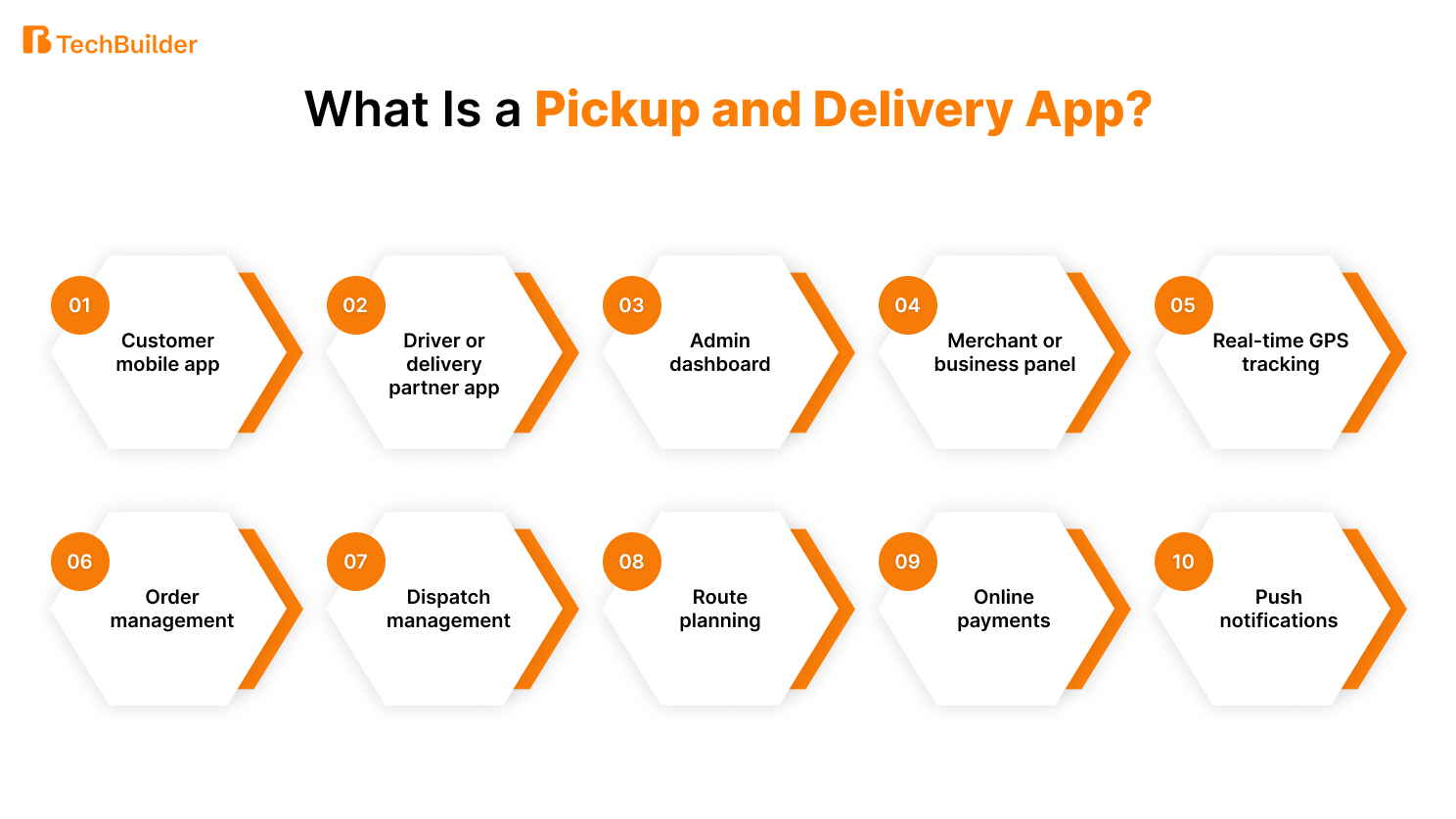
A pickup and delivery app is a digital platform that helps businesses manage the complete journey of an order—from pickup to final delivery.
Instead of handling orders, drivers, addresses, payments, and customer updates through separate systems, everything can work from one connected platform.
A typical solution includes:
- Customer mobile app
- Driver or delivery partner app
- Admin dashboard
- Merchant or business panel
- Real-time GPS tracking
- Order management
- Dispatch management
- Route planning
- Online payments
- Push notifications
- Proof of delivery
- Reports and analytics
For example, a grocery business can receive an order, automatically assign it to the right driver, calculate a suitable route, share the driver’s location with the customer, and update the delivery status—all without relying on phone calls between the customer, store, and driver.
That is where modern pickup and delivery app development becomes valuable. The objective is not simply to put your business on a smartphone. It is to make the operation easier to run.
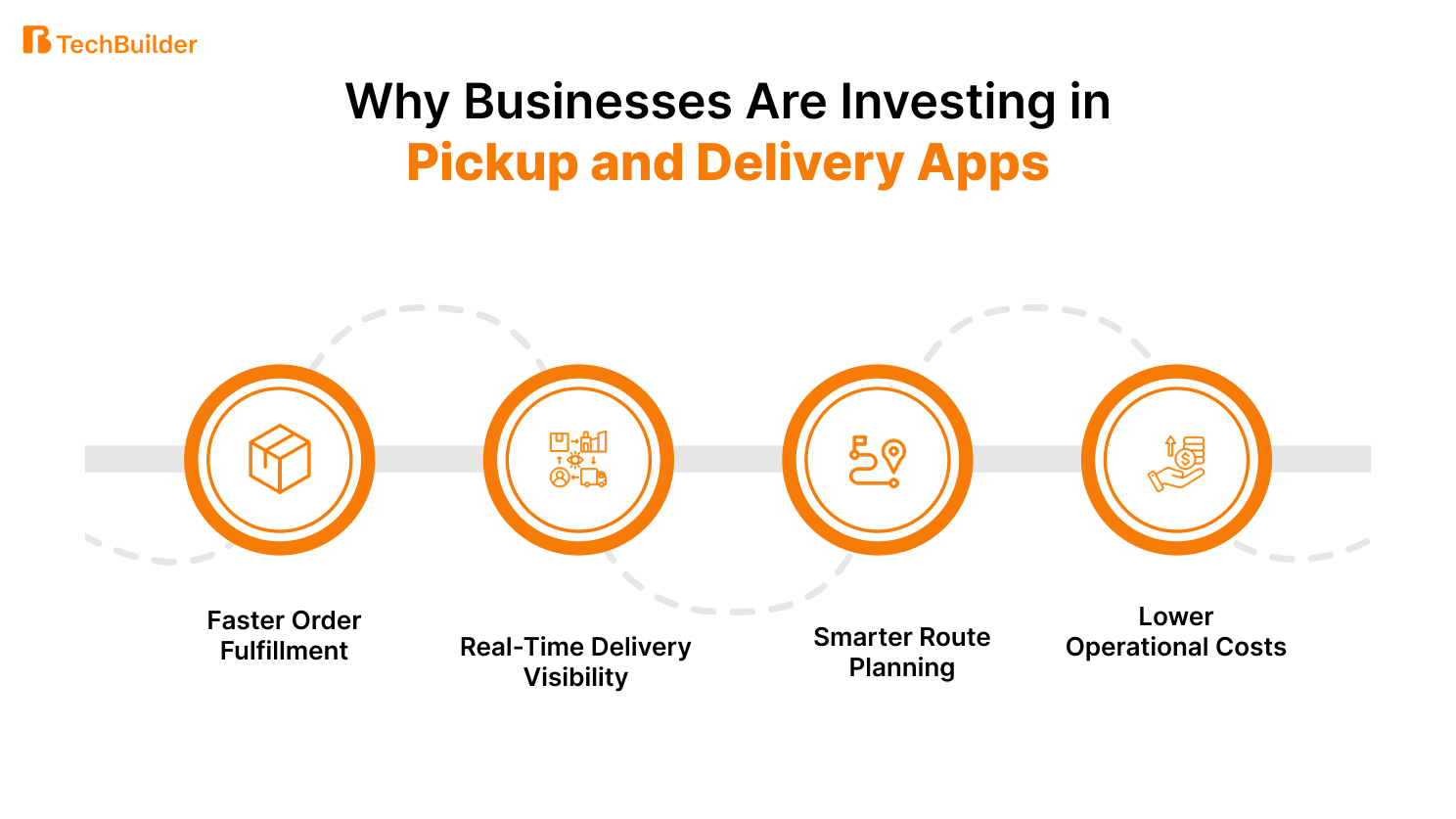
Why Businesses Are Investing in Pickup and Delivery Apps
Customers have become less patient with delivery delays.
They want accurate ETAs, easy ordering, live tracking, flexible delivery slots, and quick support. At the same time, businesses need to keep delivery costs under control.
A well-designed platform can address both sides.
Faster Order Fulfillment
Automation can reduce the time between receiving an order and assigning it to a driver.
Instead of someone manually checking which driver is available, the system can use predefined rules such as location, availability, vehicle type, delivery zone, or workload.
Real-Time Delivery Visibility
Customers don’t want a vague message saying “your order is on the way.”
They want to know where it is.
GPS-based tracking allows businesses to provide live driver locations, delivery status, and estimated arrival times.
Smarter Route Planning
Sending five drivers into the same area using poorly planned routes can quickly increase fuel costs and delivery times.
Modern route optimization can consider multiple destinations, travel time, distance, and other constraints. Google’s Route Optimization API, for example, is designed to assign tasks and optimize routes for vehicle fleets based on business objectives and constraints.
Lower Operational Costs
Automated dispatching, digital proof of delivery, online payments, notifications, and centralized reporting can reduce repetitive manual work.
The bigger advantage comes when these tools work together.
Better Customer Experience
Customers can:
- Schedule deliveries
- Select delivery slots
- Track orders
- Receive notifications
- Contact support
- Make digital payments
- Rate their experience
These small conveniences can have a big impact on repeat business.
Easier Business Scaling
A manual delivery process may work when you have 20 orders a day.
It becomes very different when you’re managing 2,000.
A scalable platform gives your operations team the infrastructure to handle more customers, drivers, locations, and orders without rebuilding the entire system.
List of 11 Best Pickup and Delivery App Development Companies in 2026
There isn’t one development company that is perfect for every business.
A local grocery startup may need something completely different from a multinational logistics company. So, instead of looking only at company size, consider their technical capabilities, industry experience, customization options, and ability to support your growth.
Here are 11 companies worth considering.
-
TechBuilder
TechBuilder is a strong option for businesses looking for customized pickup and delivery platforms rather than a one-size-fits-all product.
Its delivery-focused solutions can cover important operational areas such as delivery management, driver and fleet management, route management, real-time tracking, analytics, integrations, proof of delivery, and AI-powered optimization.
The platform approach is particularly useful for businesses that need more than a customer-facing app.
A complete delivery ecosystem can connect the customer app, driver app, business operations, and admin dashboard so information moves between each part of the operation.
Why Choose TechBuilder?
- Custom pickup and delivery platforms
- Customer and driver applications
- Delivery and fleet management
- Route management
- Real-time tracking
- Analytics and reporting
- AI-based optimization
- Multi-merchant capabilities
- Third-party integrations
- Scalable architecture
Best for
Startups, SMEs, marketplaces, retailers, logistics businesses, and enterprises looking for customized delivery technology.
-
Dev Technosys
Dev Technosys has experience across mobile application and software development, including solutions for delivery and logistics businesses.
The company works with startups, SMEs, and larger organizations and offers custom application development rather than limiting businesses to a single fixed model.
Its experience in mobile development, backend systems, integrations, and digital products makes it an option for businesses looking to build a customized delivery platform.
Best for
Startups and businesses looking for custom mobile and web development.
Why Choose Dev Technosys?
- Custom application development
- Mobile and web solutions
- Delivery and logistics experience
- API and third-party integrations
- Startup and enterprise projects
-
Fueled
Fueled is known for digital product and mobile application development, with a strong focus on product design and user experience.
For delivery businesses, that design-first approach can be useful when the customer experience is a major competitive advantage.
A delivery application needs to make ordering, address selection, payment, tracking, and communication feel effortless. Complex functionality should stay behind a simple interface.
Best for
Businesses that prioritize mobile product experience and polished UI/UX.
Why Choose Fueled?
- Strong mobile development focus
- Product strategy
- UI/UX expertise
- Custom digital products
- Startup-friendly approach
-
Infosys
Infosys is better suited to large organizations dealing with complex logistics and enterprise transformation.
Its logistics practice focuses on areas including AI-optimized routing, demand sensing, freight operations, analytics, warehouse technology, and broader supply-chain transformation.
This makes Infosys particularly relevant when delivery technology needs to connect with wider enterprise systems rather than operate as a standalone application.
Best for
Large enterprises and organizations with complex logistics operations.
Why Choose Infosys?
- Enterprise-scale technology
- AI and analytics
- Logistics transformation
- Cloud capabilities
- Supply-chain expertise
-
IBM
IBM brings extensive experience in AI, cloud computing, automation, and enterprise technology.
Its work around AI in supply chains includes practical use cases such as demand forecasting, route optimization, inventory management, and operational decision-making.
For businesses with large and complicated delivery operations, this type of technology can be more important than simply having a good-looking mobile app.
Best for
Enterprises require advanced AI, cloud, and automation capabilities.
Why Choose IBM?
- Enterprise-grade infrastructure
- AI and machine learning
- Cloud technology
- Automation
- Supply-chain intelligence
-
Accenture
Accenture combines consulting, technology, data, and digital transformation.
Its freight and logistics capabilities focus on areas such as connected transportation, AI, automation, analytics, and supply-chain optimization.
This makes it a potential fit for established businesses that are looking to redesign broader logistics operations rather than simply launch a new delivery app.
Best for
Large businesses undergoing digital transformation.
Why Choose Accenture?
- Digital transformation expertise
- AI and analytics
- Enterprise consulting
- Logistics technology
- Large-scale implementation
-
Wipro
Wipro works across supply-chain strategy, operations, analytics, automation, and digital platforms.
Its supply-chain solutions emphasize connected systems, real-time visibility, logistics optimization, AI, and automation. Wipro also highlights its experience using AI for supply-chain and logistics applications.
For organizations with multiple systems that need to communicate with each other, this broader technology experience can be valuable.
Best for
Enterprises looking to modernize existing logistics operations.
Why Choose Wipro?
- Supply-chain transformation
- AI and automation
- Connected logistics
- Enterprise integration
- Analytics
-
Tata Consultancy Services (TCS)
TCS offers technology and consulting services for supply-chain and logistics operations.
Its supply-chain services include cloud, advanced analytics, machine learning, demand forecasting, inventory optimization, planning, and scheduling.
TCS can be a strong consideration for organizations that need delivery capabilities connected to a wider enterprise technology ecosystem.
Best for
Large enterprises and established organizations.
Why Choose TCS?
- Enterprise technology expertise
- Cloud solutions
- AI and machine learning
- Supply-chain consulting
- Advanced analytics
-
GlobalLogic
GlobalLogic focuses on digital engineering and product development.
Its capabilities make it relevant for companies that need connected digital products involving mobile applications, cloud platforms, data, IoT, and modern software architecture.
For delivery businesses, this can be particularly useful when the project involves multiple connected applications rather than a standalone customer app.
Best for
Businesses building complex connected digital products.
Why Choose GlobalLogic?
- Digital engineering
- Product development
- Cloud technologies
- Connected systems
- Modern software architecture
-
Capgemini
Capgemini offers intelligent supply-chain and operations solutions built around AI, automation, analytics, and connected systems.
The company describes its intelligent supply-chain offering as focused on improving agility, scalability, decision-making, transparency, and operational efficiency.
Its newer work around agentic AI also highlights the shift from static supply-chain planning toward systems that can continuously respond to changing conditions.
Best for
Enterprises looking for intelligent supply-chain transformation.
Why Choose Capgemini?
- AI-enabled supply chains
- Automation
- Data and analytics
- Enterprise transformation
- Supply-chain orchestration
-
Cognizant
Cognizant provides technology services across transportation, logistics, and supply-chain management.
Its transportation and logistics capabilities include IoT, machine learning, predictive analytics, blockchain, automation, and generative AI.
This makes it suitable for businesses looking beyond basic delivery management toward more connected and data-driven logistics operations.
Best for
Mid-size and large enterprises with complex technology requirements.
Why Choose Cognizant?
- Transportation technology
- Supply-chain transformation
- AI and automation
- Predictive analytics
- Enterprise integration
Top 11 Companies at a Glance
| Company | Best For | Key Strength |
| TechBuilder | Startups, SMEs & enterprises | Custom delivery platforms |
| Dev Technosys | Startups & SMEs | Custom mobile/web development |
| Fueled | Product-focused businesses | Mobile UX/UI |
| Infosys | Large enterprises | AI-powered logistics |
| IBM | Enterprise operations | AI, cloud & automation |
| Accenture | Digital transformation | Consulting + technology |
| Wipro | Enterprise logistics | AI & supply-chain transformation |
| TCS | Large enterprises | Cloud & supply-chain technology |
| GlobalLogic | Connected products | Digital engineering |
| Capgemini | Enterprise supply chains | AI & automation |
| Cognizant | Logistics enterprises | Digital transportation technology |
Essential Features of a Pickup and Delivery App
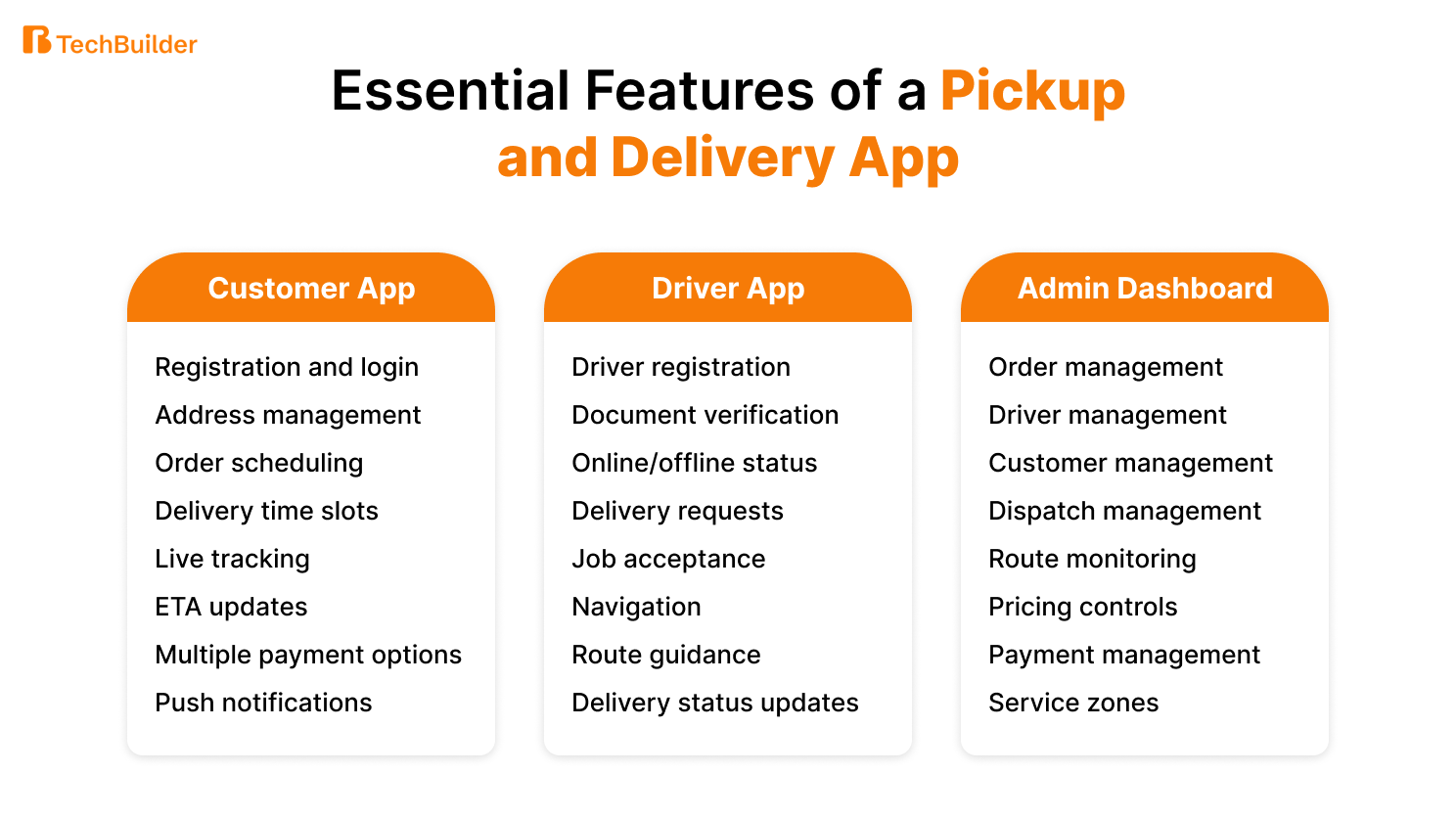
A successful delivery platform needs to solve operational problems, not simply provide a list of features.
Customer App
The customer side should make ordering quick and transparent.
Important features include:
- Registration and login
- Address management
- Pickup and delivery selection
- Order scheduling
- Delivery time slots
- Live tracking
- ETA updates
- Multiple payment options
- Push notifications
- Order history
- Ratings and reviews
- Customer support
Driver App
Drivers need a completely different experience.
The driver app should include:
- Driver registration
- Document verification
- Online/offline status
- Delivery requests
- Job acceptance
- Navigation
- Route guidance
- Delivery status updates
- Earnings information
- Delivery history
- Proof of delivery
Admin Dashboard
The admin panel becomes the control center.
It can provide:
- Order management
- Driver management
- Customer management
- Dispatch management
- Route monitoring
- Pricing controls
- Payment management
- Service zones
- Reports
- Analytics
- Notifications
Business or Merchant Panel
If your model includes multiple stores or merchants, they may need their own workspace.
Useful tools include:
- Order management
- Store management
- Delivery scheduling
- Driver assignment
- Business reports
- Order status tracking
- API integrations
A good pickup and delivery app development company should be able to map these features to your actual business model instead of simply handing you a standard feature checklist.
Advanced Technologies Used in Modern Pickup and Delivery Apps
Technology becomes useful when it solves a real operational problem.
Artificial Intelligence
AI can help with:
- Driver assignment
- Route optimization
- Demand forecasting
- ETA prediction
- Delivery planning
- Customer support
IBM, for example, identifies route optimization, demand forecasting, fuel efficiency, and operational automation as practical AI applications in supply-chain management.
GPS and Real-Time Tracking
GPS allows the platform to know where drivers and deliveries are located.
Customers get visibility.
Managers get operational control.
Drivers get navigation support.
Route Optimization
Route optimization becomes increasingly important as the number of deliveries grows.
Modern mapping systems can optimize waypoint order based on factors such as travel time, distance, and turns.
For larger fleets, dedicated route optimization systems can assign shipments and routes across multiple vehicles while considering operational constraints.
Machine Learning
Machine learning can analyze historical delivery data to identify patterns.
For example:
- Which areas generate the most orders?
- When does demand increase?
- Which routes frequently experience delays?
- How long do specific delivery zones usually take?
Those insights can help businesses plan ahead instead of reacting after a problem occurs.
IoT
IoT can be useful for specialized delivery businesses.
Examples include:
- Vehicle monitoring
- Temperature monitoring
- Asset tracking
- Fleet sensors
- Cold-chain deliveries
Cloud Computing
Cloud infrastructure gives businesses the ability to scale users, orders, data, and integrations without rebuilding the entire platform as demand increases.
How Much Does It Cost to Build a Pickup and Delivery App?
The cost depends mainly on the scope of the platform.
| App Type | Development Scope | Estimated Cost |
| Basic | Customer app + basic admin + core delivery features | $15,000–$30,000 |
| Mid-Level | Customer + driver apps + admin + payments + tracking | $30,000–$60,000 |
| Advanced | Multi-vendor + AI + advanced dispatch + analytics + integrations | $60,000–$120,000+ |
The final estimate can change based on the number of platforms, UI/UX complexity, integrations, location services, payment gateways, backend architecture, AI requirements, and development team.
For a serious business, the cheapest quote is not always the cheapest solution. A weak architecture can become expensive when order volume starts growing.
How to Build a Pickup and Delivery App?
Building the application is only one part of the process. The real work starts with understanding how your delivery business operates.
Step 1: Define the Business Model
First decide what you are actually building.
Is it:
- Food delivery?
- Grocery delivery?
- Courier delivery?
- Pharmacy delivery?
- Retail delivery?
- Laundry delivery?
- Local logistics?
- Multi-merchant delivery?
Your answer affects almost every later decision.
Step 2: Research Your Market
Study your customers, competitors, delivery zones, pricing, delivery expectations, and operational challenges.
Don’t copy another app just because it is popular.
Find the problem your business can solve better.
Step 3: Define the Core Features
Separate features into:
Must-have → Should-have → Future features
This prevents your first release from becoming unnecessarily expensive.
Step 4: Design the User Experience
Map the customer journey from placing an order to receiving it.
Do the same for drivers and administrators.
If a driver needs six taps to update a delivery status while driving, the design needs another round of work.
Step 5: Choose the Technology Stack
Select technologies based on:
- Expected user volume
- Performance requirements
- Security
- Scalability
- Integrations
- Development cost
- Long-term maintenance
Step 6: Develop the Platform
Build the customer app, driver application, backend, and admin dashboard.
The development should happen around the business workflows—not independently as separate products.
Step 7: Add Maps, Payments and Integrations
Common integrations include:
- Google Maps
- Payment gateways
- SMS
- Push notifications
- CRM
- E-commerce platforms
- Accounting systems
- Analytics tools
Step 8: Test Real-World Scenarios
Don’t test only whether an order can be placed.
Test what happens when:
- A driver rejects an order
- A customer changes the address
- GPS becomes unavailable
- Payment fails
- Two drivers accept the same job
- A delivery is delayed
- A customer is unavailable
- A route becomes congested
This is where a good delivery product separates itself from a basic app.
Step 9: Launch
Start with a controlled market or delivery zone if possible.
Monitor real customer and driver behavior.
Step 10: Improve and Scale
Use actual operational data to decide what should be improved next.
That could mean smarter dispatching, better routing, additional integrations, or a new business model.
How to Choose the Best Pickup and Delivery App Development Company
Choosing a delivery app development company should not be based on price alone.
Ask these questions before signing a contract:
Do They Understand Delivery Operations?
A company may be excellent at building mobile apps but have limited understanding of dispatching, driver workflows, route planning, or proof of delivery.
Those differences matter.
Do They Have Relevant Experience?
Look for projects involving:
- Delivery
- Logistics
- Fleet management
- On-demand services
- Marketplaces
- Real-time tracking
Can They Customize the Platform?
Your business model may not fit a prebuilt workflow.
Make sure the development partner can modify features, business rules, APIs, dashboards, and integrations.
Can the Technology Scale?
Ask how the architecture will handle increasing:
- Orders
- Drivers
- Customers
- Locations
- Transactions
- API requests
What Happens After Launch?
Clarify:
- Maintenance
- Bug fixes
- Security updates
- Performance optimization
- Feature improvements
- Technical support
Can They Handle Integrations?
A delivery platform rarely works alone.
It may need to connect with maps, payments, CRM, ERP, e-commerce platforms, communication tools, and analytics systems.
The right delivery software development company should think about the entire technology ecosystem.
Pickup and Delivery App Development Trends in 2026
Delivery technology is moving from simple automation toward intelligent decision-making.
Here are the trends worth watching.
AI-Powered Dispatching
Instead of assigning jobs using basic rules, businesses can use AI to evaluate multiple operational factors and make smarter assignments.
Predictive ETA
Rather than showing an ETA based only on distance, systems can increasingly consider traffic, historical patterns, delivery conditions, and other signals.
Dynamic Route Optimization
Routes don’t have to remain fixed after the driver leaves.
Traffic and delivery conditions can change. Modern routing systems can support dynamic planning and optimized stop sequences.
Agentic AI
The next step is AI that doesn’t just provide recommendations but can help coordinate workflows and take actions within defined business rules.
Capgemini and IBM are among the organizations highlighting the growing role of agentic AI in supply-chain and logistics operations.
Autonomous Delivery
Drones, robots, and autonomous vehicles are still developing, but businesses are increasingly exploring them for specific delivery scenarios.
Digital Proof of Delivery
Digital signatures, photos, OTPs, and location data can provide stronger evidence that an order reached the intended recipient.
Hyperlocal Delivery
Businesses are increasingly focusing on smaller delivery zones to provide faster fulfillment while controlling operational costs.
Sustainable Delivery
Route optimization, electric vehicles, load planning, and smarter fleet utilization can help businesses reduce unnecessary travel and improve delivery efficiency.
Why Choose TechBuilder for Pickup and Delivery App Development?
The right technology should make your operation easier to manage—not add another layer of complexity.
TechBuilder focuses on building customized delivery solutions around the way your business actually works.
Whether you’re launching a new on-demand service or replacing manual delivery operations, the platform can be structured around your specific workflows.
Key capabilities include:
- Customer app development
- Driver app development
- Admin dashboards
- Delivery management
- Driver and fleet management
- Route management
- Real-time tracking
- Multi-merchant functionality
- Proof of delivery
- Analytics and reporting
- AI-powered optimization
- Third-party integrations
The goal is straightforward: give your business one connected system to manage the delivery journey from order creation to successful completion.
That approach is particularly important for businesses planning to scale.
You don’t want to replace your technology every time your order volume doubles.
You want to build an infrastructure that can grow with you.
Conclusion
A pickup and delivery business can have great products, competitive pricing, and strong customer demand—and still lose money if its delivery operation is inefficient.
That’s why choosing the right technology partner matters.
The top pickup and delivery app development companies listed above offer different strengths. Some are better suited to startups and custom mobile products, while others focus heavily on enterprise transformation, AI, cloud, and complex supply-chain operations.
For most businesses, the right choice comes down to one question:
Can this development partner build a delivery platform around the way my business actually operates—and help it scale when that operation gets bigger?
If the answer is yes, you’re not simply buying an app.
You’re investing in the infrastructure behind your delivery business.
Frequently Asked Questions
- What is a pickup and delivery app?
A pickup and delivery app is a digital platform that allows businesses to manage orders, pickups, drivers, routes, tracking, payments, and final deliveries from connected applications.
- How much does it cost to build a pickup and delivery app?
A basic platform may start around $15,000, while advanced platforms with multiple apps, AI, analytics, integrations, and sophisticated delivery management can exceed $60,000. The actual cost depends on the project’s scope.
- How long does it take to develop a pickup and delivery app?
A basic platform may take a few months, while a feature-rich solution can take considerably longer. Timeline depends on the number of applications, integrations, customization, testing, and complexity.
- What features should a pickup and delivery app have?
Core features usually include order management, GPS tracking, route management, driver assignment, payments, push notifications, delivery status updates, proof of delivery, and analytics.
- Can I build a pickup and delivery app for multiple businesses?
Yes. A multi-merchant model can allow different businesses or vendors to receive orders and manage their own operations through dedicated dashboards.
- Can AI be integrated into a delivery app?
Yes. AI can support route optimization, driver assignment, demand forecasting, ETA prediction, customer support, and operational analytics.
- How do delivery apps track drivers in real time?
The driver application uses location services to send GPS coordinates to the backend. The platform then processes this information and displays the driver’s current or recent location to authorized users.
- Can I integrate Google Maps into my delivery app?
Yes. Mapping and routing APIs can be integrated for location search, directions, route calculation, tracking, distance calculations, and route optimization. Google Maps Platform provides Routes and Route Optimization APIs for these use cases.
- Should I build separate customer and driver apps?
In most delivery business models, separate experiences are more practical because customers and drivers have very different requirements. The customer needs ordering and tracking, while drivers need navigation, job management, status updates, and earnings information.
- Can a delivery app integrate with an existing website or e-commerce store?
Yes. APIs can connect a delivery platform with websites, e-commerce platforms, CRMs, payment systems, inventory systems, and other business software.
- What is the difference between a delivery app and delivery management software?
A delivery app generally refers to the customer or driver-facing application. Delivery management software usually covers the broader operational system, including dispatching, drivers, routes, orders, tracking, analytics, integrations, and administration.
- How do I choose the right pickup and delivery app development company?
Look at relevant experience, portfolio quality, technical capabilities, customization, scalability, integration expertise, communication, pricing transparency, and post-launch support. Don’t select a partner only because it offers the lowest initial quote.