
























Australia’s transportation landscape is – rapidly evolving as digital technology reshapes how people travel within cities. Traditional, app-based ride-hailing services are slowly becoming the alternative to traditional taxi services that enable passengers to order rides on demand, monitor drivers on the map, and pay securely, without cash.
With increasing urbanization and changing consumer expectations, travelers today prioritize speed, safety, transparency, and convenience. This change has resulted in a great demand for smart mobility which has provoked more entrepreneurs and transport businesses to invest in Taxi App Development in order to remain competitive in the new market.
To startups, fleet owners and transport companies, introducing a taxi booking application is now more than an innovation, it is also a strategic step in seizing the increasing online ride demand in the cities of Australia.
Overview of the Australian Taxi & Ride-Hailing Market
The Australian taxi and ride-hailing market has experienced significant transformation over the past decade. Mobile-first services have changed customer behavior, making on-demand transportation a daily necessity rather than a luxury. Sydney, Melbourne, and Brisbane as the major metropolitan regions are experiencing an increase in the usage of app-based taxi service because of the hectic life and early dependence on digital applications.
Consumers are now demanding a seamless reservation process, correct fare calculations, transparency of drivers, and fast ride options. It is this increased demand that has made the entry of new businesses to the market with innovative taxi solutions that are based on advanced technology a possibility.
- Australia is experiencing a high trend of moving towards digital ride-hailing and transportation that is based on an app.
- The growing demand of digital mobility solutions is encompassed by the fact that there were approximately 7.4 million ride-hailing apps users in Australia in 2025, as opposed to 4.2 million traditional taxi users, according to Roy Morgan.
- The main cities such as Sydney and Melbourne are highly demanded, as a result of daily commute and
- Tourism and weekend travel help to growth in the demand in Brisbane, Perth and Adelaide.
- The varying patterns of traveling in cities affect prices, characteristics, and general planning of Taxi App Development.
These trends have shown a clear indication that there is a strong opportunity for businesses intending to introduce taxi booking applications in Australia.
Ready to Launch Your Taxi App in Australia?
Turn your transportation business idea into a scalable digital platform with expert Taxi App Development solutions from TechBuilder.
Why Australia Is a Growing Market for Taxi App Development?
Australia has emerged as a promising market for Taxi App Development due to increasing urban mobility needs and strong digital adoption among consumers. Passengers are no longer interested in traditional services of taxi rides; they would rather use mobile apps to book them due to the high smartphone presence and the availability of the internet connection.
The need for convenient transportation methods, increasing urban populations, and the hectic work schedules are leading to the growth of ride-hailing companies in large cities and other regions. The licensed ride-sharing services that are supported by the government have also provided a framework on which new mobility businesses can act within legal and scale effectively.
Additionally, Australians increasingly expect features such as – real-time tracking, transparent pricing, cashless payments, and improved safety measures. These changing customer demands motivate taxi drivers and new companies to invest in contemporary applications to keep up with the competition and enhance the efficiency of service delivery.
With the ongoing rise in digital transportation, Australia provides high potential to entrepreneurs who would like – to establish scalable and lucrative taxi startups.
Business Models in Taxi App Development
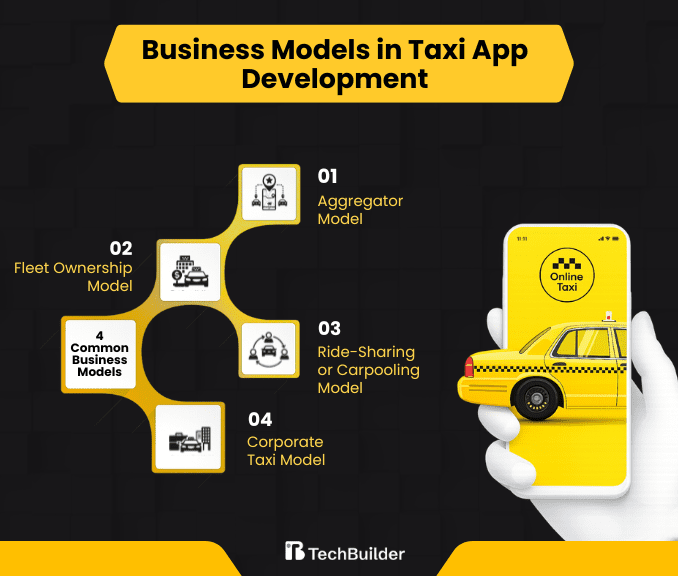
Selecting the right business model plays a vital role in determining the success and scalability of a taxi booking platform. Various business models enable firms to focus on a specific customer base in an efficient way of running operations and generating revenues.
Common business models used in Taxi App Development include:
-
Aggregator Model
This model is one that links passengers with independent drivers via a digital platform which is centralized. Businesses are the facilitators of the services without the vehicles and they are able to expand faster and have low costs of operation.
-
Fleet Ownership Model
Under this strategy, organizations directly own and operate vehicles and drivers. It gives a greater means of control over the quality of services, price and brand uniformity and guarantees standardized customer experiences.
-
Ride-Sharing or Carpooling Model
Multiple passengers traveling along similar routes share a single ride. This model will minimize the costs involved in travelling by users and increase the usage of vehicles and promote environmentally-friendly transportation.
-
Corporate Taxi Model
This model is ideal in finding solutions to corporate mobility and is designed to be used by business organizations offering scheduled rides, employee transportation management, and centralized billing systems.
The selection of appropriate business models assists businesses to harmonize technology, operation and revenue strategy in order to develop a sustainable and competitive taxi platform.
Essential Features Required for Taxi App Development
Successful Taxi App Development goes beyond simply enabling ride bookings. A modern taxi application must deliver convenience for passengers, efficiency for drivers, and complete operational control for administrators. The combination of features is the right one, which guarantees the ease of ride management, the experience, and scalability of business operations.
To build a competitive taxi booking platform, essential features should be designed across passenger, driver, and admin modules.
-
User Registration & Profile Management
It should allow passengers and drivers to easily create an account through mobile phone numbers, email or through social login procedures. Using profile management enables the user to keep personal information, payment options and ride history so that they have a customized experience.
-
Real-Time Ride Booking
Users must be able to book rides instantly by selecting pickup and drop-off locations. Real-time booking improves convenience and ensures faster ride confirmations.
-
Live GPS Tracking
GPS allows passengers to understand the position of the driver – as well as his or her predicted arrival time. It increases visibility, levels of safety, and minimizes uncertainty in journeys.
-
Fare Estimation & Transparent Pricing
The app should display estimated fares before booking confirmation. Transparent pricing will earn customer confidence and enable users to make well-informed travel choices.
-
Driver Panel & Ride Management
Drivers should have special dashboards to accept or reject ride requests, manage their availability, monitor the earnings, and trace the completed trips effectively.
-
Secure Payment Integration
The variety of payment tools including cards, digital wallets, and online payments provides flexibility to passengers as well as ensures an easy process.
-
Push Notifications & Ride Alerts
Users are also notified of booking confirmations, driver arrival and status of the trip and payment receipts in real time – by automated notification.
-
Ratings & Review System
The passengers and drivers can give feedback following every ride. This is a feature – that assists in keeping the quality of services and creates credibility of the platform.
-
Admin Dashboard
The admin panel enables organizations to manage drivers, users, bookings, pricing policies, and statistics from a centralized system, providing greater operational control.
-
Trip History & Analytics
Access to ride history and performance data allows individuals – to trace previous travels, while businesses may study demand trends and enhance services.
Step-by-Step Process to Build a Taxi Booking App
A successful taxi platform cannot be built only by an application but has to be strategized, understand the market, choose the technology to be used, and improve upon it constantly. The systematic development strategy will see to it that the application is up to the expectations of the users, it works effectively and is able to scale with ease in competitive markets such as Australia.
The process to be taken to develop a reliable and revenue generating taxi booking application on the basis of professional Taxi App Development is listed below in terms of the steps that are followed.
-
Market Research & Business Planning
The first step involves analyzing market demand, competitor platforms, target audience behavior, and regional transportation trends. Clear business goals, revenue strategies, and service areas are defined during this phase to create a strong foundation for development.
-
Selecting the Right Business Model
Businesses have to determine the model to use; an aggregator, a fleet-based model and a ride-sharing model. The move affects the functionality of apps, the work process, pricing policies, and the sustainability in the long term.
-
UI/UX Design Planning
The interface should be designed in a way that would allow easy user interaction. App layouts and wireframes have been done in such a way that navigation is easy among passengers, drivers and administrators.
-
Technology Stack Selection
The selection of appropriate technologies to be used in the frontend, backend, databases, and APIs would guarantee performance, scale, and security. The appropriate tech stack facilitates real time tracking, payments, and heavy traffic of users.
-
App Development Phase
Developers build passenger apps, driver applications, and admin dashboards simultaneously. This stage stages core capabilities – that are booking systems, GPS tracking, notifications, and payment integration.
-
Integration of Third-Party Services
Essential integrations such as maps, payment gateways, SMS services, and analytics tools are added to enhance functionality and improve operational efficiency.
-
Testing & Quality Assurance
The application is also thoroughly tested and the bugs, performance problems and other vulnerabilities are detected. This measure will guarantee smooth cross-platform performance.
-
Deployment & App Launch
After testing, the taxi app was released to Android and iOS platforms. Drivers and passengers can be smoothly boarded through proper deployment.
-
Post-Launch Support & Updates
The constant monitoring, additional features, and optimization of the performance allow ensuring the stability of the apps and adjust to the changing user needs and market trends.
Such a systematic development process assists businesses in the honest implementation of scaled car booking platforms without many risks and warranting success in the long-term perspective.
Looking to Build a Taxi App Within Your Budget?
TechBuilder helps startups and transport companies launch feature-rich taxi booking platforms faster, smarter, and within budget.
Cost of Taxi App Development in Australia
The cost of Taxi App Development in Australia varies depending on app complexity, feature requirements, scalability goals, and platform size. Businesses typically invest based on whether they are launching a basic MVP, a scalable mid-level solution, or a full enterprise-grade multi-city taxi platform.
Collaboration with an established development firm such as TechBuilder will enable companies to save a lot of costs in the development process and yet achieve high-levels of performance, scalability and quality.
| Development Type | Market Cost (Australia) | Cost at TechBuilder |
| Basic MVP Taxi App | AUD 60,000 – AUD 90,000 ($40,000 – $60,000) | AUD 42,000 – AUD 63,000 |
| Mid-Range Taxi Platform | AUD 120,000 – AUD 280,000 ($80,000 – $180,000) | AUD 84,000 – AUD 196,000 |
| Enterprise Multi-City Platform | AUD 300,000 – AUD 600,000+ ($200,000 – $400,000+) | AUD 210,000 – AUD 420,000+ |
Key Challenges in Taxi App Development and How to Overcome Them
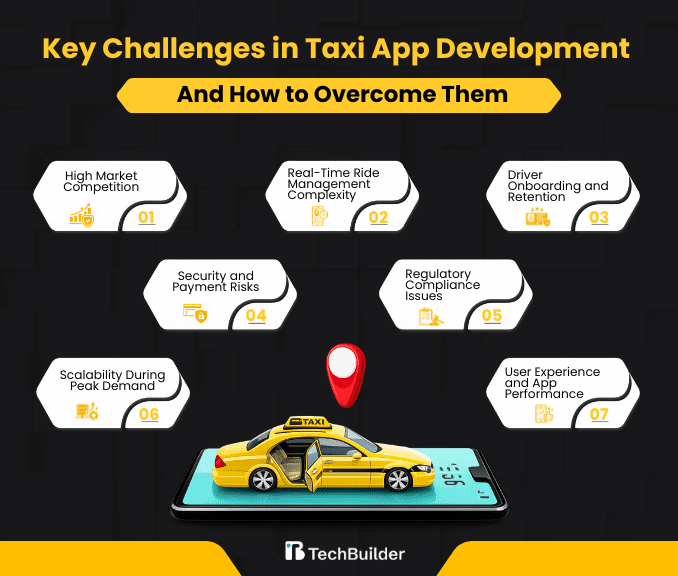
Although Taxi App Development has good business prospects, the construction and operation of a successful taxi platform are associated with technical, operational and market related setbacks. The businesses are required to consider these challenges early enough in order to achieve smooth performance, good user adoption and scalability in the long term.
The awareness of possible pitfalls and the application of appropriate strategies will assist companies to introduce stable and competitive taxi booking solutions.
-
High Market Competition
The ride-hailing sector is a very competitive one, and already existing platforms are present in big cities. The new businesses might have problems with gaining users initially.
Solution: Pay attention to the niche markets, competitive prices, high-quality user experience, and local services to make your taxi platform different.
-
Real-Time Ride Management Complexity
Backend systems are necessary to organize live ride requests, driver allocation and route optimization. Delays and cancellations may be caused by poor management.
Solution: Deploy smart dispatching software and scalable cloud computing in order to make the ride matching and real time performance.
-
Driver Onboarding and Retention
Above all, a reliable driver network is not always active and can become quite difficult to maintain, particularly at the time of high demand.
Solution: Provide a driver-focused incentive like flexible working hours, clear earnings monitoring, and incentive plans to enhance retention.
-
Security and Payment Risks
Taxi applications are sensitive – to users and financial data and are therefore susceptible to fraud and security threats.
Solution: To ensure the safety of users and the business operations – include the secure payment gateways, encryption protocols, and authentication systems.
-
Regulatory Compliance Issues
Regulations and licensing conditions on transportation differ among locations in Australia – which present a compliance problem.
Solution: Engage with mature development partners with – knowledge of the local regulations and develop compliance-complete platforms.
-
Scalability During Peak Demand
During events or holidays or even rush hour, taxi platforms usually have a lot of traffic and this may affect performance.
Solution: Take scalable cloud based architecture that can support high user load without dropping down.
-
User Experience and App Performance
Poor user retention is caused – by slow loading time or complicated interface.
Solution: Focus on the intuitiveness of the UI/UX, frequent performance improvements, and constant updates to the apps.
Through preemptive solutions to these obstacles – companies can have a hassle-free operation, enhanced customer contentment, and sustainable development of the competitive taxi business.
Monetization Strategies for Taxi Booking Apps
An efficient taxi application can be described as a successful one that is characterized not only by efficient operations but also as one that can generate a stable revenue. Modern Taxi App Development is concerned with the execution of various monetization strategies that generate sustainable sources of income without disrupting the positive user experience of a passenger or a driver.
-
Commission on Each Ride
The platform charges a fixed percentage or service fee from every completed ride. This is the most widespread monetization model and guarantees repeat income – as the number of bookings grows.
-
Surge Pricing Model
During high demand, bad weather or high hourly fares are charged. This not only boosts business income, but more drivers would be willing to work during peak hours.
-
Driver Subscription Plans
Drivers pay weekly or monthly subscription fees to access the platform instead of paying ride commissions. This gives the business a stable income.
-
In-App Advertisements
The app will allow businesses to display targeted ads by local brands, restaurants, or service providers, which will bring them another source of passive income.
-
Cancellation & Convenience Fees
The fees charged due to ride cancellations or priority booking assist in covering the cost of the operations and decreasing the unjustified disruption of the booking.
-
Corporate Partnerships
By providing transportation services to companies and enterprises, companies can make money – by making money on bulk seat reservation and contracting.
Implementing a combination of these strategies helps taxi platforms maintain profitability – while scaling operations efficiently.
Future Trends Shaping Taxi App Development
The transportation industry is in the process of change due to emerging technologies and changing expectations of the consumers. The development of Taxi Apps of the future is an innovation that strives to enhance efficiency, safety, and convenience to the user.
-
AI-Powered Ride Matching
Artificial Intelligence enhances the matching of the driver and passengers, the optimization of routes, and demand forecasting, lessening waiting time and operation expenses.
-
Electric and Sustainable Mobility Integration
Growing environmental awareness is encouraging taxi platforms to integrate electric vehicle fleets and eco-friendly ride options.
-
Autonomous Vehicle Readiness
Taxi apps are gradually preparing for self-driving vehicle integration, which may redefine transportation services in the coming years.
-
Advanced Safety Features
The introduction of such functions as – emergency alerts, live ride sharing, and AI-based driver control contribute to passengers having more safety and trust.
-
Multi-Service Super Apps
Taxi apps are no longer limited to ride-hailing since they are now combining deliveries, car rentals, and mobility subscriptions into one app.
-
Blockchain-Based Payments & Security
The concept of blockchain technology is being investigated to enhance transparency of transactions, deter fraud, and increase the level of security of payments.
By incorporating the trends into the future at an early stage, businesses will be able to create innovative taxi platforms that will still be competitive and flexible in the changing mobility ecosystem.
Choosing the Right Taxi App Development Company
One of the crucial choices during the taxis app development investment is the partner of technology chosen. An effective development company is more than just a construction of the application; it assists in the development of business strategy, scaling, and the success of the long-term platform. The partner is the right individual who will make your taxi app work in the actual market performance.
An experienced development company knows the issues in the industry, the compliance needs of the region and the changing expectations of the users, which would help companies to introduce competitive and future viable mobility solutions.
-
Industry Experience and Technical Expertise
A company that has demonstrated experience in the area of taxi or on-demand app development is aware of ride management systems, real-time tracking and scalability issues, which minimizes risks in development.
-
Customization Capabilities
Every taxi business operates differently. The development partner ought to provide any type of solution that is unique and specific to your business model, market, and operational objectives.
-
Scalable Technology Architecture
The site must be constructed to accommodate the growth of users, drivers and expansion of the city without failures as the business expands.
-
UI/UX Design Expertise
A user-friendly interface improves customer satisfaction and driver engagement – directly impacting app adoption and retention rates.
-
Post-Launch Support and Maintenance
To ensure that the taxi platform remains competitive long after it has been deployed, continuous upgrades, bug fixes, and performance monitoring are required.
-
Transparent Pricing and Development Process
Transparency in communication, track record of milestones and cost also assists businesses in keeping budgets and also delivering projects on time.
The selection of the appropriate Taxi App Development company will guarantee the easier deployment, less operational risks, and business scalability in the long term.
Partner with a Trusted Taxi App Development Company
From idea validation to post-launch support, TechBuilder delivers end-to-end Taxi App Development solutions tailored for the Australian market.
Conclusion
Australia’s transportation industry is rapidly embracing digital mobility solutions, creating strong opportunities for businesses investing in taxi booking applications. As the necessity to travel conveniently, safely, and technologically continues to grow, taxi applications have come to be a vital aspect of the transportation industry in modern cities.
To have a successful Taxi App Development, proper business model, features and a stable technology partner may be needed. With innovative solutions and user-experience orientation, businesses can create scalable platforms that can satisfy the changes in the market requirements and sustainable growth in the competitive Australian mobility ecosystem.
FAQs
-
- How long does Taxi App Development take?
The development of taxi apps normally requires 3-6 months with – respect to features, complexity of the platform, and individual needs. Advanced enterprise solutions may require additional development time.
- What is the typical cost of – taxi app development in Australia?
The development cost is dependent on the features of the apps and its scalability, and typically can be either MVP-tier apps or an enterprise multi-city platform that is highly integrated.
- What features are essential in a taxi booking app?
Its main characteristics are real-time booking, GPS tracking, payment integration, drivers, fare estimation, and dashboarding to keep the operations running smoothly.
- Can a taxi app support multiple cities and fleets?
Yes, the architecture of the modern taxi platform is also created to be scalable so that the business can launch and operate in many cities, as well as operate with a large network of drivers.
- How do taxi booking apps generate revenue?
The taxi applications typically generate revenue in the form of ride commissions and subscriptions, surge prices, advertisements and corporate sponsorships.
- Why should businesses hire a professional Taxi App Development company?
A professional development company offers safe architecture, scalable performance, regulatory compliance, and long term technical support which assists businesses in launching successful taxi platforms at a faster pace.