










In the UAE, buying a property has become as simple as opening a mobile app. Whether someone is searching for a luxury penthouse in Downtown Dubai, a beachfront villa on Palm Jumeirah, or an investment property in Abu Dhabi, their journey almost always begins online. The modern buyer is looking for a lot more than just property listings—verified information, interactive maps, and instant communication are expected to be all in one place.
This digital first mindset is transforming the real estate industry. Mobile has become the preferred way to discover and compare properties in the UAE with 99% internet penetration and one of the world’s highest smartphone adoption rates. As a result, businesses that rely only on third-party listing platforms risk losing both visibility and customer relationships.
A custom real estate app changes that. It allows businesses to have full control over the customer experience and offers them a chance to establish trust, create quality leads, and make themselves stand out in the crowded business landscape. In this guide, we will guide you on how you can create one that UAE buyers will use.
Why Every UAE Real Estate Business Investing in Custom Mobile Apps?
The UAE’s real estate market has gone mobile and so have its buyers. Today, property searches begin on smartphones, not in real estate offices. In fact, the UAE has an internet penetration rate of over 99%, while 96% of internet users access the web through mobile devices, making mobile apps the preferred way to explore properties. Buyers expect the same speed and convenience from a property app that they experience with other everyday apps; as digital adoption continues to grow; .
This is a huge opportunity for real estate companies. With a real estate development app, you don’t need to depend exclusively on third-party listing websites; you can create your own virtual world and offer buyers a consumer-friendly experience of viewing verified listings, getting customized suggestions, and interacting with your team. It also makes lead management simpler, offers valuable customer insights and enhances brand credibility.
In a competitive market such as the UAE, it is the companies that provide a smooth digital experience that will win the trust of their customers—and will also secure more business.
Key Benefits of a Custom Real Estate App
- Develop direct connections with buyers without depending on third-party platforms.
- Showcase trusted and verified listings in a familiar and branded platform.
- Generate and manage high-quality leads through real-time communication.
- Deliver individual property suggestions according to user choices.
- Gain actionable customer insights to improve marketing and sales strategies.
- Strengthen brand credibility with a secure and seamless mobile experience.
Ready to Transform Your Real Estate Business?
From property listings and broker dashboards to CRM integrations and multilingual experiences, we build scalable real estate apps tailored for the UAE’s fast-growing property market.
Different Types of Real Estate Apps for Modern Businesses
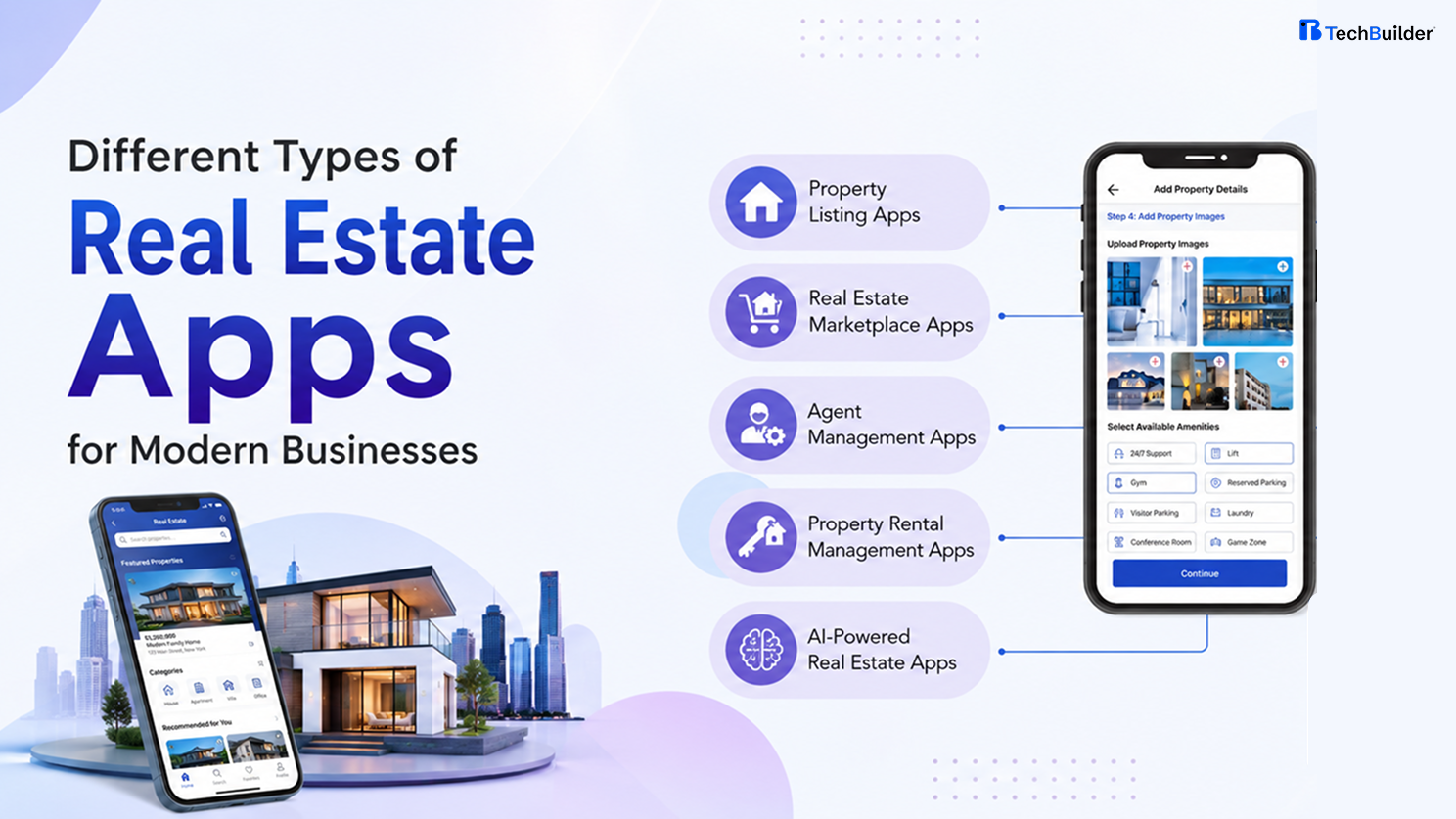
Not every real estate business follows the same business model, which means there isn’t a one-size-fits-all app. You need to choose the right type of application based on your target audience, revenue model, and service you want to provide to the target audience.
Property Listing Apps
Property listing apps are created to assist buyers in finding, filtering, and checking out properties. They typically feature sophisticated search options, interactive property maps, high-resolution photos, and comprehensive property details, making it simpler for buyers to explore various alternatives and make their decisions.
Examples: Bayut, Property Finder
Real Estate Marketplace Apps
Marketplace applications merge the buyers, sellers, real estate agencies, and builders together on a single platform. They don’t just list properties from one business but can be multiple businesses publishing and managing their own listings, thus providing a more extensive and varied property inventory.
Examples: Dubizzle Property, Houza
Agent Management Apps
These applications have been created specifically for real estate professionals, with the intent of helping them run their daily operations. They can help agents be more productive, and streamline their workflow by managing client communication, organizing leads, scheduling property visits, and more.
Examples: Zoho CRM for Real Estate, Salesforce Property Management Solutions
Property Rental Management Apps
For landlords and property managers, rental management apps ease the process of managing properties. These allow users to handle lease agreements, rent payments, maintenance requests, communication with tenants and occupancy records all through one central platform.
Examples: Buildium, AppFolio Property Manager
AI-Powered Real Estate Apps
Machine learning algorithms on AI platforms customize the property search experience. By analyzing browsing habits, they can suggest items that users may be interested in, anticipate customer choices, automate customer support, and offer information on user needs that can aid with decision-making for consumers and businesses.
Examples: Zillow, Redfin
Must-Have Features for a Successful Real Estate App
An attractive interface may encourage users to download your app, but meaningful features are what keep them engaged. Property buyers in the UAE today are looking for more than just listings— they are seeking a fast, personalized and seamless experience that makes searching for a property easy. The appropriate functionality can enhance user satisfaction and enterprise growth, from AI-driven suggestions to secure transactions.
The most important features that every real estate application should have are listed below.
Smart Buyer Features That Enhance the Property Search Experience
AI-Powered Property Discovery
The process of searching for the right property shouldn’t be stressful. AI can also examine the user’s past browsing history, saved properties, search preferences, and user preferences to suggest listings that are more likely to align with each buyer’s requirements. This customised strategy helps in engaging users and enables them to find relevant properties quickly.
Smart Search with Advanced Filters
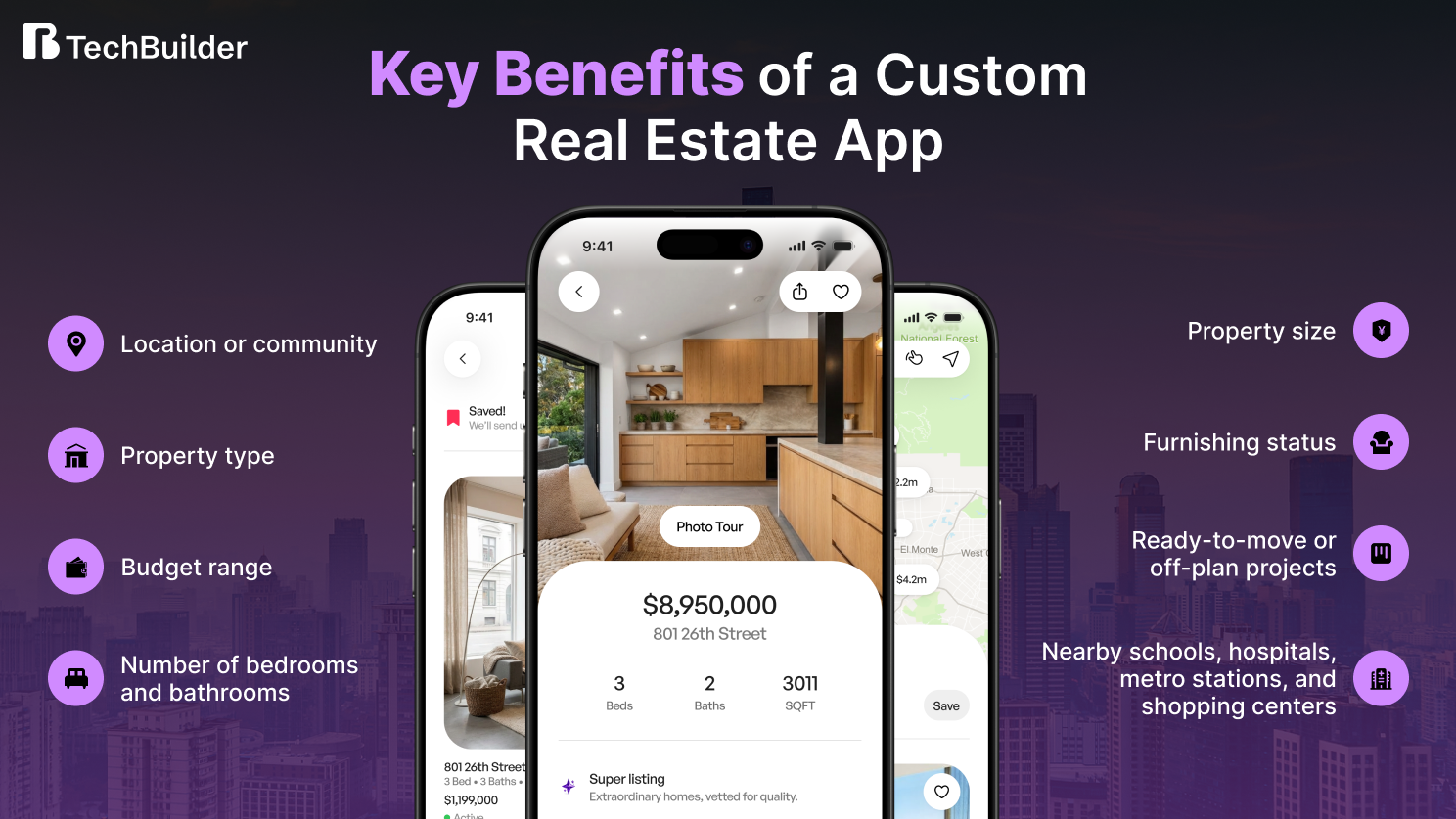
Whether you’re a real estate professional or a potential client, the backbone of any real estate app is a powerful search engine. Users should not have to sift through hundreds of listings, they should be able to filter it down by using intelligent filters such as:
- Location or community
- Property type
- Budget range
- Number of bedrooms and bathrooms
- Property size
- Furnishing status
- Ready-to-move or off-plan projects
- Nearby schools, hospitals, metro stations, and shopping centers
The more precise the search results, the easier it becomes for buyers to find their ideal property.
Interactive Maps and Neighborhood Insights
There are several factors to consider when purchasing a home. Purchasing options include also taking into account the surrounding neighborhood.
Information about local schools, hospitals, restaurants, shopping centers, parks, public transit, traffic, and lifestyle amenities can be shown on an interactive map. These features are useful to users when they want to know how to compare locations without having to switch to other apps.
AR-Powered Virtual Property Tours
Augmented Reality (AR) and 360-degree virtual tours allow buyers to explore properties remotely from anywhere in the world. Users can virtually walk through rooms, inspect layouts, and better visualize the property before scheduling a physical visit. This feature is especially valuable for international investors interested in the UAE market.
Rich Property Listings
Each property listing should provide complete and reliable information to help buyers make informed decisions.
Add the following information:
- High-quality images
- Video walkthroughs
- 360-degree virtual tours
- Floor plans
- Property specifications
- Amenities and facilities
- Nearby attractions
- Payment plans
- Developer information
- Verified property badges
Detailed listings build trust while reducing unnecessary inquiries.
Save, Compare, and Share Properties
Property buying is rarely an instant decision. Users will typically research and evaluate several alternatives to choose from.
Allow buyers to:
- Save favorite properties
- Compare listings side by side
- Create personalized wishlists
- Share listings with family members or advisors
These features encourage repeat visits and simplify the decision-making process.
Instant Communication and Appointment Booking
Modern buyers expect quick responses.
Your app should offer multiple communication channels, including:
- In-app messaging
- Click-to-call
- WhatsApp integration
- Video consultation requests
- Property viewing appointment scheduling
Improved customer satisfaction through real-time communication, and more efficient lead conversion for agents.
Mortgage Calculator and Financial Planning Tools
There’s a lot of money involved in buying a property. An integrated mortgage calculator will help potential buyers calculate monthly payments, loan eligibility, interest costs and loan repayment schedules prior to reaching out to an agent. This feature assists users to make better financial decisions.
Personalized Notifications and Property Alerts
Maintain users’ attention through intelligent notifications on:
- Newly listed properties
- Price reductions
- Saved search updates
- Open house events
- Appointment reminders
- Exclusive investment opportunities
Timely alerts encourage users to return to the app regularly.
Multilingual Support
Multilingual functionality is key for the UAE’s multicultural population. Bilingualism, that is English and Arabic, makes for better accessibility and fosters trust among local buyers and international investors. There are more languages available to extend your platform’s reach.
Productivity Features for Real Estate Agents
Agents need more than just a platform to list their properties; they need tools that enable them to manage leads, respond promptly, and close deals effectively.
Essential agent features include:
- Property listing creation and editing
- Lead and inquiry management
- Calendar and appointment scheduling
- Customer Relationship Management (CRM) integration
- Secure document sharing
- Digital contract management
- Performance dashboards
- Push notifications for new inquiries
- AI-powered lead prioritization
- Sales and commission tracking
These capabilities enable agents to provide faster, more personalized service while improving overall productivity.
Business Management Features for Admins
A strong admin panel helps ensure a smooth platform operation and delivers security, data quality, and adherence to regulations.
Key admin features include:
- Centralized admin dashboard
- User and agent management
- Property verification and listing moderation
- KYC and identity verification
- Subscription and payment management
- Commission management
- Content Management System (CMS)
- Marketing campaign management
- Business analytics and reporting
- Review and feedback moderation
- Role-based access control
- Security monitoring and fraud detection
- Compliance management for UAE regulations
A well-designed admin panel will allow companies to control the actions of their platform easily, as well as provide a safe and secure customer experience for buyers, sellers and agents.
Stand Out in the UAE’s Competitive Real Estate Market
Build a feature-rich real estate app with bilingual support, smart property recommendations, interactive maps, and modern tools that simplify buying, selling, and renting.
Advanced Features That Transform Real Estate Mobile Applications
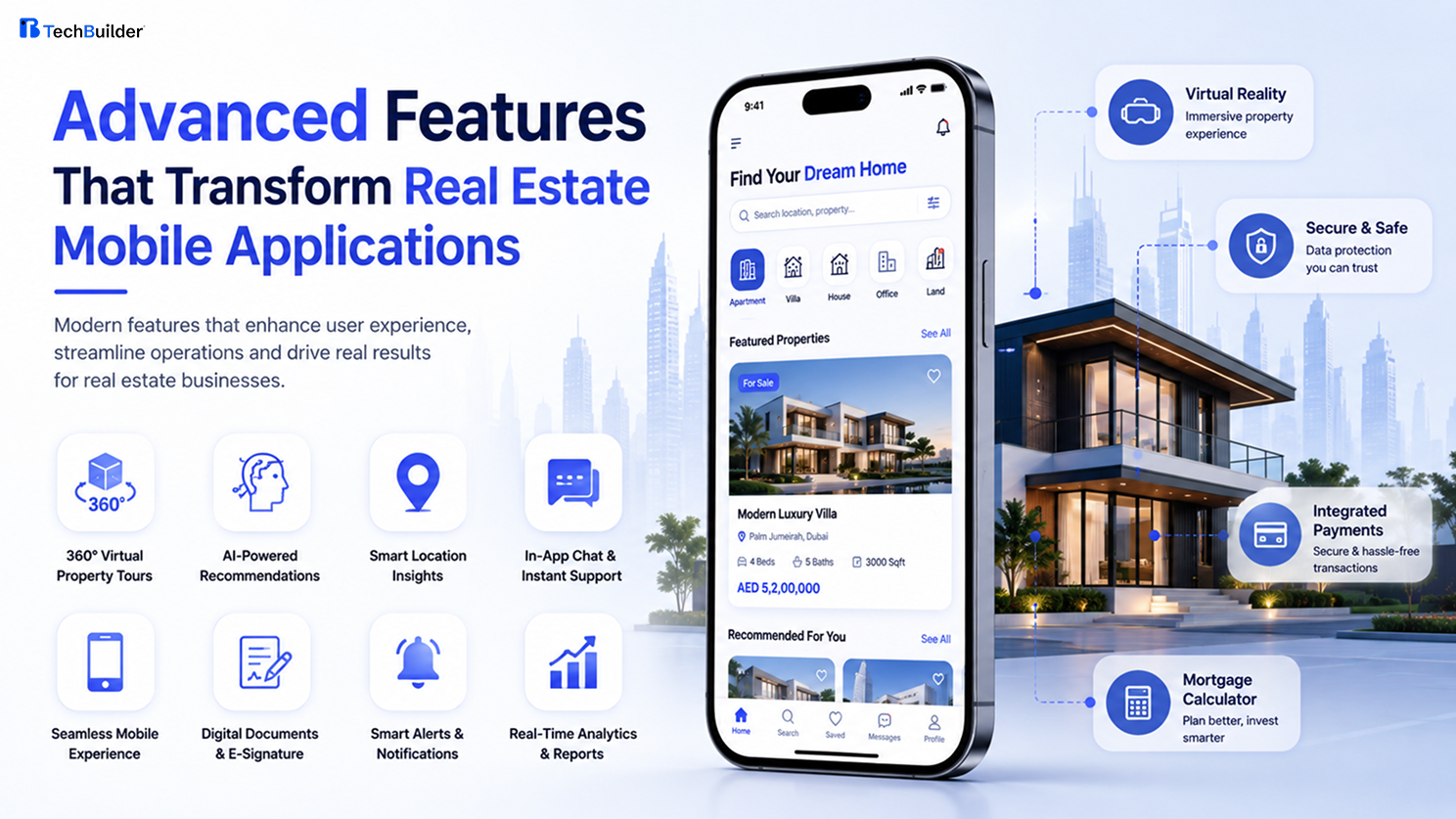
The expectations of modern property buyers have evolved significantly. They don’t want to peruse through endless listings—they will want smart suggestions, immersive property experiences, and complete certainty in information they see.
This is why technologies such as Artificial Intelligence (AI), Augmented Reality (AR), and compliance-driven options have become integral to creating next-generation real estate apps.
Artificial Intelligence (AI)
AI can revolutionize the process of buying a home. AI can suggest properties that align with user needs based on their browsing habits, search history, budget, and browsing patterns.
In addition to personalisation, AI also enhances operational efficiency with smart chatbots, automated lead qualification, predictive property pricing and customer behaviour analysis. This enables businesses to interact with users better and lessen the workload.
Key AI Features
- Personalized property recommendations
- Smart search suggestions
- AI-powered chatbots
- Property price prediction
- Customer behavior analytics
Augmented Reality (AR)
Often, pictures and videos are just a part of a property’s story. You can view a property in AR before you even go in the door to give buyers a more immersive virtual experience of the property, including 3D visualizations, virtual walkthroughs, and more.
This is particularly useful for overseas investors and busy buyers who wish to shortlist properties without having to come over, thus saving precious time and money.
Popular AR Features
- Virtual property tours
- Interactive 3D floor plans
- Interior visualization
- Furniture placement previews
- Remote property exploration
Compliance and Security Features
When dealing with real estate, there’s a lot of personal and financial information involved, which is why security and transparency are very essential. It is essential that a real estate app has security measures in place to ensure that its user information is safe and secure, and that all listings and agent profiles are accurate.
Companies based in UAE also need to make sure that their sites meet the local laws and industry standards, where applicable. Percy’s extensive security protocols not only mitigate risk but also foster trust and reliability with long-term customers.
Essential Compliance Features
- Verified property listings
- Verified agent profiles
- Secure user authentication
- Encrypted data storage
- Secure payment integration
- Privacy-focused data management
Combining AI, AR, and compliance features creates a smarter, safer, and more engaging property-buying experience that modern UAE users expect.
Top 6 Real Estate Apps Leading the UAE Property Market
Studying successful real estate apps is one of the best ways to understand what today’s buyers expect. While each platform has its own strengths, they all focus on delivering a seamless user experience, accurate property information, and reliable customer support.
- TB Estate
TB Estate is a modern real estate platform developed by TechBuilder that helps businesses launch feature-rich property marketplaces. With advanced property search, interactive maps, verified listings, agent management, virtual tours, and secure inquiry features, it delivers a seamless experience for buyers, sellers, renters, and real estate agencies while supporting scalable business growth.
- Bayut
Bayut is one of the UAE’s most popular property platforms, boasting a vast array of homes and properties available in its listings. It offers comprehensive neighbourhood guides, user-friendly search criteria and verified info about the properties and is a favourite among buyers, renters and investors alike.
- Property Finder
Combining verified listings, market insights, mortgage tools, and user-friendly interface, Property Finder has established a reputation for excellence. The sophisticated filtering capabilities enable users to refine their search for properties by location, budget, amenities and lifestyle preferences.
- Dubizzle Property
Dubizzle Property is one of the UAE’s biggest property marketplaces that links buyers, renters, sellers and real estate agencies together, all on a single platform. Its wide range of offers and user-friendliness has led it to be a sought-after place by property hunters all over the country.
- Houza
Houza is becoming popular because of its verified listings and property information transparency. A good example of how trust and data quality enhance the customer journey is the platform’s partnership with trusted real estate agencies to provide accurate listings.
- Dubai REST
Dubai REST is an official application of Dubai Land Department (DLD) that enables the real estate property owners, tenants, brokers and investors to avail various government supported real estate services. The app demonstrates the possibilities of technology to streamline and secure real estate transactions in Dubai, from verifying property details to handling transactions digitally.
The End-to-End Real Estate App Development Process
Creating a successful real estate app is not all about coding. It demands careful planning, design thinking, the proper technology stack and ongoing enhancements post-launch.
Here is a sample development path.
Step 1: Define Your Business Goals
All Apps start with a clear goal. Determine what you’re going to be doing on your platform; are you going to be listing properties, rental properties, luxury real estate, property management, or a full marketplace?
As you get a clearer vision of your business model early, it will make it easier to focus on features, cost estimates, and a roadmap that lines up with your long-term vision.
Step 2: Research Your Target Audience
Understanding your users is just as important as understanding your competitors.
Understand how customers are finding properties, the features they most value and the problems they encounter when purchasing. These insights can be used to develop an app that addresses actual user issues, instead of just listing.
Step 3: Design an Intuitive UI/UX
Real estate buyers interact with dozens of listings before making a decision. A confusing interface can quickly drive them away.
Prioritize developing a clean and visually appealing design which enables users to find, compare and ask questions about properties with ease.
Step 4: Develop Core Features
Once the designs are finalized, development begins.
This phase involves implementing key features like user sign-ups, property listings, search filters, maps, agent profiles, saved properties, chat features, and admin dashboards.
All features need to be optimized for quickness, scalability and long-term performance.
Step 5: Integrate Advanced Technologies
Once the basic application is up and running, you can then look at incorporating advanced features like AI recommendations, virtual tours, analytics dashboards, payment gateways, and CRM integrations.
All of these features enable businesses to create a more intelligent and personalized customer experience.
Step 6: Test Every Function Thoroughly
Before launch, every component should be tested across multiple devices and operating systems.
Testing should cover:
- Performance
- Security
- Navigation
- Search accuracy
- User experience
- API integrations
A smooth, bug-free experience significantly improves user retention.
Step 7: Launch and Monitor Performance
Once testing is complete,the app is published to the App Store and Google Play.
But that’s not the end of the race. The companies must always keep track of user feedback, analytics, problem solving and adding new features in accordance with the evolving user expectations.
The key to keeping users engaged in your real estate app is to constantly improve it.
Modern Technology Stack Behind Successful Real Estate Apps
The technology that you opt for will affect the performance, scalability, security, and future maintenance of your app. The right technology implementation guarantees your platform is able to manage the increasing number of property listings, larger numbers of site visitors, and feature additions without impacting speed or user experience.
Here is a modern tech stack that is typically applied in scalable real estate applications, depending on the project requirements, the technologies may vary.
| Layer | Recommended Technologies |
| Frontend | Flutter, React Native |
| Backend | Node.js, Laravel, Python (Django) |
| Database | PostgreSQL, MongoDB |
| Cloud & Hosting | AWS, Google Cloud Platform, Microsoft Azure |
| Maps & Location Services | Google Maps API, Mapbox |
| Authentication | Firebase Authentication, OAuth 2.0 |
| Notifications | Firebase Cloud Messaging (FCM), OneSignal |
| Payments | Stripe, PayTabs, Checkout.com |
| Analytics | Google Analytics, Firebase Analytics |
Selecting the right tech stack isn’t only about a quick app, it’s about a solution that’s capable of scaling with your business. With an experienced development partner, all of the technology will be chosen with your business goals in mind, not for convenience.
How Much Does It Cost to Develop a Real Estate App?
One of the first questions businesses ask is, “How much does it cost to build a custom real estate app?” There is no simple answer because it depends on a number of factors such as application complexity and design needs, 3rd party integration and technologies used.
The simpler and more basic a system is, with the inherent functions, the less will it cost, especially if compared to an enterprise-class solution equipped with AI, virtual tours and advanced analytics. Businesses should think outside the box when it comes to just the investment of a custom app, and take into account the intrinsic value it can provide for long-term value to the company through better customer engagement, streamlined procedures and increased lead conversions.
Here’s a general cost estimate for the UAE market:
| App Type | Estimated Cost (AED) |
| Basic App | AED 30,000 – AED 60,000 |
| Mid-Level App | AED 60,000 – AED 120,000 |
| Advanced AI-Powered App | AED 120,000 – AED 250,000+ |
The final development cost varies depending on project scope, feature requirements, technology choices, and customization levels.
Key Factors Affecting Real Estate App Development Costs
No two real estate apps are built the same. The final budget depends on your business objectives, technical requirements, and the overall complexity of the platform.
Here are the key factors that influence development costs.
Feature Complexity
The number and sophistication of features have the biggest impact on development costs. AI recommendations, virtual property tours or predictive analytics aren’t cheap, compared to basic search functionality.
UI/UX Design
To create an intuitive and visually appealing UI, there needs to be detailed user research, wireframing, prototyping and testing. There’s a strong connection between investment in user experience and increased engagement and customer retention.
Platform Selection
Designing for Android, the iOS and the web takes longer and more resources when compared to designing just for one platform. Trying to optimize both time and monetary investments could be accomplished by implementing cross-platform frameworks such as Flutter for the app.
Third-Party Integrations
Features such as payment gateways, Google Maps, CRM software, property databases, chat services, and analytics tools require additional integrations that influence the overall project budget.
Development Team Expertise
The benefit of experienced devs is that they can rent at higher rates but also provide you with better code, better security measures and a scalable structure which ultimately minimizes the maintenance costs in the longer term.
Maintenance and Future Updates
Once your app is live, there will be many considerations regarding the organic growth of your business. It is crucial to consistently create updates, security patches, bug fixes, and add new features to remain competitive and up-to-date with customer expectations.
How to Optimize Real Estate App Development Costs
It is not always the case that the most expensive budget is the most effective for building a high quality App. In the right development approach, companies can save on costs without compromising on customer experience.
Start with an MVP
Do not develop all the features simultaneously, start with a Minimum Viable Product (MVP), real madness comes out after posting this chapter.Do not develop everything at once, start with a Minimum Viable Product (MVP). After receiving the user feedback, more functions can be added in a later release.
Prioritize High-Impact Features
Figure out what is most valuable to your users and business. It saves money to provide basic functions up-front to get to the market quickly.
Choose Cross-Platform Development
There are such frameworks as Flutter and React Native that enable developers to develop Android and iOS apps one after another with the same code base. This greatly minimizes the development time and the cost of the project.
Build for Scalability
From the outset, planning for growth can save considerable amounts of money for future changes in the buildings. It is easier to scale back to add more features in the future as your business grows.
Partner with an Experienced Development Company
An experienced app development firm can assist you steer clear of mistakes that can be expensive and keep you from reaching your goals, offer you the appropriate tech stack, and give you a product that satisfies the business requirements now and into the future.
Real Estate App Development Costs with Real-World Examples
Businesses can be better equipped to plan their budgets when they understand the ranges of investments. Although every project is different, most real estate applications fall into one of these categories.
Startup Property App
These apps usually contain the essential elements of a real estate listing website, such as property listings, search filters, user sign up, and inquiry forms, and are specifically made for startups and small-size agencies.
Estimated Cost: AED 40,000–80,000
Marketplace Platform
Marketplace applications enable a number of agencies/brokers/property owners to list properties on a single application. Typically they provide dashboard, messaging, admin controls, and payment integrations.
Estimated Cost: AED 100,000–200,000
Enterprise Real Estate Platform
Examples of enterprise grade applications are AI recommendations, virtual property tours, CRM integration, analytics dashboards, multilingual property support, and very-tailored workflows.
Estimated Cost: AED 250,000+
The price of building a custom real estate app can differ depending on the company, but it must be considered a long-term investment, instead of a one-time bill. A good platform will help build leads, boost customer relationships, and benefit years of your business.
Best Monetization Strategies for Real Estate Apps
Building a successful real estate application is just a single beginning. You can either pick an ad strategy or a subscription-based approach—both work, depending on how many users you’ll generate and how in-depth your platform will be.You can go for ads or a subscription model, both options will work depending on your expected number of users and depth of your platform.
Featured Property Listings
Property agents and developers may pay to display listings at the top of the page to boost the visibility of their property and gain more enquiries.
Subscription Plans
Offer advanced tools, extra listings, more powerful analytics, or higher percentages of marketing tools for professional real estate agents, owners, and investors at month-to-month or annual fees.
Commission on Transactions
If your platform supports home sales, rentals or bookings, you can make a small profit on every sale you do if you charge a commission fee whenever it is successful or not.
Advertising and Sponsored Listings
Various companies, including developers, mortgage players, designers and home service companies, can promote their services using sponsored banners or offers to list their offers.
Premium User Features
Provide paid features such as market reports, investment insights, advanced property alerts, or AI-powered property recommendations for users seeking a more personalized experience.
A diversified revenue strategy not only increases profitability but also reduces dependence on a single income source.
How to Find the Best Real Estate App Development Partner
Choosing the best real estate app developer partner is the most important part.Partnering with the best real estate app development partner is vital..
Here are a few factors to consider before making your decision.
Industry Experience
Just research a real estate building, market place or property management application business with experience in construction. Knowledge of industry can result in more efficient feature suggestions and implementation.
Strong Design Capabilities
What matters above all is functionality, and that’s something that starts with an attractive interface. Take some time to consider the company’s past projects and analyze if they have been designed keeping the user in mind and how they have incorporated mobile development.
Technical Expertise
Make sure the development team has mastered today’s cutting-edge technologies, scalable architectures, cloud infrastructures and API integrations needed for long-term growth.
Transparent Communication
When selecting a partner, ensure that they communicate effectively throughout the project development, are regularly updating you on progress and have a clear development process.
Post-Launch Support
After the launch, you will need to work on your application, optimize it for performance and improve upon features. A good development company should provide long-term technical support for your platform to address future market needs.
Conclusion
Buyers now use mobile technology to find, compare and invest in real estate in the UAE, and the real estate industry is undergoing rapid transformation.No company can afford to be solely dependent on third party platforms if an opportunity knocks to build a better customer connection and to establish a company’s digital identity.
By getting a real estate developer application customized, you can find out how to create a branded experience, give customized home recommendations, offer simpler lead management and construct a long-lasting, positive trust with your target market. Any intuitive design, cutting-edge technology like AI and AR, plus business agility and scalability via an adaptive development underpin a platform that meets buyers’ expectations and forecasts market trends for tomorrow.
For startups aiming at enhancing their online visibility or for real estate agencies in the growth phase or any property developers with a competitive real estate presence, a custom mobile application isn’t merely a ‘digital upgrade’ anymore; it is a strategy for longevity. Together with an experienced development partner such as TechBuilder, you’ll be able to witness your vision realized, leading to the development of a secure, scalable, and comprehensive offering that will be compelling in the highly competitive real estate sector in the UAE.
Frequently Asked Questions (FAQs)
- How long does it take to build a custom real estate app?
The time for development is usually 3-6 months, depending on the complexity of an application, the characteristics of it, integrations with third parties, and customization needs. More sophisticated platforms, those that incorporate Artificial Intelligence, Augmented Reality and enterprise-level features may require more time.
- How much does it cost to develop a real estate app in the UAE?
Generally, the starting price of the software is AED 30,000 plus additional fees. The mandatory price may reach AED 250,000 for more features software that incorporates AI recommendations, virtual house tours, CRM integration, as well as advanced analytics.
- Which features are essential for a successful real estate app?
Advanced property search, filters, property maps, verified property listings, AI-powered recommendations, multilingual property search capabilities, virtual property tours, secure payments processing, in-app messaging and user authentication are key capabilities.
- Why should businesses choose a custom real estate app instead of a ready-made solution?
Complete control of the app can be achieved via its customization, including branding, features, scalability, security and user experience. It can also be customized in terms of the local market needs and incorporated into the existing systems of businesses.
- Can AI improve the performance of a real estate app?
Yes. AI makes property recommendations better, dictates buyer behavior, creates chatbots, enhances search results, streamlines lead qualification, and provides personalized user experience.
- Why is the UAE an ideal market for real estate app development?
By combining the UAE’s booming real estate market, high smartphone adoption, tech-savvy clientele, and a surge in digital property transactions, the market is poised to be an excellent setting for pioneering real estate applications.
- Which technologies are commonly used to build a real estate app?
Flutter, React Native, Swift, Kotlin, Node.js, Laravel, Python, Firebase, AWS, Google Maps API, AI frameworks such as TensorFlow and OpenAI APIs are popular technologies.
- What role does AR play in real estate mobile applications?
Augmented Reality (AR) allows potential buyers to interact with virtual properties, visualize interior layouts, and explore remote properties remotely, all of which boost understanding and engagement to drive sales.
- Is multilingual support important for UAE real estate apps?
Absolutely. The UAE is a country with a wide range of languages, so it is helpful for the displays in the elevator to be available in other languages as well as English and Arabic.
- How can a real estate app ensure secure user data?
Through the use of end to end encryption, secure authentication, roles based access, biometric login, regular compliance and security audit and adhering to the UAE data protection regulations.
- Can a real estate app integrate with CRM and ERP systems?
Yes. Comprehensive integration with CRM, ERP, MLS, payment gateways, marketing automation and analytics solutions allows up to streamline operations and enhance customer management.
- What makes a real estate app stand out from competitors?
Features such as AI-powered property matching, instant chat, mortgage calculators, virtual tours, neighborhood insights, personalized alerts, and seamless navigation help differentiate an app.
- How important is user experience (UX) in a real estate app?
User experience is critical. A clean interface, quick loading time, easy user navigation and customized product recommendations enhance user engagement, retention and conversion.
- Should a real estate app include payment and booking features?
Yes. Secure online payments, property reservation, appointment scheduling, and booking management simplify the buying and renting process while enhancing customer convenience.
- How can businesses monetize a real estate mobile app?
Common monetization strategies include premium property listings, featured advertisements, subscription plans for agents, lead generation services, commission-based transactions, and in-app promotions.
- Why should you partner with an experienced real estate app development company?
An experienced development company understands market trends, regulatory requirements, modern technologies, and user expectations. They can build a scalable, secure, and feature-rich real estate app tailored to the UAE market while ensuring long-term support and future upgrades.