




















The logistics business is quickly evolving to on-demand solutions where technology plays a major role. Companies now demand speedy access to trucks and clear pricing along with real-time updates on their freight – without incessant phone calls and manual handling of freight. This has changed the situation and has resulted in increased use of Uber-like software to book trucks.
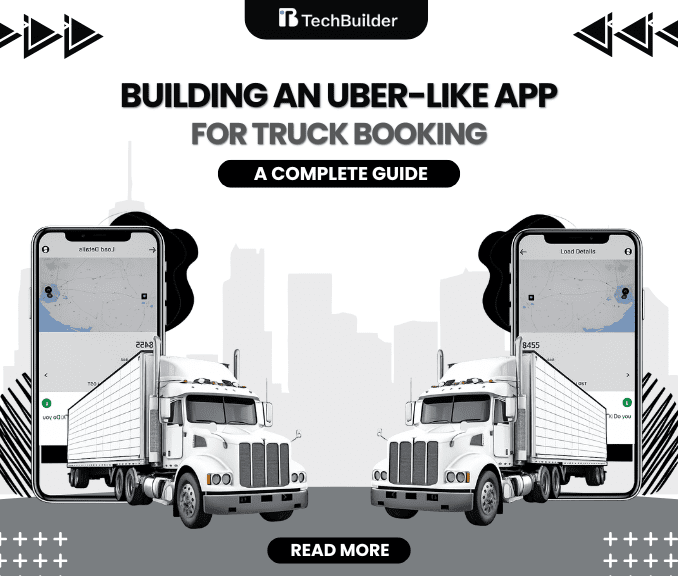
An Uber-Like App will introduce the convenience and efficiency of ride-hailing services to the trucking and logistics sector. Shippers are also able to book trucks, track deliveries and even handle payments with a few taps. This guide will discuss the role of developing an Uber-Like App to book a truck in the simplification of logistics activities and to open up new opportunities in business.
What Is an Uber-Like App for Truck Booking?
An Uber-Like App is a web-based application that helps to connect businesses or individuals in need of transporting goods with the services of the truck drivers that are available on the fly. It operates on an on-demand basis enabling the users to order trucks instantly depending on the location, the type of truck and the delivery needs.
Like ride-hailing applications, this Uber-Like App will allow the use of such functions like live GPS positioning, automatic pricing, in-app messaging, and secure digital payments. It eradicates old-fashioned inefficiency in freight booking by enabling the whole process to be quicker, more open and reliable to the shipper and the truck operator.
Market Demand for Uber-Like Truck Booking Apps
The demand for Uber-like truck booking apps is rising as logistics businesses look for faster, more reliable, and technology-driven freight solutions. Traditional trucking models often struggle with limited visibility, manual coordination, and delayed bookings. On-demand truck booking platforms are solving these challenges by connecting shippers and carriers through a single digital ecosystem.
The success of this model has been already demonstrated by the industry leaders. Uber Freight, which was introduced in May 2017, is effective in closing the gap between shippers and carriers in the mobile-first manner. The platform currently processes over 18 million transactions within a year and it functions as one of the biggest carrier networks in the logistics industry.
- Competing with 302 freight applications in the global market, Uber Freight has its market share at 0.25 percent of the total market in the market of global fleet management and logistics.
- North America contributes to 42.4 percent of the market revenue due to high eCommerce uptakes, lack of trucking capacity, development of AI-based solutions of logistic needs, good logistics infrastructure, and active cross-border trading with Canada and Mexico.
- Major third-party logistics providers offering truck booking platforms beyond Uber Freight include C.H. Robinson, XPO Logistics, DSV, JB Hunt Transport, and DHL.
- Strait Research estimates the logistics software market will reach an annual growth of 9.36 percent in the period between 2026 and 2033 to have a market value of 39.66 billion.
This expanding market is a clear example of why investing in an Uber-Like App that allows to book trucks is becoming an effective strategic decision of logistics startups and already established businesses.
How an Uber-Like App for Truck Booking Works
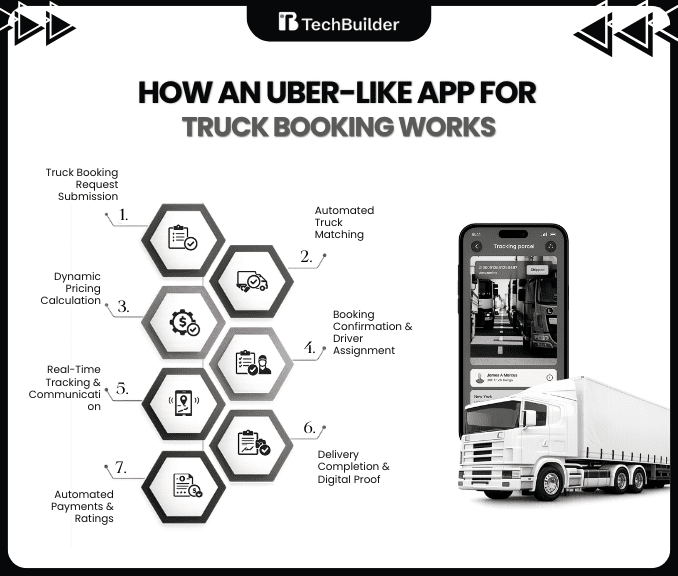
An Uber-Like App for truck booking digitizes the traditional freight booking process by replacing phone calls, paperwork, and manual coordination with an automated, real-time platform. The app acts as a smart marketplace where shippers can instantly find available trucks, and drivers can receive consistent freight opportunities. By using GPS, automation, and data-driven pricing, the platform improves delivery speed, transparency, and operational efficiency for all parties involved.
- Truck Booking Request Submission
The shipper enters pickup and drop locations, cargo weight, truck type, delivery schedule, and any special handling instructions.
- Automated Truck Matching
The Uber-Like App evaluates the location of the drivers, capacity of the truck, availability, and efficiency of their route – in order to match the best driver. This reduces the miles that are empty and enhances fleet utilization.
- Dynamic Pricing Calculation
The app calculates pricing in real time based on distance, fuel costs, demand, cargo type, and route conditions. The transparent pricing is displayed in front of the users before the booking is confirmed.
- Booking Confirmation & Driver Assignment
After confirmation it will send instant notification/s and trip details to the assigned driver allowing them to accept the assignment and dispatch as quickly as possible.
- Real-Time Tracking & Communication
Live GPS tracking helps the shippers to track the movement of the truck and the in-app chat or call features enable effective communication during the voyage.
- Delivery Completion & Digital Proof
Drivers confirm delivery status on the app and submit delivery proof, which makes them accountable and increases the settlement speed.
- Automated Payments & Ratings
The platform takes safe digital payments and allows mutual rate, contributing to upholding the quality of service and trust.
Core Features of an Uber-Like App
An efficient Uber-Like App to book a truck should be able to provide reliability, scalability and manageability. The essence of these features is to simplify logistics operations and give a smooth experience to shippers, drivers and administrators.
- Intuitive Booking System
The booking flow is clean and easy to use so that a user can make an order quickly, choose types of trucks and schedule pickups, as well as manage the deliveries without technical complexity.
- Advanced GPS & Route Optimization
Dynamic tracking and smart routes recommendation will assist drivers to save time, save on fuel, and better delivery times.
- Multi-Truck & Load Support
The application is compatible with vehicles of all sizes and types of loads, allowing companies to carry postage packages of various sizes up to heavy freight.
- Secure Payment Gateway Integration
Various online payment systems will guarantee that people can easily make payments without risking data security and financial laws.
- Driver & Fleet Management Tools
Drivers are able to handle the request of the trip, earnings, schedules and availability and fleet owners can have more insight into the operations.
- Powerful Admin Panel
The platform owners can manage platform users, drivers, pricing, commissions, disputes, and real time performance statistics using the admin dashboard.
- Notification & Alert System
There are automated notifications to keep the users aware of booking status, delays, arrival and payment confirmations which minimise uncertainty.
- Ratings, Reviews & Quality Control
A transparent feedback promotes service quality and long-term trust inside the platform.
Development Process of an Uber-Like App
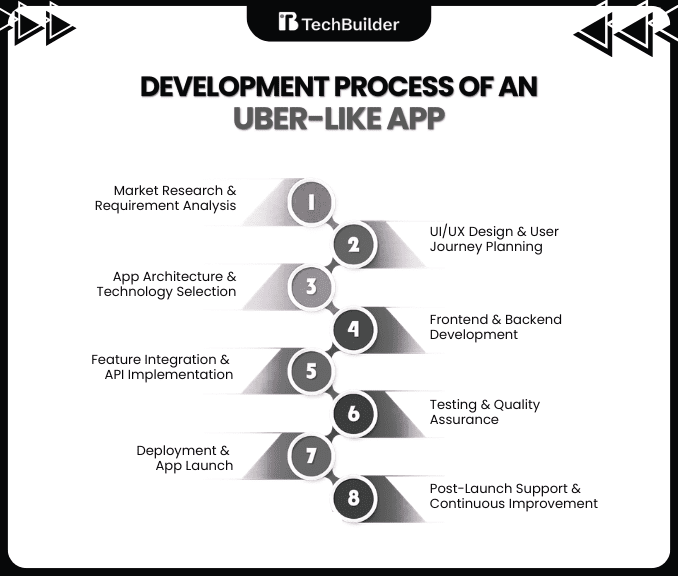
To achieve long-term scalability, performance, and reliability, an Uber-like app for booking trucks must be developed in a systematic manner. Between idea validation and app launch, each stage is critical in providing a smooth on-demand logistic solution that meets the needs of the business and the consumers.
- Market Research & Requirement Analysis
This stage focuses on understanding the target audience, logistics challenges, competitor platforms, and market gaps. Understandable requirements assist in defining feature, user role and monetization plans prior to the commencement of development.
- UI/UX Design & User Journey Planning
Designers create intuitive layouts and user flows for shippers, drivers, and admins. A smooth booking experience reduces friction and improves adoption across all user types.
- App Architecture & Technology Selection
The technical foundation will be built by selecting an appropriate tech stack, APIs, cloud infrastructure, and database solutions to provide real-time tracking and scalability.
- Frontend & Backend Development
Developers build mobile apps for users and drivers, along with a powerful backend system that handles bookings, payments, notifications, and data processing.
- Feature Integration & API Implementation
Most of the common features, including GPS tracking, payment gateways, route optimization, and notifications, are incorporated – to make sure that there is real-time performance.
- Testing & Quality Assurance
The application is thoroughly tested to determine bugs, security threats, and performance problems, and it should be stable on devices and platforms.
- Deployment & App Launch
Once approved, the app is deployed on app stores and cloud servers – making it accessible to users and drivers.
- Post-Launch Support & Continuous Improvement
The Uber-Like App is competitive and scalable because it is constantly updated, has new features added, and is performance monitored.
Cost to Build an Uber-Like App for Truck Booking
The development cost of an Uber-Like App to book trucks would be determined by various factors, such as the complexity of features, the type of platform, and the design of the app, and the integration needs. The companies can begin with a simple version and expand with the increase in demand.
| App Complexity | Estimated Cost | Estimated Timeline | Cost and Time at TechBuilder |
| Basic Uber-like App for Trucks | $20,000-$30,000+ | 2-3 Months | $14,000 – $21,000 1 – 2 Month |
| Mid-Level Uber-like App for Trucks | $30,000-$60,000+ | 3-5 Months | $21,000 – $42,000 2 – 4 Month |
| Advanced Uber-like App for Trucks | $60,000-$120,000+ | 5-8 Months | $42,000 – $84,000 4 – 6 Month |
Monetization Models for an Uber-Like App
An Uber-Like App for truck booking offers multiple revenue streams that allow platform owners to generate consistent income while delivering value to shippers and drivers. The selection of monetization strategy is contingent on your target market, your pricing model and your long term expansion.
- Commission Per Booking
The platform charges a certain percentage on each trip done. This model is naturally scaled to the growth of the booking volume and is common in on-demand logistics platforms.
- Subscription Plans
Owners of fleets or shippers who use their ship regularly may subscribe to monthly or annual benefits, including reduced commissions, preferred booking, or analytics.
- Surge Pricing
During peak demand or limited truck availability, dynamic pricing increases trip rates, allowing the platform to earn higher margins – while balancing supply and demand.
- Featured Listings & Promotions
Drivers or fleet operators can pay to be featured at the top of the search results, which increases visibility and booking chances.
- Service & Convenience Fees
Extra costs for immediate booking, express delivery, or special handling help might provide additional revenue – without affecting the base price.
Challenges & Solutions in Uber-Like App Development
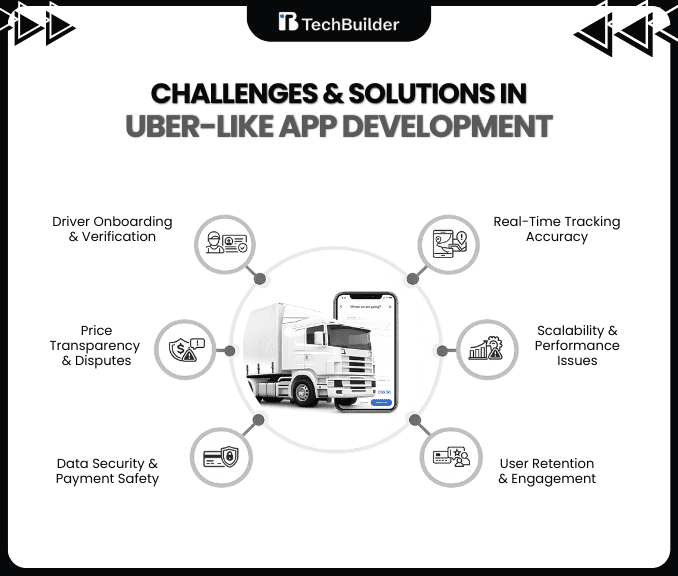
The need to create a Uber-Like App in truck booking is associated with operational and technical peculiarities. Early solutions to such problems will guarantee easier launches, improved user experiences and scalability over time.
Driver Onboarding & Verification
Challenge: The challenge is to ensure driver authenticity and compliance, which can take time.
Solution: Digital KYC, document uploads, and background checks will be – used to speed up the onboarding process without jeopardizing security.
Real-Time Tracking Accuracy
Challenge: GPS inaccuracy may affect visibility of delivery.
Solution: Advanced mapping APIs and constant location synchronization are recommended – to track well.
Price Transparency & Disputes
Challenge: The manual pricing causes – misunderstanding and conflicts.
Solution: Automated fare calculation and transparent cost breakdowns help to create trust.
Scalability & Performance Issues
Challenge: Traffic may reduce the speed of the app.
Solution: Cloud based infrastructure provides – seamless expansion – in the time of need.
Data Security & Payment Safety
Challenge: The challenge is to handle sensitive user and payment information.
Solution: Encrypted transactions, a secure payment gateway, and compliance-focused security measures.
User Retention & Engagement
Challenge: How to retain drivers and shippers on the platform.
Solution: Retention is enhanced by ratings, incentives, loyalty programs, and smooth app performance.
Why Choose TechBuilder for Uber-Like App Development
TechBuilder is a reputable application development firm that has an excellent experience in developing scalable and high-performing Uber-Like App solutions for logistics and trucking companies. TechBuilder’s advanced technologies and industry expertise to create an efficient and effective on-demand truck booking platform, which is designed to grow, be secure, and be successful long term.
- Proven Experience in Uber-Like App Development
TechBuilder has practical knowledge in developing on-demand platforms, which are replicas of the Uber concept, with smooth booking patterns, tracking, and effective fleet management.
- Custom-Built Solutions
Every Uber-Like App is tailored to your specific business needs, whether you’re targeting local truck booking or large-scale logistics operations.
- Scalable and Future-Ready Architecture
Applications are created on top of cloud computing infrastructure and cutting-edge frameworks, and as the user base grows – your platform may expand rapidly.
- Advanced Technology Integration
TechBuilder improves performance by – integrating critical technologies such as GPS monitoring, route optimization, AI-driven analytics, and secure payment gateways.
- Strong Focus on UI/UX Design
The interfaces are easy to adopt by shippers, drivers, and admins to enhance engagement and retention throughout the platform.
- End-to-End Development & Support
TechBuilder offers the whole life cycle of the app, which includes the validation and development of the idea to deployment and maintenance after launching.
Conclusion
Creating an Uber-Like App to book the trucks is not a technological improvement anymore, but a strategic step to make the logistics operation smarter, faster and more transparent. As the needs in choosing on-demand freight services and solutions based on digital-first solutions grow, the first to invest in new opportunities receive a great competitive advantage in the industry.
With the help of a team of professional developers, such as TechBuilder, you will be able to turn your idea into a stable and scalable Uber-like App – that can fulfill the requirements of contemporary logistics. The correct strategy, functionality, and technology are capable of enabling you to – simplify business operations, boost consumer satisfaction, and unlock sustained business development.