






















The world of app development is changing at a rapid pace. Conventional applications that are based on pre-coded logic and manual changes have been of good support to business over the years. But with the emergence of artificial intelligence (AI), an era of new apps development has arisen. Data analysis, user behavior learning, and real-time provision of personalized experiences can be used by AI-powered applications to provide businesses with smarter means of reaching their customers. Selecting the appropriate category of app development in 2026 can prove to be an important efficiency, user experience, and business growth factor.
The development of AI apps is not a far-off dream anymore, it is becoming a viable solution to businesses in most of the industries. In the healthcare field as well as in e-commerce, AI apps can automate procedures and trends as well as provide insights that were previously unavailable with traditional apps. Since businesses are seeking to remain competitive, it is important to learn the distinction between AI-powered applications and conventional development. This and this guide will look into these differences and assist the businesses consider what approach fits best in their 2026 objectives.
Curious How AI Apps Can Transform Your Business In 2026?
Discover smarter solutions and real-time insights with TechBuilder’s AI app development.
What is Traditional App Development?
Traditional app development refers to building applications using pre-defined rules and logic. These apps follow instructions exactly as programmed and do not adapt or learn from user behavior. They are mostly consistent, predictable, and appropriate to businesses that have definite needs.
Conventional apps tend to be constructed with technologies such as Java, Kotlin, Swift, Objective-C, Python, PHP and .NET. They find extensive applications in use where there are structured workflow, secure transactions and extensive performance.
Some typical ones are e-commerce applications, banking applications, inventory software, booking software, and ERP software. Although conventional applications are reliable and can be controlled, they do not allow customizing the experiences and making real-time choices relying on the data.
What is AI App Development?
Artificial intelligence technologies are used to develop AI apps, which are capable of learning, adapting, and drawing conclusions based on information. The apps are intelligent and responsive compared to the traditional apps because they can understand user behavior, predict trends and give personalized experiences.
The use of AI apps makes use of technologies like predictive analytics, machine learning (ML), natural language processing (NLP), and computer vision. They will be able to automate intricate operations, enhance decision-making, and engage the users more in industries.
Common use cases include healthcare apps for diagnosis and patient management, e-commerce apps for personalized recommendations, logistics apps for route optimization, and financial apps for fraud detection and predictive analytics. AI app development allows businesses to create smarter, data-driven solutions that continuously improve over time.
Comparing AI Vs Traditional App Development
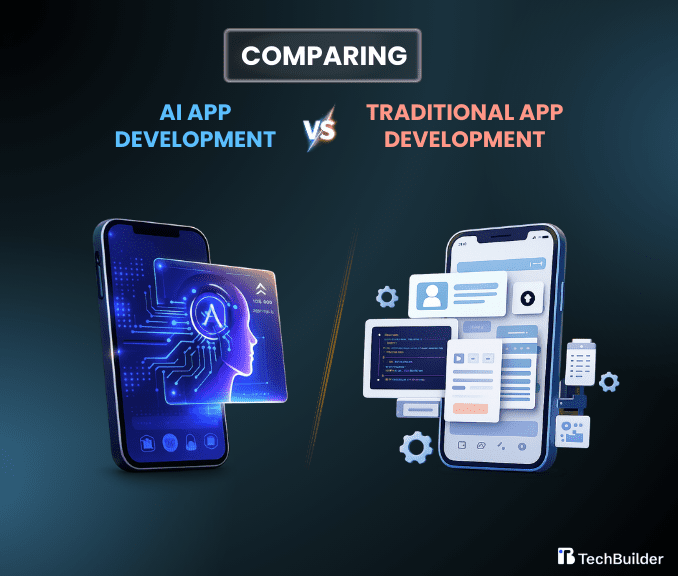
When businesses need to choose whether to develop AI apps or develop old-fashioned apps, a number of factors emerge. These are the rate of development, general cost, scalability, and performance. The traditional apps are stable and cost-effective, whereas AI apps are intelligent, flexible, and long-term value, based on data-driven insights. The knowledge of these differences assists businesses to make a reasonable decision that will suit their objectives and expansion strategies in the year 2026.
| Factor | Traditional App Development | AI App Development |
| Speed | Faster initial development for straightforward apps | Longer development due to AI integration and training models |
| Cost | Lower upfront cost, predictable budgeting | Higher initial investment, but potential long-term ROI |
| Scalability | Limited to pre-defined workflows, may require upgrades | Highly scalable, adapts to growing users and data |
| Performance | Stable and consistent performance | Performance improves over time as AI learns and optimizes |
Traditional applications are easy to develop when needs are well understood, and cost is certain, however, when scaling or introducing intelligence later is generally difficult. AI applications need to be invested in and trained on more time upfront because of the requirement to train models, integrate data and test.
They are, however, the best when it comes to growth and long term performance since they are able to forecast, predict and automate processes. AI app development is also more likely to be advantageous to businesses that require a smart, data-driven solution, even though it is more expensive to develop.
Want To Automate Tasks, Personalize User Experiences, And Boost Efficiency?
Let TechBuilder help you build AI-powered apps that grow with your business.
Benefits of AI App Development
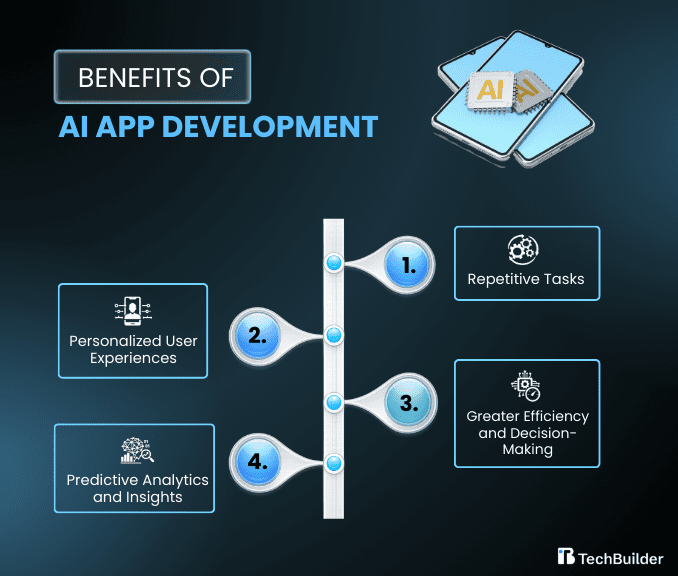
AI app development offers businesses more than just automation; it provides smarter, data-driven solutions that improve efficiency, user engagement, and decision-making. By integrating artificial intelligence, apps can learn from user behavior, predict trends, and deliver personalized experiences that traditional apps cannot. Such benefits render the AI apps a crucial option to companies that want to remain competitive in 2026.
- Repetitive Tasks:
Repetitive tasks are automated. Robotic apps are capable of performing routine and repetitive tasks like scheduling, notifications, and entering data. This saves on manual work, eradicates mistakes and enables the employees to concentrate on other more valuable work.
- Personalized User Experiences:
Using user interaction, preferences, and previous interactions, AI applications can provide customized content and product recommendations or services. Individual experiences enhance the level of engagement, satisfaction, and customer loyalty.
- Predictive Analytics and Insights:
AI apps can forecast trends, detect anomalies, and provide actionable insights. This is useful in ensuring that a business will make sound decisions, run ahead of customer needs and maximize strategies in advance before things get out of control.
- Greater Efficiency and Decision-Making:
It is an ever-learning and ever-changing AI-powered application which becomes more efficient to operate with time. Businesses are able to use real-time data to make smarter decisions, optimize processes and get faster results when compared to the traditional apps.
Limitations of Traditional App Development
Although conventional app development has proven itself to be trusted over the years, it is associated with certain limitations that may inhibit growth and usage. These apps are programmed with pre-determined logic, which implies that they cannot change, evolve, and provide a unique experience.
With increased customer demands and competition in the market, as the businesses are expected to make new decisions in 2026, these limitations are important in providing the right development decision.
- Lack of Intelligence and Adaptability:
Conventional apps would be restricted to fixed functions and would not be able to acquire knowledge of users as they use or become better at their tasks with time. This restricts their capabilities – to provide dynamic solutions or foresight.
- Slower Response to Market Changes:
Modifying old applications to suit new needs or to add new technology may not only be time-consuming, but can also be quite expensive – which will postpone the time it takes a business to adapt to the market trends.
- Limited Personalization for Users:
Since traditional apps lack AI capabilities, they cannot provide personalized recommendations, tailored content, or adaptive user experiences, which can reduce user engagement and satisfaction.
- Scalability Challenges:
Conventional applications tend to be incapable of supporting large numbers – of users or data – without major improvements to the infrastructure. This may be a problem to growth of businesses that would wish to grow quickly.
Use Cases of AI App Development
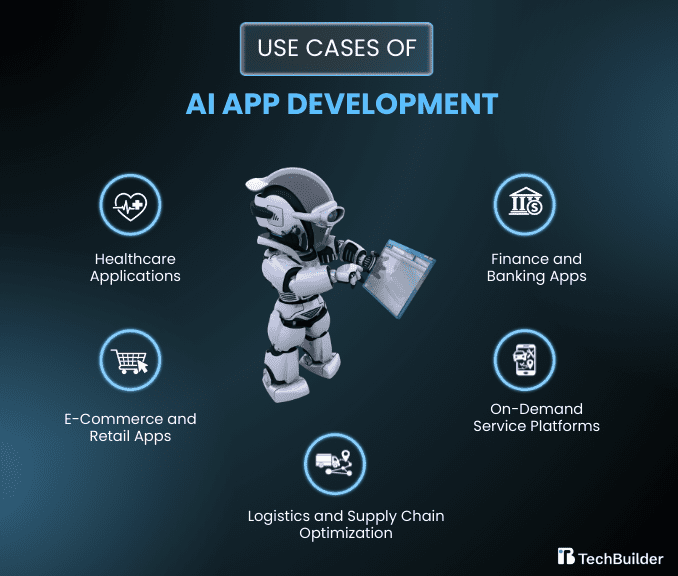
The development of AI apps is changing the work of businesses in all sectors making it smarter and more data-driven. AI apps have applications that are useful such as predicting customer behavior, automating complex tasks, and many more which no traditional apps can compete with. Those companies utilizing AI will be able to achieve efficiency, increase user experience, and remain competitive in 2026.
- Healthcare Applications:
AI applications assist in the – management of patients, diagnosing, predictive analytics, as well as customized treatment procedures. They are capable of processing a lot of medical data as a – means of supporting doctors and enhancing patient outcomes.
- E-Commerce and Retail Apps:
AI apps provide personalized product recommendations, dynamic pricing, chatbots for customer support, and predictive inventory management, enhancing the shopping experience and boosting sales.
- Logistics and Supply Chain Optimization:
AI applications can optimize shipping routes, predict demand and track inventory in real time. This enhances efficiency, lower cost and speedier deliveries.
- Finance and Banking Apps:
AI applications detect fraud, analyze purchases, provide predictive financial recommendations, and control the processing of transactions, which makes banking safer and more efficient.
- On-Demand Service Platforms:
Ride-hailing, food delivery, and home service apps use AI to match demand with supply, optimize scheduling, and provide real-time tracking, improving service quality and customer satisfaction.
Factors to Consider When Choosing Between AI and Traditional Development
The decision between AI app development and traditional app development cannot be taken in a decision that fits all. There are a number of factors that should be considered carefully by businesses to conclude on the approach and method that suits their objectives, resources, and growth strategies. These considerations can be used to make sure the selected strategy of app development would bring forth the highest value, efficiency, and user-friendliness in the year 2026.
- Business Goals and Objectives:
The type of application development needs to be in line with your general business strategy. When you want to offer customized, smart experiences or make use of data-driven insights – AI-based app development is a more appropriate option. Conventional applications are suited to firms – that have processes that are clearly and inflexibly defined.
- Budget and Resource Availability:
AI app development generally requires a higher initial investment for technology, training models, and integration. The conventional approach of application development is cheaper at the outset and would be applicable to businesses with low budgets or simple needs.
- Target Audience and User Expectations:
Consider the preferences and expectations – of your users. If your audience requires – real-time personalization, predictive features, or smart automation, AI apps will be – able to fulfill their needs. Conventional apps are good when the interactions involved are simple and predictable.
- Scalability and Future Growth:
AI applications are very flexible and can easily be scaled with your business – as it expands to accommodate a larger number of users and data and constantly be enhanced. Conventional applications might need lots of modifications or infrastructure modification to support accruing growth, which makes them less scalable over time.
How Businesses Can Transition to AI Apps
The AI-powered applications need to be carefully planned and implemented instead of the traditional ones. The companies are supposed to make sure that AI technologies are integrated smoothly with the existing operations less affected. A strategic approach allows businesses to use AI to become efficient, personalize experiences of users, and obtain a competitive advantage in 2026.
- Evaluate Existing Systems and Processes:
Start by evaluating your present applications, work processes and data infrastructure. Knowledge of what is functioning and what should be improved can be used to identify – where AI can provide the greatest value.
- Identify Areas for AI Integration:
Pinpoint tasks or processes that can benefit – from automation, predictive analytics, or personalization. Start by evaluating your present applications, work processes and data infrastructure. Knowledge of what is functioning and what should be improved can be used – to identify where AI can provide – the greatest value.
- Choose the Right AI Technologies and Tools:
Choose the AIs models, frameworks, and platforms that suit your business. Machine learning, natural language processing, computer vision, and predictive analytics – are all common technologies.
- Develop a Roadmap for Implementation:
Make the transition in stages so as to make the least disturbance. Begin pilot projects, experiment with AI capabilities and expand to full deployment as confidence increases.
- Train Teams and Prepare for Change:
Provide the staff with all the required skills to operate AI-powered systems. Management of change guarantees a flawless acceptance and utilization of AI integration.
Ready To Take Your Business To The Next Level With AI?
Start your AI app journey with TechBuilder and stay ahead of the competition in 2026.
Conclusion
The development of AI apps is changing the manner in which the business is being conducted, making it smarter, data-driven, and more personalized. Although conventional app development is still valid to develop simple and structured processes, AI-driven apps are beneficial in the long term in terms of automation, predictive analytics, and user experience. The decision to take the correct route will rely on what you want to achieve with your business, the budget you have, your target audience and how you can scale your business in 2026.
Learning about the distinction between AI and conventional app development, businesses will be able to make a well-founded choice that will lead to greater efficiency, better customer experience, and growth. The switching to AI apps might take additional investments and planning, yet the possible advantages, such as smarter operations and better insights and competitive advantage, make it a worthwhile solution to the companies aiming to become successful in the digital world.
FAQ’s
What is AI app development?
AI application development is the construction of applications based on – artificial intelligence that learn and develop, adapt, and offer customized experiences, depending on user data.
How is AI app development different from traditional app development?
Unlike traditional apps that follow fixed rules, AI apps can make predictions, automate tasks, and improve over time by analyzing data and learning from user behavior.
What industries benefit most from AI apps?
The healthcare, finance, logistics, e-commerce, and on-demand services platforms are – some of the industries that benefit greatly due to AI-assisted applications.
Is AI app development more expensive than traditional app development?
Yes, the initial investment that the use of AI apps is often more cost-intensive because of the communication with technology and the training of the model, and it provides more opportunities to scale and ROI.
Can existing traditional apps be upgraded to AI apps?
Yes, companies can incorporate AI into their existing applications and consider the points of automation, predictive analytics, or personalization and add AI portions step by step.
How do AI apps improve user experience?
AI applications will offer customized suggestions, automate routine processes, anticipate consumer requirements, and provide real-time feedback and result in a more interactive and effective experience.