










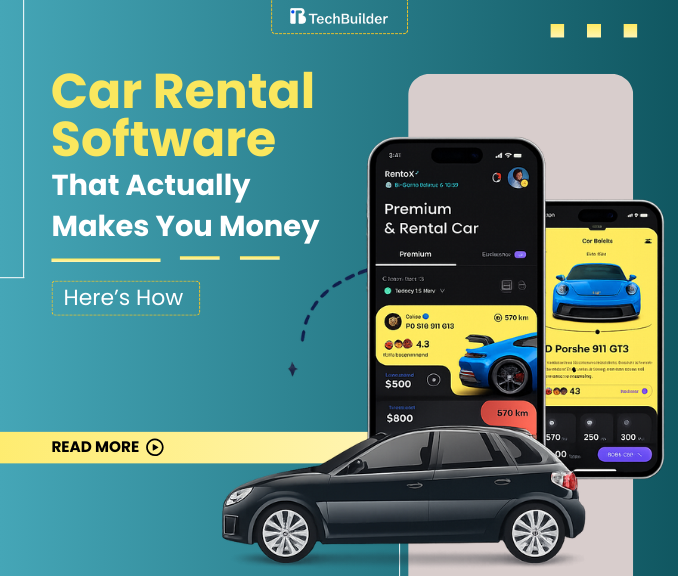
Many car rental businesses start strong but struggle when demand increases. Everything slows down due to the manual booking system, spreadsheets, phone reservation and disconnected payment processes. Along with the increase in bookings, there are more mistakes in operations, duplicated reservations, slow confirmations, and unsatisfactory customer experiences. Lack of a centralized system makes the process of controlling fleet availability, pricing, and customer information enormous – and that directly affects revenue.
By 2026, customers expect instant reservations, open pricing, electronics agreements, and live updates. Unless your ownership renting business can provide them with that kind of convenience, they are soon going to switch to another business. It is here that Car Rental Software will be a revenue-driving asset instead of a management tool. It automates processes, minimizes human errors and assists you to attract more bookings without raising overhead expenses.
What Is Car Rental Software and Why It Matters in 2026
Car Rental Software is an online platform that allows management of bookings, fleet management, payments and pricing, customer databases and reports through a single dashboard. It enables the rental companies to automatize their reservation system, monitor the vehicle availability on a real-time basis, deal with documentations, and combine secure payment gateways. Rather than using several tools, everything works under a single smart ecosystem that is designed to be efficient and develop.
In 2026, the car rental market is becoming more competitive due to peer-to-peer platforms like Turo and digital-first rental brands. In the quest to remain competitive, both the conventional and new rental products to be used by both conventional and new businesses should embrace technology that enhances speed, precision and ease of use. Modern Car Rental Software does not only ease operations but also brings such functions as dynamic pricing, analytics, and integration of a mobile application – which are directly related to the increase in profitability and scalability in the long term.
Ready To Automate Your Rental Business And Increase Bookings?
Talk to TechBuilder today and get a customized Car Rental Software solution designed to maximize your revenue.
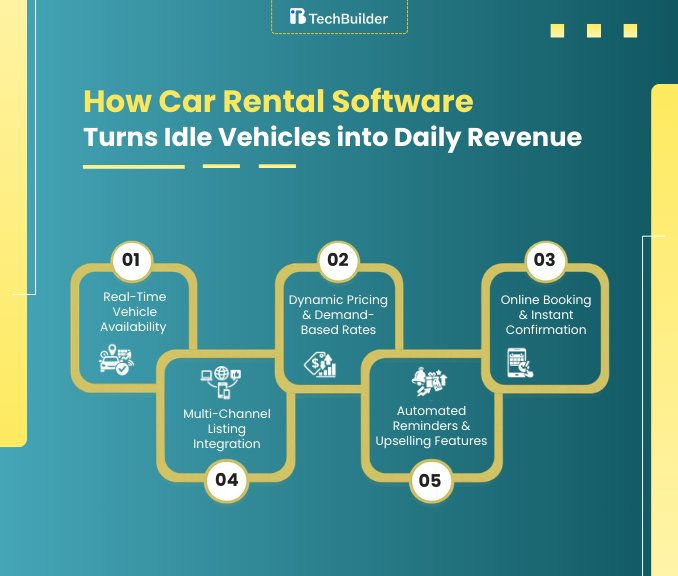
How Car Rental Software Turns Idle Vehicles into Daily Revenue
Car rental businesses lose money every time a vehicle sits unused. Unutilized cars imply parking fees, depreciation, insurances, and zero investments. It is not only the ownership of vehicles but rather the use of vehicles to the fullest. Car Rental Software comes in to play a transformational role here because it will assist you in keeping track, controlling, and making money out of all cars under your fleet.
Car Rental Software will make sure that your cars are in the right hands at the right price and the right time with real time tracking, automated bookings and smart pricing. The system operates 24/7 to eliminate booking gaps, schedule optimization and downtimes, repurposing unused assets into steady streams of daily revenue as opposed to manual coordination, which relies on schedules and desk scheduling segments.
- Real-Time Vehicle Availability Management
The system tracks every car’s status — available, booked, under maintenance, or reserved — in real time. This prevents double bookings and ensures no vehicle remains unintentionally unlisted or unused.
- Dynamic Pricing & Demand-Based Rates
Car Rental Software has flexibility of varying the rates of rental according to demand, season, location and type of vehicle. The periods of high demand lead to a high margin and competitive prices during a slow period ensure that cars are not lying idle in the parking lots.
- Online Booking & Instant Confirmation
The customers can also make a booking anytime without making a call to your office. Immediate confirmation enhances trust and decreases the drop-off, securing a higher number of bookings 24/7.
- Multi-Channel Listing Integration
You can add your fleet – to various platforms or marketplaces and automatically synchronize availability. This widens coverage as well as – improves the possibility of quicker reservations.
- Automated Reminders & Upselling Features
Automated emails and SMS notifications minimize no-shows, and add-ons such as insurance, GPS, child seats, or premium upgrades make the average booking value per customer higher.
Revenue-Driving Features Every Profitable Car Rental Software Must Have
Not all Car Rental Software is built to generate profit. Some systems only manage bookings, while advanced platforms are designed to actively increase revenue and reduce operational costs. To truly scale your rental business, your software must go beyond basic functionality and focus on performance optimization.
In 2026, profitability depends on automation, analytics, and customer experience. The right feature set allows you to improve fleet utilization, streamline payments, reduce manual workload, and make data-driven decisions. The features listed below are the ones that the bottom line depends on.
- Smart Fleet Management Dashboard
A centralized dashboard gives you full control over fleet performance, maintenance schedules, vehicle status, and booking trends — helping you identify underperforming assets and optimize usage.
- Integrated Secure Payment Gateway
Fast, secure, and multiple payment options improve customer trust and reduce payment failures. Automated invoicing also speeds up cash flow.
- Advanced Reporting & Analytics
With deeper data on revenue, utilization rate, seasonal pattern, and customer behavior you are able to make better pricing and expansion choices.
- Mobile App Integration
With mobile access, customers can book, upload documents, make payments, and track reservations easily — improving convenience and increasing repeat bookings.
- Automated Contract & Documentation Management
Online contracts and personal ID check save on paperwork and helps in accelerating the process of renting and still keeping the choice within the limits.
- Customer Review & Rating System
Good reviews create a feeling of trust and impact potential clients. A rating system also helps maintain – service quality and improve brand reputation.
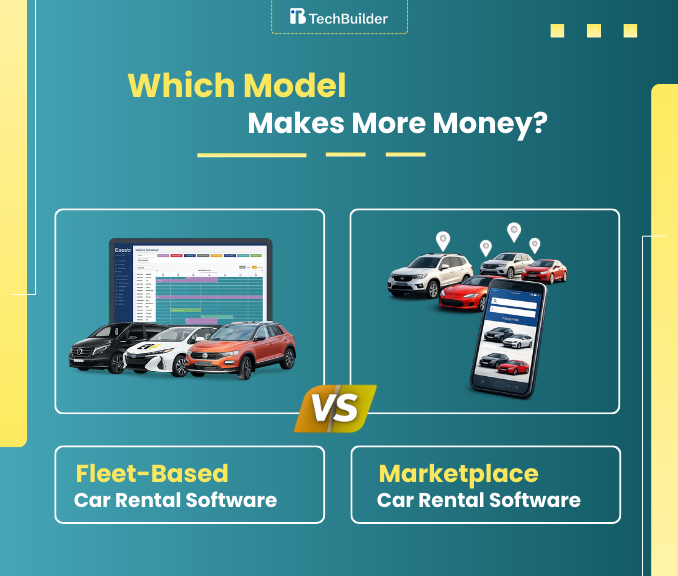
Fleet-Based vs Marketplace Car Rental Software: Which Model Makes More Money?
The appropriate Car Rental Software model will have a direct effect on your revenue, scalability, and the level of risk. The following is a simplified analogy that would be easy to comprehend:
Fleet-Based Car Rental Software
- You purchase and manage your own vehicles
- Full control over pricing and branding
- Higher upfront investment
- Higher revenue per booking
- Responsible for maintenance and insurance
- Profit depends on maximizing fleet utilization
Why It Makes Money:
You keep 100% of the rental income. If your vehicles stay booked consistently, the profit margins may be high. Nevertheless, non-productive cars will drive up the operation expenses.
Marketplace Car Rental Software
- Car owners list their vehicles on your platform
- You earn commission on every booking
- Lower upfront investment
- Faster scalability
- Focus on technology and marketing
- Less financial risk compared to owning a fleet
Why It Makes Money:
You make money on commissions and do not have to spend a lot of money on cars. The development will rely on the need to get additional car owners and customers on your platform.
Which Model Is More Profitable?
Fleet-based = Higher control + higher risk + higher margins per car
Marketplace = Lower risk + scalable growth + steady commission income
Best choice depends on your budget, business goals, and expansion plan
How Platforms Like Turo Changed the Car Rental Game
Rental car companies previously dominated the car sector using large fleets based on airports and physical stores. The customers were offered a restricted number of vehicles, no choice of prices, and long procedures of completing paperwork. Then services such as Turo came in with an entirely different business model – a peer-to-peer, technology-driven marketplace that is driven by sophisticated Car Rental Software.
Turo replaced the situation where thousands of vehicles are owned by a company and offered thousands of people the opportunity to list what they own and earn money. This change did not only bring about a new business model but also a change in the way rentals are priced, booked, and managed.
Major Changes Introduced by Marketplace Platforms
- P2P vehicle sharing as opposed to just company collections.
- Greater range of vehicles such as luxury, EVs and specialty.
- The entire process of booking and verification is digital.
- Pick up/ Drop off flexible.
- Trust and transparency rating and review system.
These changes gave customers more freedom and personalization while giving vehicle owners a new income opportunity. It turned everyday cars into earning assets and made rentals accessible beyond airport counters.
Technology-Driven Disruption
Marketplace business used smart Car Rental Software to automate the complicated processes that were manually performed in conventional companies.
- On-demand car tracking.
- Online payments and digital contracts are made secure.
- Demand and location-based dynamic pricing.
- Online booking and managerial system via mobile apps.
- Over-the-counter revenue model, which is automated using commissions.
Using scalable technology rather than intensive infrastructure, platforms such as Turo could operate at low costs as they grew very quickly between cities and countries.
Impact on Traditional Rental Companies
Legacy brands such as Hertz and Enterprise Rent-A-Car were compelled to speed up the digital transformation due to the emergence of peer-to-peer platforms. Customers started to have a demand for app-based booking, open pricing, and hassle-free experiences, as opposed to paperwork and long lines.
In simple terms, Turo proved that modern Car Rental Software can transform a traditional rental business into a scalable, technology-powered marketplace. It showed that the future of mobility is not just about owning cars — it’s about building the right digital ecosystem around them.
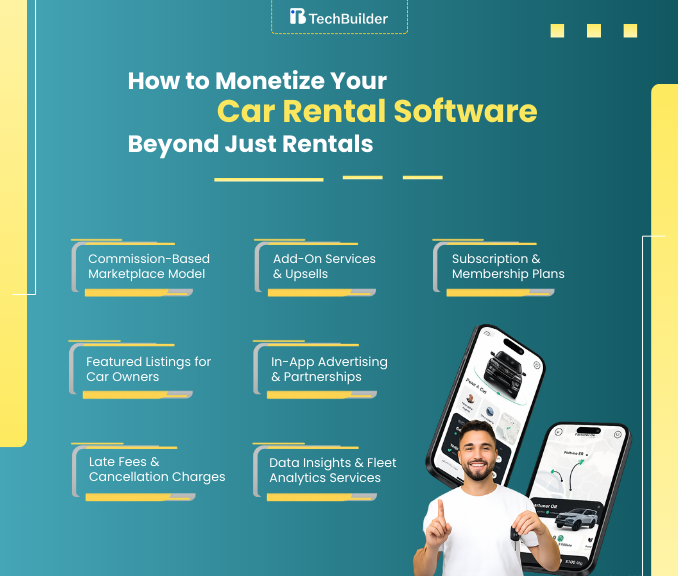
How to Monetize Your Car Rental Software Beyond Just Rentals
Most businesses think revenue from Car Rental Software only comes from daily or hourly bookings. However, in real life, rentals are not only the main source of income, but also not the only one. A properly structured platform has the ability to open various sources of revenue that enhance the average transaction value and generate recurring revenue.
In 2026, profitable rental platforms will aim to increase customer lifetime value, rather than single bookings only. Through the implementation of intelligent monetization concepts in your Car Rental Software, you will be able to make more profits without expanding your fleet.
- Commission-Based Marketplace Model
If you operate a peer-to-peer model, you can earn a percentage from every booking made on your platform. This will generate revenue in scale without the need to own vehicles.
- Add-On Services & Upsells
Provide additional services such as insurance, GPS, child seats, fuel packages or premium services. These are minor add-ons that add up to great booking value.
- Subscription & Membership Plans
Offer monthly or annual membership schemes such as reduced prices, priority reservation or free deposit. This ensures recurring and predictable income.
- Featured Listings for Car Owners
Allow vehicle owners to pay for priority placement in search results. This generates more revenue and assists the owners to gain more visibility.
- In-App Advertising & Partnerships
Collaborate with traveling agencies, hotels, insurance firms, or fuel brands – to put specific promotions in your platform.
- Late Fees & Cancellation Charges
Automated penalty systems limit abuse and generate extra revenue at the same time -as ensuring your business is not at a loss.
- Data Insights & Fleet Analytics Services
Provide premium reporting software to large fleet companies – to enable them to examine performance and streamline their pricing plans.
Choosing the Right Development Approach for Maximum ROI
The development of profitable Car Rental Software does not merely have features, it has to do with the right development strategy. The technical strategy has direct effects – on the cost, scalability, time-to-market, and long-term return on investment (ROI).
In 2026, businesses must balance budget, customization, and scalability. Whether you are starting or expanding an enterprise rental brand, the choice you make in your development will dictate your rate of growth and profitability that you will keep.
- Custom Development from Scratch
Complete Online Car Rental Software with fully customized offerings. It is ideal in terms of long-term scalability and unique features, but needs more initial investment.
- White-Label / Ready-Made Solutions
Ready to use platforms which can be re-branded and introduced fast. Reduced initial expenditure and reduced customization.
- MVP (Minimum Viable Product) Approach
Limit the basic features and launch in the market, experiment and scale up. This makes your business less risky and enables you to prove your business model prior – to substantial investments.
- Marketplace vs Fleet-Focused Architecture.
Your software structure should match your revenue model. Marketplace systems require commission logic and owner dashboards, while fleet systems need maintenance tracking and asset control.
- Cloud-Based Scalable Infrastructure
Cloud hosting ensures high performance, data security, and scalability as bookings grow.
- Mobile-First Development Strategy
Since most bookings happen via smartphones, building a seamless mobile experience increases user engagement and conversion rates.
Want To Build Car Rental Software At Lower Cost Than The Market?
Get a free consultation with TechBuilder and receive a detailed project estimate tailored to your business model.
How Much Does It Cost to Build Profitable Car Rental Software in 2026?
The development of Car Rental Software in 2026 will have varying costs depending on the features, type of platform (fleet-based or marketplace), complexity of the UI/UX, integrations, and scalability. The simplest version with the minimum amount of booking and fleet management services will be much cheaper than an entirely automated, AI-driven marketplace service.
The investment that you make must be in line with your long term vision of the business when your objective is to develop a profitable Car Rental Software. The market development expenses might be high, but this could be minimized when the appropriate technology partner is selected without affecting the quality, scalability, or performance.
| Software Level | Market Cost Estimate | Estimated Cost at TechBuilder | Features |
| Basic Version | $20,000 | $14,000 | Includes core booking system, fleet management dashboard, payment integration, and admin panel. |
| Mid-Level Version | $25,000 – $35,000 | $17,500 – $24,500 | Includes – comprehensive analytics, dynamic pricing, mobile app integration, multi-role dashboards, and automation capabilities. |
| Advanced Version | $40,000+ | $28,000+ | Includes – marketplace functionality, AI-powered pricing logic, real-time tracking, scalable cloud infrastructure, third-party connectors, and enterprise-level security. |
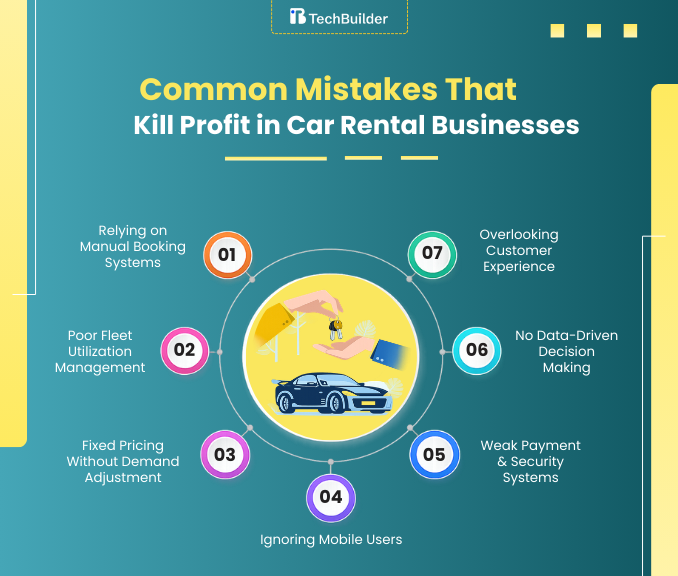
Common Mistakes That Kill Profit in Car Rental Businesses
Running a successful rental business entails more than simply having automobiles. Many firms struggle with profitability due to operational inefficiencies, antiquated systems, and bad strategic decisions – rather than a lack of demand. Without the proper Car Rental Software, minor mistakes can easily escalate into significant financial losses.
In 2026, competition is fierce, and customers demand speed, transparency, and convenience. If your rental operations are not streamlined, you risk losing bookings, raising costs, and eroding client trust. The following are the most typical profit-killing blunders – that rental firms should avoid.
- Relying on Manual Booking Systems
One of the challenges when using reservations is that it leads to more errors, bookings and time wastage. Car Rental Software creates automation that gets rid of these risks and enhances efficiency.
- Poor Fleet Utilization Management
Idle vehicles mean lost revenue. It is hard to know which assets are not performing well or making the most out of the available resources without real time tracking and reporting.
- Fixed Pricing Without Demand Adjustment
Keeping the same rates year-round ignores seasonal demand spikes. Dynamic pricing will be used to maximize revenue periods when there is a high demand.
- Ignoring Mobile Users
The majority of customers like to make bookings using smartphones. In any case, without a mobile friendly site or application, you are losing a major part of your potential bookings.
- Weak Payment & Security Systems
Any payment method that is not secured or restricted diminishes trust and leads to more transactions not being completed meaning that revenue is directly impacted.
- No Data-Driven Decision Making
In the absence of analytics, you are making guesses rather than making plans. Information on the trends of booking and the customer behaviors is useful in enhancing profitability.
- Overlooking Customer Experience
Slow confirmations, complicated paperwork, and poor support drive customers to competitors. Seamless digital processes increase repeat bookings.
Future Trends in Car Rental Software You Shouldn’t Ignore
The car rental business is changing at a high rate and technology is influencing the customer demands and patterns of operation. In order to remain competitive and profitable, companies should embrace new features and new infrastructure in their Car Rental Software.
The failure to adopt the trends in the industry can make your business obsolete and susceptible to technological competition. These are the major trends that are sure to dominate the rental market in 2026 and above.
- AI-Powered Dynamic Pricing
Artificial intelligence analyzes demand, location, and booking patterns – to automatically adjust rental rates for maximum profitability.
- Peer-to-Peer Marketplace Expansion
Following the footsteps of companies such as Turo, an increasing number of companies are starting to use commission-based marketplace models in order to scale quicker.
- Electric Vehicle (EV) Integration
With the spread of EVs, Car Rental Software will need to aid in mapping charging stations, battery tracking, and EV-specific pricing models.
- Contactless & Digital-First Rentals
Digital ID verification, e-sign agreements, and keyless access systems are becoming standard expectations.
- Telematics & Real-Time Vehicle Tracking
GPS tracking and vehicle diagnostics help reduce theft risk, monitor usage, and improve operational control.
- Subscription-Based Rental Models
Monthly car subscriptions allow companies to have predictable recurrent revenues as opposed to booking specials.
- Blockchain for Secure Transactions
The blockchain technology increases the transparency of payments, identity verification, and fraud prevention.
Planning To Launch Or Scale Your Rental Platform In 2026?
Partner with TechBuilder to develop scalable, revenue-focused Car Rental Software that gives you a competitive edge.
Conclusion: Build Smart, Scale Fast, and Maximize Revenue with Car Rental Software
The future of the rental business is no longer about owning cars anymore but exploiting the appropriate Car Rental Software to be more efficient, automate the process and open a variety of revenue-generating opportunities. Modern software can turn traditional businesses relying on rentals into technology-driven, scalable platforms and change the experience of smart booking systems and dynamic pricing to marketplace models. The companies who invest in the digital infrastructure will be the same companies that will conquer the mobility market in the future.
The appropriate Car Rental Software is the most valuable asset in case your objective is to achieve more fleet utilization, lower operations costs, and develop a sustainable and high-profit rental model. With a scalable development strategy and revenue-driven functionality, you do not simply operate rentals, you create a growth engine that will run long-term and adjust to the market conditions and customer needs.
FAQ’s
- What is Car Rental Software and how does it work?
Car Rental Software: It is a computerized platform that is used to automate and manage the whole process of renting vehicles and includes: listing of vehicles, booking, payment, tracking the fleet, administration of customers, and reporting. It operates by integrating all the rental activities in one platform such that the customer can check, make a reservation, upload documents and do the payment online.
- How much does it cost to develop Car Rental Software in 2026?
The cost of developing Car Rental Software in 2026 depends on the complexity and features required. A minimum model with the central booking and fleet management functionalities can be priced at approximately 20,000 dollars on the general market. The cost of a mid-level solution that involves high analytics, mobile app, and automation can be between 25,000 to 35,000. AI-based pricing, real-time tracking, and scalable infrastructure Advanced marketplace-based systems can be more than $40,000. The ultimate price will be based on customization, integrations, and your development partner.
- What features are essential in profitable Car Rental Software?
Profitable Car Rental Software should also have live vehicle availability control, payment security, dynamic pricing, automatic bookings, and reporting options.
- Which is better: Fleet-based or Marketplace Car Rental Software?
The final decision on fleet-based or marketplace Car Rental Software is determined by how you run your business and your ability to invest. Fleet based systems are perfect in case you have vehicles and you want to have complete control in the pricing and branding. This model has the capacity of making more profit margins per vehicle but it needs a lot of initial investment. Platforms such as Turo have been the basis of marketplace systems where third-party car owners list their vehicles as you make commissions per booking. This model provides reduced financial risk and quicker scalability hence appealing to startups.
- How does Car Rental Software increase profitability?
Car Rental Software makes the operations profitable since they are automated and minimize the errors of manual processes and fleet utilization optimization. Dynamic pricing will guarantee a higher price when the demand is the highest, and automated reminders will decrease no-shows.
- How long does it take to develop and launch Car Rental Software?
The growth plan will be based on scope of the project. A simple Car Rental Software solution will require 3 to 4 months in designing, developing and deploying. The mobile applications and sophisticated features in mid-level platforms may make it take 4 to 6 months. Innovative marketplace solutions featuring sophisticated integrations, AI, and scalable architecture can be completed in 6 months or more. Timelines are also subject to customization needs, third party integration needs, and pre-launch testing.