










Consider the apps that you use on a daily basis. They recommend exactly what you want, answer questions instantly, predict your next-move, and make every interaction feel effortless. That’s not luck, it is Artificial Intelligence working behind the scenes.
Now here is the real question: Can your existing mobile app do the same?
If not, you are not alone. Many businesses built great apps a few years ago, but customer expectations have changed dramatically. Users now expect all of these features – customization, on-demand support, smarter search, and intelligent automation – as industry standard – not as a premium feature.
The good news is that you do not need to build a brand new application to keep up. All without re-inventing the wheel, you can modernize your app, improve user engagement, automate repetitive tasks and find new business opportunities by Integrating AI Into Your Existing Mobile App.
In this guide, we will show you exactly how to do it, what AI features deliver the biggest impact, common mistakes to avoid, and the practical steps to transform your existing app into a future ready digital product.
Need Experts to Integrate AI Into Your Mobile App?
From Generative AI to machine learning and AI agents, we build scalable AI solutions tailored to your business needs.
Why AI Integration Is Becoming a Business Priority in 2026
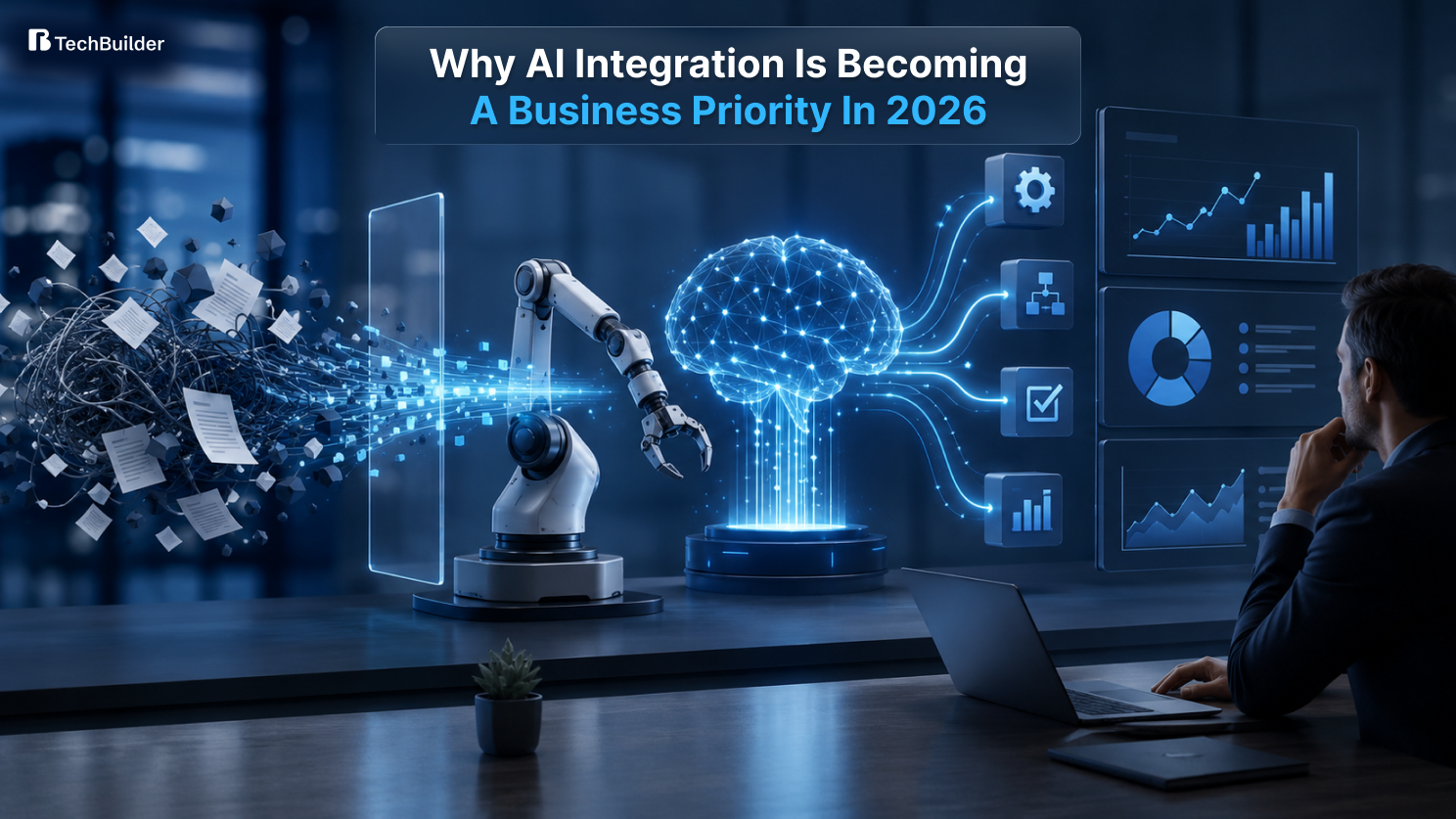
AI is no longer a futuristic concept, it is becoming a competitive necessity. AI is enabling businesses in every sector to provide more efficient, personalized and instant mobile-experiences.
The facts speak for themselves:
- 78% of companies today are leveraging-AI in at least one business process (McKinsey, 2025).
- The global AI market is projected to exceed – $826 billion by 2030 (Statista).
- Over 80% of customer-interactions are expected to involve AI assisted technologies (Gartner).
- Companies adopting AI report productivity gains of up to 40% (Microsoft Work Trend Index).
Think about apps like Netflix, Spotify, Amazon, or Google Maps. They do not just respond to users; they anticipate their needs. That is the level of intelligent experience customers increasingly expect from every mobile app in 2026.
What Does AI Integration Actually Mean?
One of the biggest myths about AI is that you need to throw away your existing app and build a brand new one. Thankfully, that is rarely the case.
Think of AI as an upgrade; not a replacement.
Rather than starting from scratch; these intelligent features are added to the existing app.
That could mean:
- A chatbot that answers customer-questions instantly.
- Product recommendations based on browsing-history.
- Smart search that understands user intent.
- Predictive-analytics that forecast future demand.
- Automated workflows that reduce manual work.
All the existing features remain the same. AI simply makes them smarter.
For many businesses, this approach is faster, more affordable, and far less disruptive than starting over.
Signs Your Existing Mobile App Is Ready for AI
Not every app needs advanced artificial intelligence immediately. But, if you’re facing any of the following problems, AI may give your business a major edge.
- Customer Support Is Becoming Overwhelming
An AI chatbot can handle repetitive inquiries that may be answered by your support team much of the day.
Your support team can work on more complex-issues, and your customers will receive immediate answers.
- Users Spend Less Time in Your App
If engagement is low, it is a sign that users are not getting the value they need from you.
AI driven personalization can suggest – content, products, or services that align with the interest of each user, leading them to spend more time on the site and come back more frequently.
- Decision-Making Relies on Manual Reports
AI can automatically recognize the patterns and extract actionable-insights from the data, eliminating the need for manual effort.
- Your App Has Large Amounts of User Data
Businesses collect enormous amounts of information every day. Without AI, much of that data remains underutilized.
Machine-learning algorithms can identify the customer behavior patterns, forecast future buying trends, and also enhance business strategies.
- Competitors Are Offering Smarter Features
If competing apps already provide – AI powered search, recommendations, virtual-assistants, or automation, customers will naturally begin comparing your experience with theirs.
Keeping pace with industry-innovation helps protect customer loyalty and strengthens your market position.
Ready to Add AI Without Rebuilding Your App?
Integrate AI features like chatbots, automation, predictive analytics, and personalized recommendations into your existing app with expert guidance.
Top AI Features You Can Integrate Into Your Existing Mobile App
The good news is that:
You don’t need dozens of features of AI.
A few extra high impact capabilities can make a huge difference in terms of the performance of your app and user experience.
Let’s consider the best value options.
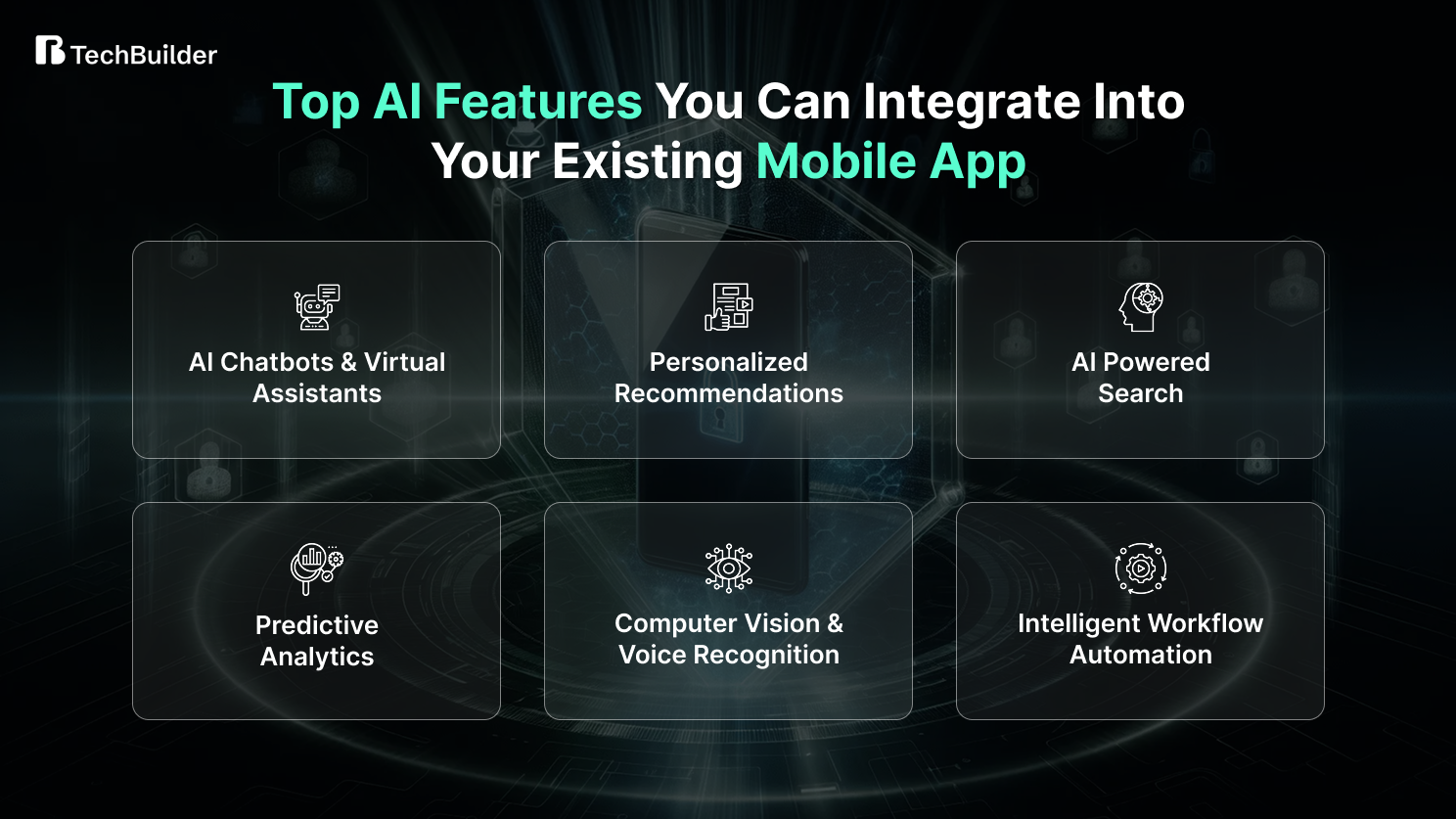
AI Chatbots & Virtual Assistants
No one likes to wait for customer-support.
Within seconds, you can ask a question, solve common problems, make appointments, process bookings, and even complete transactions with a modern AI chatbot.
Best suited for:
- Healthcare
- Food delivery
- Taxi-booking
- Banking
- E-commerce
- Travel
Business impact:
- Reduced support-costs
- Faster response times
- 24/7 availability
- Improved customer satisfaction
Personalized Recommendations
Strange how Netflix always knows what you are going to watch next? That is AI.
Recommendation engines can predict products, services or content based on the user’s preferences by analyzing their behavior.
Your app provides a different experience for each user, rather than repeating the same choices for all.
This will frequently result in:
- More purchases
- Higher engagement
- Better customer retention
AI Powered Search
Traditional search treats keywords as a search term. AI search comprehends meaning.
For example, if someone searches:
“Affordable running shoes for beginners”
Unlike traditional keyword matching, AI can grasp the user’s intent. That means customers find what they need faster; and are more likely to complete a purchase.
Predictive Analytics
What if your app could predict customer behavior before it actually happens?
Predictive AI helps businesses forecast:
- Customer churn
- Sales trends
- Inventory-demand
- Delivery delays
- Equipment maintenance
- Fraud-risks
Businesses can be – proactive, rather than reactive, in their decisions.
Computer Vision & Voice Recognition
AI has made significant-strides in the accuracy of interpreting both visuals and audio.
Popular use cases include:
- Face authentication
- QR and document scanning
- Product image-recognition
- Voice search
- Speech-to-text
- Identity verification
Such features make mobile apps more convenient and less manual for the users.
Intelligent Workflow Automation
Not every AI feature has to be customer facing.
Some of the biggest productivity gains happen behind the scenes.
AI can automatically:
- Assign support tickets
- Schedule appointments
- Optimize delivery routes
- Process invoices
- Classify documents
- Generate reports
These are examples of small automations that can save hundreds of working hours per month.
How to Integrate AI Into Your Existing Mobile App: A Step-by-Step Guide
You understand the importance of AI and the key capabilities that can significantly enhance your website. The next question is:
So how can you leverage AI without disturbing your current mobile application?
Fortunately, AI use isn’t a daunting task. By the right strategy, you can gradually bring in the intelligence and keep your app stable, secure and user friendly.
Here are some tips you can do:
Step 1: Specify a Definite Business Goal
Be sure to have a problem to solve before selecting any AI tool or technology.
Ask yourself:
- Are customer support requests increasing?
- Is user-engagement dropping?
- Do you want to improve conversions?
- Are manual processes slowing your team down?
- Do you need better business insights?
Your answers will help you prioritize the right AI solution instead of investing in unnecessary-features.
Pro Tip: Start with the one high impact use case. Once you see measurable-results, expand AI capabilities over time.
Step 2: Evaluate Your Existing App
Your current application is the foundation of your AI journey.
Review its:
- Over-all architecture
- Backend infrastructure
- APIs and integrations
- Database quality
- User behavior-analytics
- Performance bottlenecks
This evaluation can be used to determine — where AI seamlessly integrates without impacting the stability of your app.
Step 3: Select the Right AI Model or Service
Custom built AI-models are not necessary for all businesses.
As a matter of fact, many companies are effectively employing AI via cloud based services provided by AI giants like OpenAI, Google Cloud AI, Microsoft Azure AI, or AWS AI.
Your choice depends on:
- Business goals
- Budget
- Data availability
- Required accuracy
- Scalability
Choosing the right solution at the start of the process will save time and development costs later on.
Step 4: Prepare Your Data
AI learns from data. The more structured and tidy your data — the more effective your AI-models will be.
Before implementation, make sure that your data is:
- Accurate
- Updated
- Properly categorized
- Free from duplicates
- Collected with user consent
Remember that poor data leads to poor AI performance.
Step 5: Build, Test, and Improve
AI is not a stand alone initiative. It is a continuous process.
Run your AI features in various real world situations before you deploy.
Pay attention to:
- Response accuracy
- User feedback
- Prediction quality
- Performance speed
- Error-rates
As user behavior evolves, keep fine tuning your AI models to – stay relevant. As user behavior evolves over time, keep refining your AI models to remain-relevant.
The businesses that see the best results are the ones that continuously improve their AI; not the ones that simply launch it.
Traditional Mobile App vs AI-Powered Mobile App
The difference goes beyond technology. AI transforms your app from a tool that simply performs tasks into one that learns, adapts, and delivers smarter-experiences over the time.
| Feature | Traditional Mobile App | AI-Powered Mobile App |
| User Experience | Same experience for everyone | Personalized for every user |
| Customer Support | Manual support during business hours | AI-powered support available 24/7 |
| Search | Keyword-based search | Context-aware smart search |
| Recommendations | Generic suggestions | Personalized recommendations |
| Decision Making | Based on historical reports | Predictive insights in real time |
| Operations | Mostly manual | Automated and intelligent workflows |
Real-World Example: How AI Helped a Food Delivery App Grow Faster
Let’s consider a real life situation.
Imagine a food delivery platform with thousands of daily users.
Business growth is strong, but so are the challenges:
- Customer-support requests keep increasing
- Delivery times are inconsistent
- Users struggle to discover new restaurants
- Repeat orders begin to decline
The company opted to add AI features to the existing app, rather than developing a whole new application.
Here is what changed:
AI Chatbot
Common customer inquiries like order tracking, refunds, delivery updates were now managed by — an AI powered chatbot.
Result: Better response times and lower workload for support teams.
Personalized Recommendations
The app started recommending food items and restaurants according to order history, place and browsing history.
Result: Better higher order values and repeat purchase.
Route Optimization
AI was used to analyse the real time traffic and delivery routes and allocate drivers efficiently.
Result: Faster deliveries or enhanced customer satisfaction.
In just a few months, the business saw – customer retention, improved operational efficiencies, and better user experience all without needing to switch out the mobile app.
From this example we learn an important lesson:
The best use of AI is to address a specific business issue instead of being implemented just because it is the latest trend.
Common Challenges and How to Overcome Them
Like any digital transformation initiative, AI integration comes with its own set of challenges.
Fortunately, most of them can be dealt with by careful planning.
Data Privacy & Security
AI can be used to – analyze customer data and provide personalized experiences.
Protecting that data should always be a top priority.
Best Practice
- Follow or Adhere to GDPR and other relevant privacy laws.
- Encrypt sensitive information.
- Be clear about capturing and utilizing user’s data.
Poor Data Quality
The good old AI model can only produce correct outcomes when it is trained with full and up-to-date information.
Best Practice
Always keep your data clean, organized and updated before training AI models.
Integration Complexity
Older mobile apps may need to be reconfigured or improved in the back-end before the integration of AI can run smoothly.
Best Practice
Incorporate a technical evaluation at the beginning so as to prevent challenges when integrating.
Unrealistic Expectations
Certain companies think that AI will take care of all their problems in an instant.
The truth is, the implementation of AI is a continuous process of testing, learning, and optimizing.
Best Practice
Instead of striving for perfection, try to make measurable gains.
Need Experts to Integrate AI Into Your Mobile App?
From Generative AI to machine learning and AI agents, we build scalable AI solutions tailored to your business needs.
How Much Does AI Integration Cost?
One of the most common questions businesses have is:
“How much will it cost to add AI to my mobile app?”
The answer depends on several-factors.
Your investment may vary based on:
- Existing app complexity
- Number of AI features
- Custom AI vs third party APIs
- Data preparation requirements
- Integration effort
- Ongoing maintenance
For instance, an AI Chatbot is far more cost-effective than building a custom AI predictive analytics or computer vision system.
AI is not a cost, it is an investment.
As time goes on, the right AI capabilities can lower operating expenses, enhance customer retention, boost conversions, and generate new revenue-streams.
AI Trends to Watch in 2026
AI is developing at an unprecedented-pace.
Companies that keep an eye on these trends will be better equipped to adapt to evolving customer-demands.
AI Agents
In business, AI agents can now handle intricate tasks that require multiple steps, which is beneficial for customer service, scheduling, and workflow streamlining all without much human effort.
On-Device AI
More AI models are now deployed directly on the smartphone, instead of being entirely dependent on cloud processing.
Benefits include:
- Faster performance
- Better privacy
- Reduced internet dependency
Multimodal AI
Modern AI can read, listen, see and video, all at once.
This helps to deliver richer, more intuitive experiences to users of mobile applications.
Hyper-Personalization
Whereas AI previously allowed for general user segmentation, it now enables much more customized experiences, tailored to each user’s preferences and real time activity.
Predictive Business Intelligence
Companies are going beyond the past reporting.
Today, AI plays a role in predicting customer needs, recognizing growth prospects and forecasting potential operational issues even before they arise.
Conclusion
AI is revolutionizing the building, use, and user experience of mobile applications.
The biggest takeaway?
You do not need to start from scratch to take advantage of AI.
All while maintaining the app you invested in, you can implement smarter features and automate repetitive tasks, enhance the customer satisfaction, and make better business decisions.
The idea is to have a well defined goal, stick to the user’s real world issues and integrate AI gradually. In an era of continually changing customer expectations, forward thinking enterprises will be positioned to meet future challenges by adopting AI now.
With AI on the horizon for your mobile application, this is the ideal moment to assess your application and determine where AI helps you make the most impact and help you develop a more intelligent, future ready digital experience.
Frequently Asked Questions (FAQs)
- Can I integrate AI into my existing mobile app without rebuilding it?
Yes. Many of the AI capabilities, including chatbots, personalized suggestions, smart search, and predictive analytics, can be integrated into existing mobile app without having to start from scratch. This depends on your architecture and business needs of your app.
- Which AI feature should I implement first?
Begin with a feature that is most important to your business. For instance, AI chatbots are effective in enhancing customer support, and recommendation engines boost engagement and sales.
- How long does it take to integrate AI into a mobile app?
The duration will rely on the intricacy of your application and the AI attributes you plan to incorporate. Simple integrations can take anywhere up to a few weeks, and the custom AI solutions, which are more complex and require some machine learning or computer vision, can take a few months.
- Is AI integration suitable for startups and small businesses?
Absolutely. With AI-powered platforms and APIs available on the cloud, businesses of any size can harness the power of AI without requiring a massive data center investment. There are many AI features that can be implemented in the early stages of a startup, and they can be added as the company grows.
- What’s the biggest mistake businesses make when adopting AI?
The most frequent mistake is to use AI without an obvious business goal. AI projects that are most successful are those that address a specific problem, measure results, and are continually evolving according to user feedback.