










We all understand the fact very clearly that nowadays customers want to purchase any product they like from any online platform at a high speed or fast delivery. People are expecting to have access to real-time tracking, same-day delivery, and seamless shopping experiences without any hassle. Because of this fact, online delivery speed has become a very essential factor for any ecommerce business growth and success.
If you think about managing deliveries manually often leads to delays, higher costs, and poor customer satisfaction. This is where delivery management software plays a transformative role.
The global delivery management software market, valued at USD 2.41 billion in 2024, is projected to reach USD 2.80 billion in 2025 and USD 10.33 billion by 2035, representing a CAGR of 13.94% during the forecast period.
The delivery management software market size is forecast to increase by USD 666.7 billion at a CAGR of 7.26% between 2023 and 2028.
With businesses aiming to remain competitive in 2026, implementation of the appropriate delivery management software has ceased to be an option, as it is critical in streamlining operations, lowering expenses, and creating outstanding customer experiences.
What is Delivery Management Software?
Delivery management software is a computer-based application to facilitate and automate all the steps involved in the delivery process, such as assigning orders and planning routes, real-time tracking and confirmation of final delivery. It provides a centralized platform through which businesses, drivers and customers are linked to have efficient and smooth logistics operations.
The software helps companies to optimize their – delivery routes, track driver performance, automatize dispatching, and ensure live updates to customers. With the help of innovative technologies such as AI and real-time data analytics, companies can dramatically shorten the delivery time and operational efficiency.
The implementation of such solutions is gaining momentum with the growing need to deliver goods more quickly. The market of the last-mile delivery software alone is projected to increase by itself more than $15.2 billion in 2025 to more than $41.5 billion by 2035, and indicates the increasing significance of smart delivery systems.
Simply put, delivery management software enables businesses to deliver faster, smarter and more effectively- as well as enhance customer satisfaction and the overall performance of the business.
Why Delivery Management Software is Essential in 2026
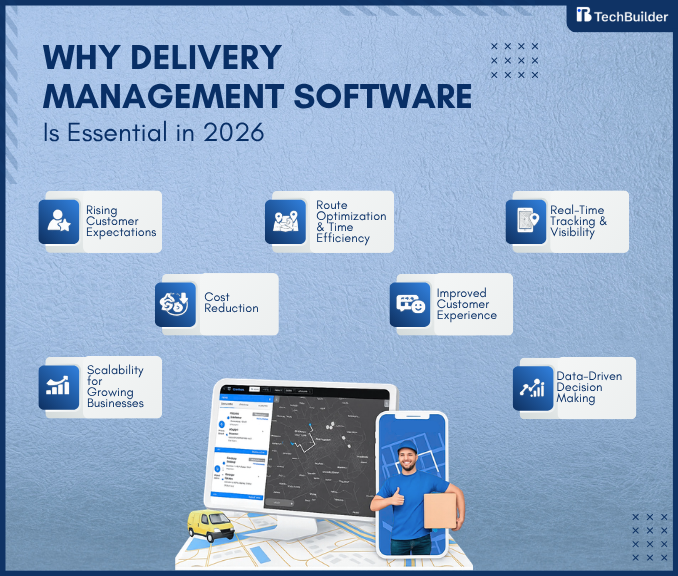
With the customer expectations that are ever-increasing and the volumes of deliveries increasing, businesses can no longer afford to operate off of manual processes or the old system of logistics. Speed, accuracy, and real-time visibility are the key to the successful delivery operations in 2026.
Delivery management software assists companies in ensuring that they maintain their competitiveness through automation of operations, lowering operational expenses, and ensuring quicker and more dependable deliveries. Not only does it increase the internal efficiency – but also customer satisfaction, which makes it an important investment in the contemporary business.
- Rising Customer Expectations
The customers are now demanding quick delivery of goods within a day or even immediately and the software to track the goods in real-time, which has increased the use of advanced software.
- Route Optimization & Time Efficiency
The smart route optimization increases the speed of delivery, lowers fuel use, and decreases operational expenses.
- Real-Time Tracking & Visibility
Businesses can monitor deliveries – live ensuring transparency and better control over operations.
- Cost Reduction
Automation helps to reduce the number of errors in manuals and minimize the time spent and decreases the costs of logistics considerably.
- Improved Customer Experience
Such features as live tracking, notifications, and correct ETAs lead to customer satisfaction and trust.
- Scalability for Growing Businesses
With the growing volume of delivery, software is used to streamline operations without the need to complicate them.
- Data-Driven Decision Making
Advanced analytics will give the businesses an understanding of their performance and how to streamline their strategies.
Still Managing Deliveries Manually? Let’s Fix That.
Stop losing time, money, and customers due to inefficient delivery operations. Discover how an AI-powered system can completely transform your logistics workflow.
Key Features to Look for in Delivery Management Software
The selection of the appropriate delivery management software is important in the smooth and efficient logistics operations. They should not only automate processes but offer real-time insights, scalability, and integrate smoothly with the existing systems. With attention to the appropriate features, companies can enhance the speed of delivery, minimise costs and optimise the overall performance of operations.
- Real-Time Tracking & Notifications
Allows businesses and customers to track deliveries live and receive instant updates on order status.
- AI-Based Route Optimization
Uses intelligent algorithms to determine the fastest and most efficient delivery routes.
- Automated Dispatching
Gives orders to drivers automatically according to location, availability, and priority.
- Driver Management System
Assist in monitoring the performance of drivers, scheduling, and enhance workforce effectiveness.
- Proof of Delivery (POD)
Records digital signatures, photos, or barcodes as a validation of delivery success.
- Analytics & Reporting Dashboard
Offers knowledge on performance of delivery, delays and performance of operation.
- Integration Capabilities
Integrates well with the existing systems such as CRM, ERP and eCommerce systems.
- Scalability & Customization
Make sure that the software is scalable to your business and can be modified to meet specific operations.
Top 7 Delivery Management Software
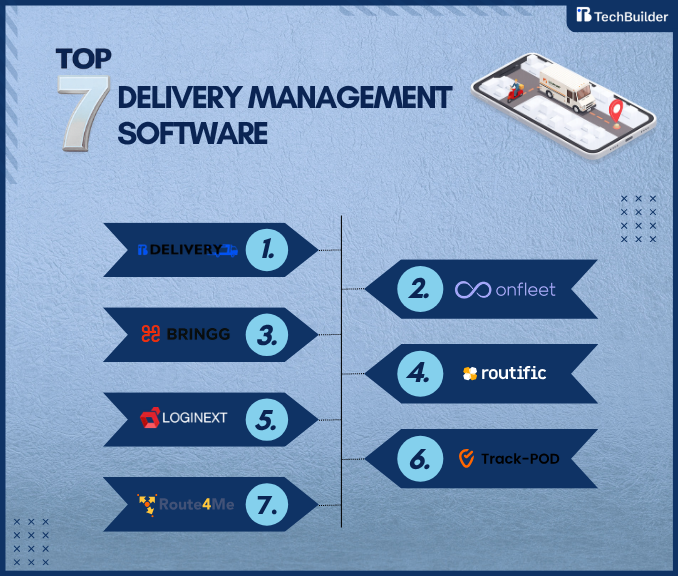
As the world of logistics and last-mile delivery rapidly changes, companies should have robust software solutions to remain competitive. The appropriate delivery management software could automate activities, make routes more efficient, enhance the tracking process, and customer satisfaction. The following are the 7 best delivery management software solutions that will be transforming the way deliveries are done in 2026.
TB Delivery
TB Delivery by TechBuilder is a modern, AI-powered delivery management solution designed to streamline end-to-end logistics operations. It provides sophisticated automation, real-time tracking, and intelligent route optimization to enable businesses to handle deliveries effectively. The system is very scalable and can be used by both start-ups and large businesses. TB Delivery can help businesses – to lower operational expenses and increase speed and service levels of deliveries and customer experience with automated dispatching, driver management, and analytics management.
Onro
Onro is an AI delivery and courier management software built specifically for courier companies that need more than dispatching and tracking. Onro supports end-to-end delivery workflows, including on-demand, same-day, next-day, and hub-based operations, within a single courier management system. Onro key differentiators include a dedicated barcode scanner app for warehouse processes, fully white-label web and mobile applications, AI Agents that automate customer communication and operational tasks, and a unified platform connecting dispatchers, drivers, warehouse teams, and customers in real-time.
Bringg
Bringg is an enterprise-grade delivery management platform designed for large-scale logistics operations. It provides supply chain visibility both end-to-end and last-mile supply chain delivery and third-party logistics integration. Its main strengths are that it can connect businesses to a large pool of delivery providers and coordinate smoothly. Bringg is also automation-friendly, inventory-tracking-friendly, and integrates with other platforms, such as Salesforce, which makes it perfect in the dynamic logistics ecosystems.
Routific
Routific is a delivery software that is route optimization-centered and aimed at small to mid-sized companies. It employs sophisticated algorithms to develop optimal delivery paths, which save on the time and fuel expenses. The platform provides such features as route planning with a drag-and-drop option, real-time tracking, and delivery alerts. Routific is famous because of its simplicity and low cost, and it is a perfect solution to companies that need simple yet effective route planning.
LogiNext
LogiNext is a powerful logistics automation platform based on – AI and machine learning to streamline the delivery process. It offers real-time monitoring, predictive analytics, and route optimization to improve the performance of deliveries. LogiNext has a great popularity among enterprises to control the huge delivery networks and enhance the efficiency of the work. The ease it offers in managing complicated logistics processes is why it is a favorite among industries such as retail, eCommerce and transportation.
Track-POD
Track-POD is an end-to-end delivery management software with emphasis on electronic proof of delivery (ePOD). It enables companies to record signatures, photos and barcode scans as delivery confirmation. The platform has the option of route optimization, real-time tracking, and automated notifications. Track-POD aids business in enhancing accuracy in delivery, minimizing paperwork, and improving communication with customers due to its complete range of features and ease of use.
Route4Me
Route4Me is a powerful route optimization and fleet management software designed for businesses with complex delivery needs. It allows users to plan, optimize and manage routes of several drivers and vehicles. The platform facilitates the capabilities such as real-time tracking, delivery proof, and customization of the route with multiple constraints. Route4Me is also very flexible and has many add-ons and integrations, which is why it is applicable to any business with different logistics needs.
Not Sure Which Software Fits Your Business?
Every business has different delivery challenges — and choosing the wrong tool can cost you more than you think. Get a solution tailored specifically to your needs.
Comparison of Top 7 Delivery Management Software
The selection of the appropriate delivery management software will be determined by the size of your business, the volume of delivery, and the complexity of your operations. Some of the platforms are optimizing routes and providing low prices, whereas others provide an enterprise level of automation and inter-carrier coordination. The following table gives a quick comparison that would enable you to compare the best solution depending on your needs.
| Software | Best For | Key Strength | Notable Features | Scalability |
| TB Delivery | Startups to Enterprises | AI-powered automation | Real-time tracking, route optimization, analytics, customization | High |
| Onfleet | High-volume deliveries | Auto-dispatch & tracking | Real-time GPS tracking, automated notifications, analytics dashboard | High |
| Bringg | Enterprise logistics | Multi-carrier orchestration | Third-party integrations, delivery orchestration, automation | Very High |
| Routific | Small & mid-sized businesses | Route optimization | AI route planning, drag-and-drop dispatching, live tracking | Medium |
| LogiNext | Large-scale operations | AI & predictive analytics | Smart dispatching, predictive ETAs, performance analytics | Very High |
| Track-POD | Proof of delivery focus | ePOD capabilities | Barcode scanning, offline mode, delivery confirmation | High |
| Route4Me | Complex routing needs | Customization & flexibility | Multi-driver optimization, route constraints, add-on modules | High |
How to Choose the Right Delivery Management Software for Your Business
Choosing the appropriate delivery management software is essential in the process of ensuring that business logistics runs smoothly and that the business expands in the long-term. Having a variety of solutions, companies have to consider their unique requirements, the scale of their operations and their future objectives and make a choice. The solution must not only address the existing challenges but enable scalability, efficiency, and customer satisfaction.
- Business Size and Delivery Volume
Select software that can fit in your existing operations. The needs of small businesses might be simple tools, whereas advanced and scalable solutions are demanded by enterprises.
- Core Features and Functionality
Make sure the software will support the necessary features such as real-time tracking, route optimization, automated dispatching, and analytics.
- Ease of Use and User Experience
An easy-to-use interface enables your staff to learn the system in a short period of time and less training.
- Integration Capabilities
The software should seamlessly integrate with your existing systems such as CRM, ERP, and eCommerce platforms.
- Scalability and Flexibility
Choose a solution that will – expand with your business, and meet rising delivery needs.
- Cost and ROI
Assess price in relation to the value it offers in terms of efficiency, cost saving and better performance.
- Customer Support and Reliability
Reliable support ensures quick resolution of issues and uninterrupted operations.
Future Trends in Delivery Management Software
The industry of delivery and logistics is fast developing due to the technological progress and shifting customer requirements. The delivery management software will keep evolving in 2026 and further on, providing smarter, faster and more sustainable solutions. Those businesses that remain ahead of these trends will have a huge competitive edge.
- AI and Machine Learning Integration
Smart route planning, demand prediction, and predictive decision-making – will be possible with sophisticated algorithms.
- Autonomous Delivery Solutions
The use of drones, robots, and self-driving vehicles will redefine last-mile delivery efficiency.
- Real-Time Predictive Analytics
Companies will use data to anticipate delays, create a better route, and increase delivery precision.
- Hyperlocal Delivery Growth
The trend will be – improved, faster, location-based deliveries, particularly eCommerce and food delivery businesses.
- Sustainability and Green Logistics
Businesses will now be interested in green transportation options, including electric cars and efficient routes to minimize carbon emissions.
- Enhanced Customer Experience
Additional features such as live tracking, instant notifications, and accurate ETAs will keep on enhancing to achieve improved user satisfaction.
- Cloud-Based and Scalable Solutions
The use of cloud technology will allow the management systems of delivering to be flexible, scalable and cost effective.
Why Choose TechBuilder for Delivery Management Solutions
It is as important to choose the technology partner as it is to choose the software. TechBuilder is a trusted and innovative company in terms of offering delivery management solutions to businesses to streamline their logistics, enhance efficiency, and scale their operations without any difficulty.
TechBuilder, with its emphasis on customization, high-tech and user-friendly design, provides solutions to fit the specific requirements of the contemporary business.
- Custom-Built Solutions
TechBuilder provides customized delivery management systems, which are specifically made to fit your business model, and are more in line with your operational requirements.
- AI-Powered Automation
A higher level of AI functions can assist with automation of dispatching, route optimization, and better decision-making – to make deliveries faster and smarter.
- Scalable Architecture
Startup or enterprise, the platform expands with your business, delivering volumes of growing deliveries comfortably.
- Real-Time Tracking & Visibility
Have full control over your delivery processes through – live tracking, updates, and performance indicators.
- Seamless Integrations
Connect with your existing systems, including – CRM, ERP and eCommerce platforms, effortlessly to have a single workflow.
- Dedicated Support & Expertise
TechBuilder offers end-to-end support which includes development, deployment, and maintenance – thus making operations smooth at all levels.
Turn Your Delivery Operations Into a Competitive Advantage
Don’t just manage deliveries — optimize, automate, and scale them with a solution designed for growth.
Conclusion
In 2026, delivery management software is no longer just a convenience – it’s a necessity for businesses aiming to stay competitive in a – fast-paced and customer-driven market. Ranging between the optimization of routes and the real-time tracking and increased efficiency of the operations, these solutions are crucial in changing the way the logistics will be performed and increasing the overall performance.
Through selecting the appropriate delivery management software, businesses have the ability of saving money, increasing the speed of delivery and providing superior customer experiences. Regardless of the size of your operation, startup or large business, investing into a scalable and reliable solution such as TechBuilder can leave your operations future-proof and succeed in the long-term.
Frequently Asked Questions
- What is delivery management software?
A digital delivery management software assists companies in managing, tracking, and optimizing the whole delivery process – including order assignment and final delivery.
- Which is the best delivery management software in 2026?
The most suitable software is based on your business requirements, but such popular ones as TB Delivery, Onfleet, Bringg, and Route4Me are based on their sophisticated features and scalability.
- How does delivery management software improve efficiency?
It automates tasks including route planning, dispatching, and tracking, reducing manual errors and saving time while increasing delivery accuracy.
- Is delivery management software suitable for small businesses?
Yes, many solutions are scalable and reasonably priced – making them suitable for small firms wishing to improve their delivery operations.
- What features should I look for in delivery management software?
The key features you must look at are – real-time tracking, route optimization, automatic dispatching, analytics, and integration options.