











When it comes to building a mobile app, one of the biggest questions businesses ask is: What will it really cost? And the remedy is not always so easy. App development costs in 2026 will vary depending on aspects like as – complexity, features, design quality, platform choice, and level of customization.
App development is – no longer just about coding. It entails strategic planning, good user experience design, secure architecture, scalable infrastructure, and maintenance in the long term. All these factors lead to the total investment needed to develop a successful product.
In today’s competitive market, businesses need apps that not only function well but also deliver seamless user experiences and high performance. This automatically affects the price because a better quality and more features take longer, more skills and resources.
App Market Statistics and Growth Trends
Statista indicates that in 2027, the worldwide mobile apps market is estimated to make more than 638 billion dollars, which illustrates a huge growth in the demand of apps.
The mobile app industry continues to grow rapidly, making it one of the most powerful digital ecosystems in the world. Understanding these statistics helps businesses realize the true potential behind app investment and the increasing demand for mobile solutions.
According to Statista, the global app market generated around $437.75 billion in 2022 and is projected to grow at a CAGR of 7.25%, reaching approximately $781.70 billion by 2029. This steady growth reflects the increasing reliance on mobile applications across industries.
A major portion of this revenue comes from different monetization channels, with in-app purchases contributing $167.33 billion and mobile advertising generating $265.84 billion, showing how apps are evolving into strong revenue-generating platforms.
The app ecosystem is also driven by massive user engagement, with over 237 billion app downloads recorded globally in 2022. This demonstrates the increasing demand for mobile applications in both established and emerging regions.
Interestingly, the average revenue per download is approximately 1.86 that can be interpreted as the fact that the slightest increase in user retention and engagement can increase the overall revenue significantly.
Regionally, nations such as China lead the app economy with more than 162.37 billion app revenue, and this is an indication of how various markets can stimulate growth worldwide.
These statistics clearly demonstrate that mobile apps are not just a cost—they are a strategic investment with strong revenue potential, making it crucial to carefully evaluate the cost to develop an app before entering the market.
Discover how TechBuilder helped a startup turn their app idea into a scalable platform that attracted thousands of users and accelerated business growth.
An Overview of Average App Development Costs in 2026
Understanding the average cost of app development allows organizations to establish more achievable goals and plan their budgets more effectively. The cost of developing a mobile app in 2026 can be different depending on the nature of the application and its complexity.
Basic mobile applications that have basic functionality such as login, profile creation, and static content will be priced between $40,000 – $100,000.
Medium-complexity applications that might include API integrations, payment, and real-time updates cost between $100,000 – $200,000.
Advanced and high-function apps such as on-demand apps, eCommerce apps, and AI-solutions may cost between $200,000 – $400,000 and more.
Highly scaled, secure and complex mobile applications used by enterprises can cost more than $400,000.
Costs of a mobile app are greatly dependent on features, complexity of design, technology stack, and development time.
Constant costs of maintenance, updates, hosting as well as security can be a huge addition to the overall investment.
By outsourcing development to cost-effective locations, businesses have the potential to cut down on expenses by 30 to 60 percent without quality being sacrificed.
The platform (iOS or Android or both) also has an influence on the ultimate cost of the development.
The use of such sophisticated technologies as – AI, AR/VR, and real-time analytics adds time and cost to development.
| Complexity Level | Estimated Market Cost | Development Time | Cost and Time at TechBuilder |
| Basic App | $40,000 – $100,000 | 3-6 Months | $28,000 – $56,000
2-4 Months |
| Medium App | $100,000 – $200,000 | 6-9 Months | $56,000 – $140,000
4-8 Months |
| Advanced App | $200,000 – $400,000 | 9-12 Months | $140,000 – $280,000
8-10 Months |
| Enterprise-Grade App | $400,000+ | 12-18 Months | $280,000 – $350,000
10-16 Months |
| SaaS-Based App | $3,000 – $12,000 | 3-4 Months | $1,000 – $10,000
1-2 Months |
Key Factors That Affect App Development Costs
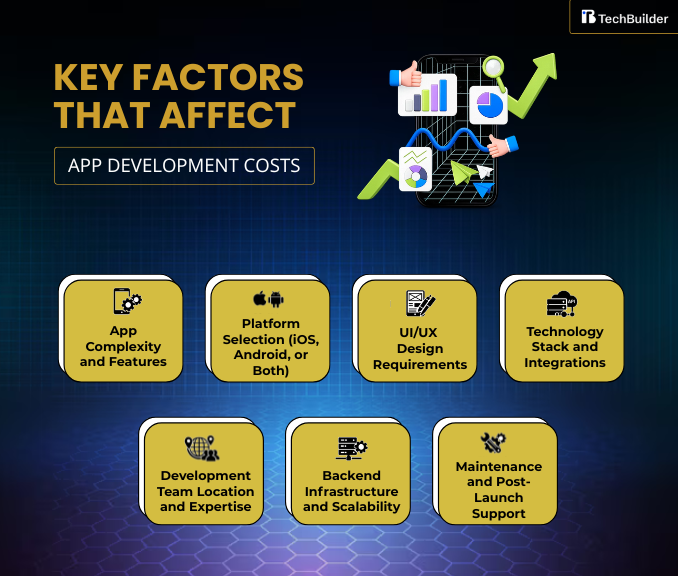
Understanding what factors influence the cost of app development is critical for efficient budget planning. A mobile app’s final pricing is not predetermined – it is determined by a number of interconnected elements, including features, design, technology, and development method. Every choice that you make in the planning phase has a great potential to influence the whole cost, schedule and quality of the end product.
- App Complexity and Features
One of the largest drivers of cost is the complexity of your app. A basic app that takes minimum resources and time to develop, and a more advanced one that has features, can integrate with third-party applications, or other technologies is much more expensive to develop such as an AI or an AR. The more features, the more development time, testing, and refining.
- Platform Selection (iOS, Android, or Both)
A decision between – iOS, Android app, or both platforms will directly affect the cost of developing a mobile app. Developing distinct native applications for each platform is more expensive and time-consuming – but cross-platform development can help save money while ensuring the same user experience across all devices.
- UI/UX Design Requirements
App success also depends on an excellent user interface and experience. Custom designs, animations, and interactive elements add to the design and development work, increasing user engagement. Basic designs would be cheaper whereas higher quality designs will need more budget.
- Technology Stack and Integrations
The choice of technologies, frameworks, and third-party connectors determines both – performance and cost. Additional complex technologies, APIs, and interfaces to payment gateways, analytics software, or cloud services may necessitate additional development time and experience, increasing the entire cost.
- Development Team Location and Expertise
Your development team’s location and level of experience – can influence prices. Employing developers in places with high labor prices will cost more and outsourcing to qualified teams in places with low labor costs will cut down the total budget by up to 30-60 percent.
- Backend Infrastructure and Scalability
Apps that require strong backend systems, cloud hosting, and scalable architecture tend to cost more. A strong backend guarantees – seamless performance, data security, and the flexibility to handle increased user demand as your app expands.
- Maintenance and Post-Launch Support
The cost of designing an app does not end with its debut. Continuous maintenance, upgrades, bug patches, and security enhancements are required to keep the application running smoothly.
Hidden Factors Affecting Mobile App Development Cost
While most firms focus on apparent expenditures such as design and development, a number of hidden factors can have a big impact on a mobile app’s entire budget. These expenditures are sometimes neglected during – initial planning – but they can accumulate over time, hurting your entire investment. Understanding these hidden variables allows you to minimize unexpected charges and better plan for long-term success.
- App Maintenance and Updates
Once your app is launched, it needs to be maintained regularly to address any bugs, enhance performance, and be compatible with emerging operating systems. Patches are essential to make your app work and safe – but they also introduce continuous expenditures most businesses do not take into account.
- Third-Party API and Integration Costs
Most applications depend on third-party applications such as payment gateways, mapping applications, or analytics applications. These services are usually provided as subscription or usage-based services, which further adds to the price of building an app in the long run.
- App Store Fees and Compliance Charges
When publishing an app on such platforms as the Apple App Store and Google Play Store, registration fees and compliance requirements are involved. Also, it can be more expensive as it can demand additional development to follow the strict guidelines.
- Security and Data Protection Measures
Introducing strong security features like data encryption, good authentication and adherence to data protection laws complicate and add to the cost of development. Nevertheless, the measures are necessary to safeguard the user information and gain trust.
- Cloud Hosting and Server Expenses
Cloud hosting is needed to support applications that process a lot of information or interact in real-time. These services are recurring and proportional to usage and thus are a major undetected cost in mobile app development.
- Marketing and User Acquisition Costs
The creation of an app is just the beginning and marketing is needed to have people download and use the app. Costs related to digital advertising, SEO, influencer marketing, and promotions can – significantly impact your overall budget.
- Scalability and Future Feature Upgrades
As the number of your users increases, your app might need new features, better infrastructure, and better performance. Scalability planning guarantees that your application can cope with growth – but it also contributes to the long-term development and maintenance expenses.
Cost Differences Based on App Complexity and Features
The complexity of your app and the features you decide to implement, are some of the largest factors that will affect the total cost of development. An application of a basic functionality will need minimum resources whereas an application of advanced features with high complexity will need more time, knowledge and investment. The more the scope of your app the higher the cost of developing an app.
- Simple Apps with Basic Features
Basic apps consist of a few basic features such as log in, profile creation, static content and basic backend support. These applications are fast to develop and use less resources, making them the most affordable.
- Medium-Complexity Apps with Moderate Features
These apps include features like API integrations, real-time updates, push notifications, and basic user interaction. They demand more qualified development teams and are time-consuming to construct, and they become more expensive than simple apps.
- Complex Apps with Advanced Functionality
Complex applications are those that are advanced with real-time tracking, multiple-user roles, payment systems, and advanced backend applications. These applications take a lot of planning, testing and development which makes them very expensive.
- Feature-Rich Apps with Integrations and Scalability
Third-party integrations, cloud-based infrastructure, and scalable architecture are apps demanding more development time and resources. These applications are designed to support an increasing number of users and data, thus being costlier yet future-proof.
- AI, AR, and Advanced Technology-Driven Apps
Applications which integrate technologies such as – Artificial Intelligence, Augmented Reality or Machine Learning need specialized knowledge and sophisticated development cycles. These technologies are user-friendly but contribute a lot to the total cost of developing a mobile app.
Cost Breakdown Based on Platforms and Technologies
The technology stack and platform used are very important factors in deciding on the cost of app development. The budget, timeline and performance of your app can largely depend on whether you are building an iOS, Android, or both, and what technologies you are developing it in.
- Native App Development (iOS and Android Separately)
Native apps are developed in both iOS and Android in platform-specific languages such as Swift or Kotlin. This solution is high-performance and more user-friendly but more costly and time-consuming to develop as two independent applications have to be supported.
- Cross-Platform App Development
Cross-platform development allows a single codebase to be used for multiple platforms, reducing development time and cost. Although it is cheaper – it might be limited in the functionality and customization of performance as compared to fully native apps.
- Backend Technologies and Frameworks
The backend handles – business logic, storage and processing of data. Commonly used technologies include Node.js, Python or Java. A more elaborate backend which has high security requirements and scalability adds to the cost of development.
- Frontend Frameworks and UI Technologies
Frontend development deals with user interface and experience. Complexed structures and bespoke user interfaces offer greater work and raise the total price – particularly in cases of animations and interactivity.
- Third-Party APIs and Integrations
Adding third party services such as payment gateways, maps, authentication, or analytics services might be time-saving, but usually require a subscription fee and extra integration work, which affects the overall budget.
- Cloud Services and Hosting Infrastructure
Hosting, storage, and scalability are offered by cloud providers, such as AWS, Google Cloud, or Azure. These services are on a pay-as-you-go basis, i.e. the more your app grows in terms of features and its users demand, the higher the costs.
Step-by-Step Mobile App Development Process with Estimated Cost Breakdown
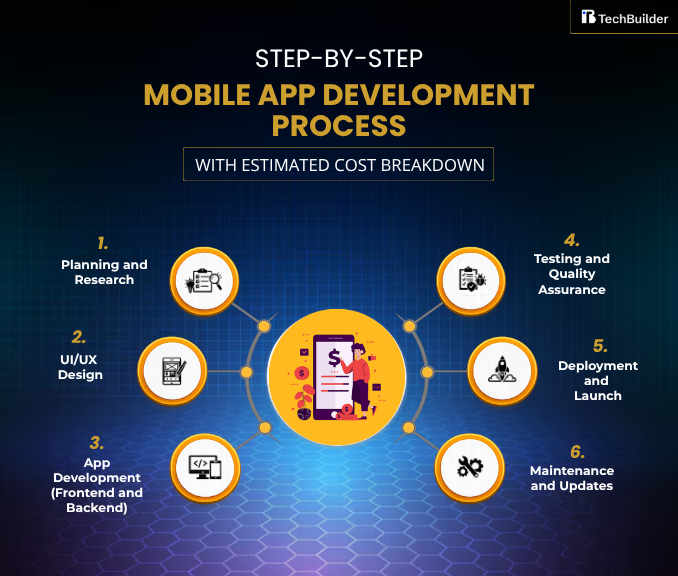
The development of a mobile app is a systematic procedure that comprises several steps, each of which adds to the total cost and schedule. The breakdown into steps can assist businesses in better planning their budget and prevent unpleasant surprises in the course of development.
- Planning and Research
This is the work base of your app where your idea is tested, your target market is identified and your feature is developed. Effective planning minimizes risks and eliminates expensive changes in the future.
Estimated Cost: $1,000 – $5,000
- UI/UX Design
Designers produce wireframes, prototypes and final user interfaces in this stage. An app with good design enhances the users but needs time and skills.
Estimated Cost: $3,000 – $8,000
- App Development (Frontend and Backend)
It is the main phase during which developers construct the functionality of the app, combine APIs, and develop the backend infrastructure. This phase is greatly influenced by the complexity of features.
Estimated Cost: $10,000 – $100,000+
- Testing and Quality Assurance
The app goes through testing before the launch to identify any bugs, performance and security vulnerabilities. This will guarantee easy user experience and minimize after-launch problems.
Estimated Cost: $2,000 – $15,000
- Deployment and Launch
The application is released on such platforms as app stores, which guarantees the adherence to the guidelines and appropriate configuration.
Estimated Cost: $1,000 – $3,000
Maintenance and Updates
Post-launch, the app requires regular updates, bug fixes, and performance improvements.
Estimated Cost: 10%–15% of total development cost annually
| Development Stage | Description | Estimated Cost (USD) |
| Planning and Research | Idea validation, market research, and feature planning | $1,000 – $5,000 |
| UI/UX Design | Wireframes, prototypes, and user interface design | $3,000 – $8,000 |
| App Development (Frontend & Backend) | Core development, APIs integration, and backend infrastructure | $10,000 – $100,000+ |
| Testing and Quality Assurance | Bug fixing, performance testing, and security checks | $2,000 – $15,000 |
| Deployment and Launch | App store release, configuration, and compliance | $1,000 – $3,000 |
| Maintenance and Updates | Ongoing updates, bug fixes, and improvements (post-launch) | 10%–15% of total cost annually |
How Design and User Experience Impact Development Costs
The success and cost of a mobile app highly depends on design and user experience (UX). Although good design improves usability and interaction – it demands more time, creativity, and technical work, directly affecting the development budget.
- Custom UI Design vs Standard Templates
Custom-designed interfaces are more user-friendly and designed – to match your brand, yet more time and resources are needed than using pre-built templates, which are quicker and less expensive.
- Complexity of User Flows and Interactions
Simple apps are – less expensive and simple to develop. Nonetheless, complex user flows that comprise numerous steps, conditions and interactions demand more design work and are more expensive to develop.
- Use of Animations and Micro-Interactions
Animations and interactive features enhance the interaction between the users and make the application look attractive. However, they increase development time and testing requirements, raising overall expenses.
- Responsive and Adaptive Design
To create an app that can be used on various devices – with varying screen sizes and orientations, additional effort is needed. Maintaining a level of consistency among devices adds to the design and development costs.
- User Testing and Design Iterations
Designing an ideal user experience may take several testing and refinement cycles. With each iteration the design work is enhanced, yet the product becomes better and easier to use.
Backend Development and Infrastructure Cost Considerations
The backbone of any mobile app is the backend, which is responsible for providing data storage, server logic and user authentication and general performance. As users interact with the frontend, the backend infrastructure makes sure that everything works smoothly. An effective and scalable backend must be planned, the appropriate technology stack, in the end it will need continuous investment which will directly influence the total cost of development.
- Server Architecture and Database Management
Selecting the appropriate server architecture and database is important to the app performance. Applications that have a large volume of data or need to be real-time demand more complex and performance-intensive systems, which raise costs of development and infrastructure.
- API Development and Third-Party Integrations
APIs enable communication between the app and external services – like payment gateways, maps, or analytics tools. Developing custom APIs or using third-party services will contribute to development time and can come with maintenance costs.
- Cloud Infrastructure and Hosting
The majority of contemporary applications are based on cloud services in terms of hosting and storage. Services such as cloud servers, storage and content delivery networks are usage based services i.e. the more your app grows and the larger your user traffic, the higher the cost.
- Security and Data Protection
Enhancing powerful security structures like encryption, secure authentication and adherence to the regulations of data protection adds complexity in the backend. This will increase cost but is necessary to safeguard data of the users and ensure trust.
- Scalability and Performance Optimization
As your application expands – it will need to support larger amounts of users and data. The development of the scalable backend and performance optimization necessitates further development, which would add to the initial expenses -but guarantee long-term stability.
Maintenance, Updates, and Post-Launch Costs
Launching your app is just the beginning. In order to maintain it in a smooth and marketable manner – it is necessary to maintain and update it. These post-launch costs are not taken seriously by many businesses yet they are essential on the long-term success and performance of the app.
- Regular Bug Fixes and Performance Improvements
Users can be faced by bugs or performance problems after launch. To ensure the smooth user experience and avoid negative reviews, it is necessary to monitor and make quick fixes.
- OS and Device Compatibility Updates
Mobile operating systems like iOS and Android frequently release updates. New versions and devices have to be also compatible with your app, which also has to be updated to continue incurring costs.
- Feature Enhancements and Upgrades
Apps must be constantly improved and given new functions in response to the feedback of the users and the tendencies of the market. Such improvements demand more resources in terms of development.
- Server and Infrastructure Maintenance
Backend servers, databases, and cloud services require regular maintenance – to ensure their availability, speed, and dependability. These ongoing charges increase as your user base grows.
- Security Updates and Compliance
Security threats keep on changing and it is important to keep on updating to prevent any security threat to user data. The continuous monitoring and updating of data regulations are also cost contributors to compliance, which is a long-term cost.
- Customer Support and Monitoring
The customer support, performance of the app, and user behavior analysis are crucial in the growth. The associated tools and teams in these processes contribute to the post-launch costs.
How to Optimize Your Mobile App Development Costs
A mobile application may be an expensive investment, yet it is possible to find the right balance between cost and investment with the appropriate approach. Cost optimization is not corner-cutting, it is smart decision-making, feature-focused and applying the appropriate development approach to ensure that you can get the most out of your budget.
- Start with a Minimum Viable Product (MVP)
Rather than creating a fully-fledged app initially, release an MVP with bare bones. This saves on start-up expenses and enables you to test your concept in the market without spending more money.
- Prioritize Essential Features First
Concentrate on aspects that bring maximum value to the users. Functionalities that are not necessary should not be added at the initial stages since they add time and cost in the course of development.
- Choose the Right Development Approach
Selecting between native and cross-platform development can impact your budget. Cross-platform solutions are often more cost-effective for startups, while native apps are better for performance-focused projects.
- Use Pre-Built Solutions and APIs
Instead of developing everything, use existing tools, frameworks, and third-party APIs. This saves time, is less developed and costs less.
- Outsource to Cost-Effective Regions
It can be cost-effective to hire expert developers at half to two-thirds of the price of those in a higher-cost region and still ensure quality when you select the appropriate team.
- Plan Everything Before Development
A clear roadmap with defined features, timelines, and goals helps avoid scope changes and delays, which are major causes of increased costs.
- Focus on Scalable Architecture
Build your app with future growth in mind. A scalable architecture prevents the need for expensive redevelopment when your user base grows.
Common Mistakes That Increase App Development Cost
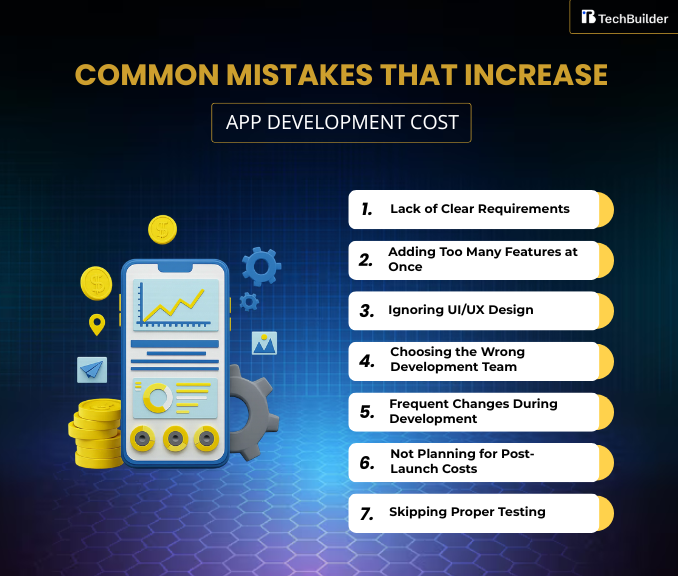
Most of the businesses make decisions unconsciously leading to an extreme increase in the cost of developing a mobile app. These are some of the pitfalls that can be avoided to save time and money and also have a smoother development process.
- Lack of Clear Requirements
Without a clear vision or a set of requirements, starting development will only result in confusion, rework and delays, which will only add to the cost.
- Adding Too Many Features at Once
Attempting to develop a fully loaded app in the initial version complicates and adds more time to the development. This not only increases the cost, but also postpones the launch.
- Ignoring UI/UX Design
Poor design leads to low user engagement and may require redesigning later, which adds extra cost and effort.
- Choosing the Wrong Development Team
Hiring inexperienced or unqualified developers can result in non-quality work, delays and more long term costs due to rework.
- Frequent Changes During Development
The constantly changing requirements or the introduction of new features in the development process breaks the workflow, making the task more difficult and more expensive.
- Not Planning for Post-Launch Costs
Not doing comprehensive testing can be cost-effective in the short term – but can result in expensive post-launch corrections and low user experience.
- Skipping Proper Testing
Avoiding thorough testing may save money initially but can lead to costly fixes and poor user experience after launch.
Monetization Strategies for Mobile App Development
Creating a mobile application is not a strictly functional process, but also a source of revenues and its further expansion in the long run. The suitable monetization strategy will be based on the nature of your app, target market, and your business goals. Revenue model should be made in the appropriate way such that your app does not only recuperate the development cost but is also a successful asset.
- In-App Purchases (IAP)
This model enables users to purchase more features, content or services in the app. It can be effectively used in gaming, eCommerce, and service-related apps and can be used to create a steady flow of revenue among active users.
- Subscription-Based Model
Premium features or content is offered at a recurring fee (monthly or yearly). This model guarantees predictable and consistent revenue, which is why it is popular among SaaS, fitness, and streaming applications.
- In-App Advertising
Apps have the potential to generate revenue through advertisements like banner ads, video ads, or sponsored content. The model is most useful when dealing with apps that have a significant number of users and are highly engaged.
- Freemium Model
The application is offered free of charge and users may upgrade to a premium version with more features. This will assist in drawing a big number of users and transforming some users into paying clients.
- Paid Apps
The customers are required to pay in advance to acquire the application. This model will yield instant returns but it will need good value and brand trust in order to persuade users to purchase.
- Commission and Transaction Fees
Transacting applications (like marketplaces or reservation applications) may make money by imposing a commission on every transaction carried out on the application.
ROI and Long-Term Value of App Investment
Making an investment in a mobile app can be an expensive endeavor in the short-term – but it can yield substantial returns in the long-term when thought and implemented in the right way. A successful application has the potential to become a valuable business asset, which generates revenue, enhances customer engagement, and reinforces brand equity.
- Increased Customer Engagement and Retention
Mobile applications offer immediate engagement with users by sending notifications, providing personalized experiences, and providing continuous access. This also boosts client involvement and loyalty in the long term.
- New Revenue Streams and Business Growth
Apps can be monetized with different strategies that bring constant revenue (subscriptions, purchases, or ads) and help in the long-term business development.
- Improved Brand Visibility and Recognition
A mobile app supports your brand, and makes your business easily accessible – to the users, boosting brand recognition and loyalty.
- Operational Efficiency and Automation
Applications can automatize business processes and operations such as bookings, payments and customer services, reducing the human labor and the cost of running the business.
- Competitive Advantage in the Market
The mobile app also provides a competitive advantage to businesses in the modern-day digital-first world where their competitors can only use the traditional channels or websites.
How TechBuilder Helps You Estimate App Development Cost
The cost of developing an app may be a complicated estimation, particularly in situations where several variables such as – features, design, and technology are taken into consideration. This is where TechBuilder comes in to make things easier. TechBuilder assists businesses to obtain precise cost estimates and develop scalable and high-quality mobile applications without unwanted surprises with a strategic approach, industry expertise and emphasis on transparency.
- Detailed Requirement Analysis
TechBuilder will start with what you want to accomplish in your business, to whom you are targeting, and what features you need. This is useful in the development of a clear roadmap and also makes sure the estimation of cost is in line with your real needs.
- Transparent Cost Estimation
With a clear breakdown of each stage of development, TechBuilder provides transparent pricing without hidden charges. This assists companies in budgeting with a lot of confidence.
- Customized Development Approach
All the apps are unique and TechBuilder will develop the app according to your needs. This is so that you only spend what you really require without any unnecessary expenses.
- Expert Consultation and Guidance
TechBuilder has a wealth of experience in the industry along with technical knowledge to guide you in making the right choices in terms of features, technologies and budget optimization.
- Scalable and Future-Ready Solutions
TechBuilder is interested in developing apps that can expand with your company. This saves the expensive redevelopment in the future and makes it efficient in the long term.
- End-to-End Development Support
Ease of use TechBuilder offers full support in the entire app development process, starting with validation of the idea up to the maintenance of the app after the launch, making the process cost-effective.
Ready To Build Your Custom Mobile App Within Your Budget?
Get professional advice and a customized cost quote on your app idea.
Conclusion
To make effective business decisions, it is vital to comprehend the cost of developing an app in 2026. The complexity of the app and the choice of platforms to use as well as the unseen costs and costs after launching, several factors affect the total investment. With proper planning and emphasizing on the appropriate features, businesses will be able to control the costs and develop a high-quality mobile application.
An app is not a cost but an opportunity to invest in the long-term, which will bring in revenues, enhance customer experience, and build your brand image. When you join forces with the correct development team such as TechBuilder, you are confident of the best value to your budget and development of a scalable and future proof solution.
FAQs
- How much does it cost to develop a mobile app in 2026?
The development price of a mobile app in 2026 will generally be between 40,000 and 400,000 and above based on the complexity of the app, features, and the development needs.
- What factors affect the cost to develop an app?
The important aspects are the complexity of the apps, platform (iOS or Android), design needs, technology stack, location of the development team, and maintenance after launch.
- How long does it take to develop a mobile app?
A simple application can take 2-4 months and a complex application could take 6-12 months and further depending on features and customization.
- Can I reduce the cost of app development?
Yes, MVP can save you money, concentrate on the essential capabilities, pre-built applications, and outsource to inexpensive development teams.
- Is app maintenance included in the development cost?
No, maintenance is usually a separate ongoing cost, typically around 15–20% of the initial development cost annually.
- Why should I choose TechBuilder for app development?
TechBuilder is low-cost, offers quality guidance, customized services and full-fledged maintenance to make sure that companies develop quality applications at an affordable price.